07 June 2011

Visit to Italy's Lake District: Part IVa - Isola San Giulio

Leaving the chapels at the Sacro Monte of Orta, which was added to the World Heritage List in 2003, we noticed a groundskeeper, thoroughly absorbed in his hedge-clipping.  He was protected from the horrendous noise by his headphones.  We were not.

Fortunately, the noise diminished as we began our descent, passing by villas clustered along the lakeside, and entered the lovely little town of Orta San Giulio.


Before proceeding to the large lakeside square, the Piazza Motta, we stopped to visit the little church of Santa Maria Assunta, a lovely golden-sided structure that dates from the 15th century when it was built to consecrate the end of a plague epidemic.  The inside, originally decorated in baroque style, was beautifully redecorated in the 18th century.

One reason that it has become a favorite venue for weddings is because of the view of Lake Orta from its steps.

From there, we continued our descent to Piazza Motta and the lakefront, where we boarded a ferry for the Isola San Giulio.

San Giulio, also known as Saint Julius of Novara, was a missionary priest to northern Italy in the 4th century.  Few facts are known about his life.  He may originally have been Greek and educated in the Christian faith by his parents.  According to legend, he was ordered to destroy pagan altars and sacred woods and to build Christian churches.  Also according to legend, he walked on his cloak across Lake Orta to the island that now bears his name.  He is said to have built 100 churches and the 100th is located on the island.

The Basilica de San Giulio, established in 390 AD, has had its interior redecorated since then.  Like many of the Sacro Monte chapels and Santa Maria Assunta, it has baroque features, including an enormous serpentine pulpit carved from dark green marble mined from a nearby quarry.  As we had already learned from our time in Stresa, quarries abound in these mountainous areas.

We also strolled around the island via the path of silence.

The path of silence received its name from an order of Benedictines who took vows of silence.  We were respectful but not necessarily silent as we toured the narrow streets,

and viewed the decorated houses

and sculptured fountains.

Beauty was everywhere, from simple geraniums adding bright emphasis to weathered stones

to vividly blue hydrangeas

to a fellow traveller, posing unaware as she herself attempted to capture the moment.

06 June 2011

Visiting Italy's Lake District: Part IV - Il Lago d'Orta

Il Lago d'Orta (Lake Orta) is one of the smallest - just eight miles long and two miles wide - and least known of the northern Italian lakes.  Tiny as it is, however, it provided both HWMBO and me with some of our most pleasant and memorable, even sublime, moments from the visit to Italy.

This little jewel of a lake has been known as Lake Orta since the 16th century.  Before then, it was known as the Lago di San Giulio after San Guilio (Saint Julius of Novara), who lived during the fourth century and is the patron saint of the region.  More about him later.

Our day began in Stresa where our group walked to the lakeside and boarded a small tour bus.  On the way, Guide K described some of what we would be seeing once we had arrived.

Once the bus had arrived at Orta San Guilio, the little town named after San Guilio, which is built on a peninsula projecting from the east shore of the lake, we were reunited with Guide P, who described the walk that we would take for the first part of the morning, which was to be a climb to the Sacro Monte (Sacred Mountain) di Orta.


Wouldn't you know it?  The morning was beautiful, bright and sunny, with none of the haze that we had experienced the previous day when we had hoped to view Lago Maggiore and its setting from the heights.  In fact, it was actually growing hot and the climb to the Sacro Monte was more of a challenge than we had anticipated.   When we got to the top, some of us were winded.  We all had new respect for those medieval pilgrims who had made this particular pilgrimage in conditions much less favorable than our own.

The Sacro Monte was built on a hill overlooking the old village of Orta San Guilio and Lake Orta.  The itinerary is a devotional one begun in the late 16th century with work lasting more than a century.  It consisnts of twenty chapels depicting the high points of the life of Saint Francis of Assisi.  The Sacro Monte chapels were presented in a way intended to prevent those followers of the Catholic Church in Rome from converting to Protestantism.  Saint Francis was chosen as the model for living a Christian life and the itinerary of the visit presents those aspects of his life that most echo those of Jesus Christ.  

The chapels are decorated with frescoes

and life-size terra cotta figures. 

The episodes are often depicted in a charmingly lifelike and credible manner.  The artists used local people as models so that those who visited, who were illiterate for the most part, could easily follow the events of Saint Francis's life, identify with them to a certain extent and understand that the message was not meant just for those who were wealthy members of the aristocracy.

While the earlier chapels were built in late Renaissance-style, the style changed to baroque during the second half of the 17th century. 


Rococo touches were added until the last quarter of the 18th century. 

Building of the last chapel, the Cappella Nuova, was conducted in the neoclassical style but it remains incomplete.


After viewing most of the chapels on the Sacro Monte, we headed towards the little city of Orto San Giulio for the next part of our visit, which would take us to the lovely Isola San Giulio.

04 June 2011

Visiting Italy's Lake District: Part IIIa - Isola Bella cont'd

The gardens of Isola Bella form a beautiful and extraordinary floral monument.  They are laid out over a series of ornate and overlapping terraces.  As such they are a classic example of the seventeenth century "Italian garden."  The gardens contain many rare and exotic plants and their spectacular blossoming is planned to ensure that the gardens are filled with colors and scents from March until October.

Initially little more than a barren and rocky crag in Lago Maggiore, Isola Bella was not at all a promising site for gardens.  Work on the gardens began in 1632 and continued for 40 years.  As can be expected, it was a gruelling and labor-intensive project.  Rocks on the island were levelled off and great quantities of soil were brought over from the mainland so that trees and plants could be sustained there.  Where necessary, the gardens were extended on pillars into the lake.

There are ten terraces rising one above the other in diminishing scale that have led to Isola Bella's gardens being compared to the Hanging Gardens of Babylon.


Each terrace is balustraded and heavily garnished with vases and statues.

They make Isola Bella resemble an ornate many-decked flower-laden ship.  Here is its prow, seen from above.

And here it is viewed from the lake as we departed.

The whole garden is theatrical.  The success of the ornamentation throughout is, according to one viewer, due to three causes:
"The first which in a way embraces the others is the extravagant beauty of the setting which by its unreality causes a heightening of fancy.  The colour of the lake and the contours of the land are not of a kind to compete with the man-made intricacies of the foreground; nor is there any problem here of transition, which is responsible so often for failure in gardens which try to combine with remarkable land scenery; the mind accepts the water as the inevitable solution of the middle distance. The second reason lies in the nature of the plan itself, which never permits extensive views within the garden, but nearly always relates every feature to the lake and the mountains rather than to other features of a similar kind. The third reason is the presence of flowers."
From the highest terrace, HWMBO ponders the spectacular mixture of natural and man-made beauty.

On the way out of the gardens, we saw exotic plants in sheltered areas.

Leaving the gardens, we saw a local bazaar with shops where souvenirs could be purchased.  These mask souvenirs, however, were more typical of the Venetian region than of Lombardy where we were.

I don't believe that one can overdose on beauty.  But if I did, the gardens of Isola Bella would be a good candidate for a place to test that theory.

02 June 2011

Visting Italy's Lake District: Part IIIa - Isola Bella

After returning from our morning visit to Monte Mottarone, we first headed back to the Hotel Fiorentino for lunch, which featured a delicious asparagus risotto.

Having fortified ourselves for the afternoon's excursion, we were quite happy to walk along Stresa's lakefront once more
in order to board a small ferryboat to Isola Bella.

Guides K and P discuss the upcoming visit while the rest of us board the ferry.

Isola Bella is one of the Borromean Islands of Lago Maggiore.  Until 1632, the island was a rocky crag occupied by a tiny fishing village.  In that year the influential Borromeo family began the construction of a palazzo that was dedicated to the wife of Carlo III de Borromeo, Isabella D'Adda, from whom the island takes its name. Construction was interrupted around middle of the century when the Duchy of Milan was struck by a devastating outbreak of the plague.  Construction resumed when the island passed to Carlo’s sons, who completed the palazzo and turned it into a place of sumptuous parties and theatrical events for the nobility of Europe.  The gardens were completed later and inaugurated in 1671.  There have been many famous visitors who stayed at Isola Bella, including Napoleon and his wife Josephine.  Here are some views of the palazzo from the exterior. 


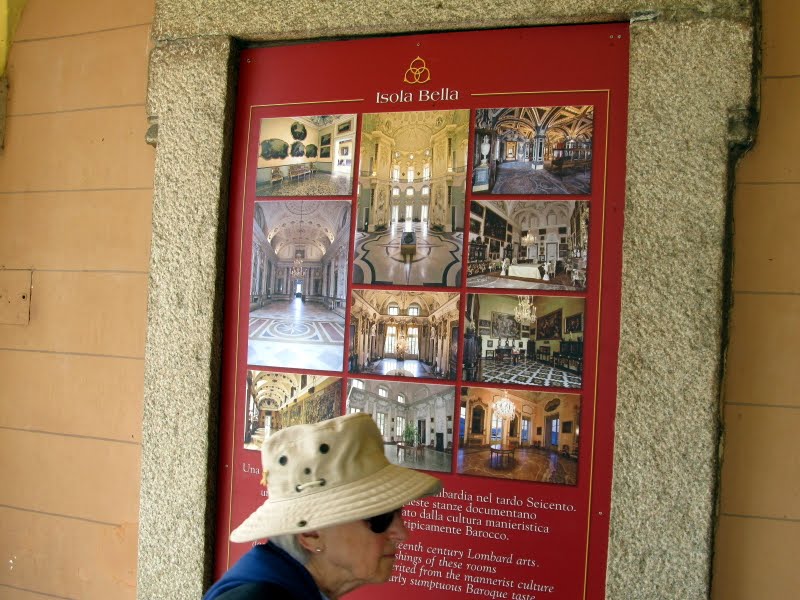
We were not allowed to take photographs of the interior of the palazzo although we did have a guided tour throughout.  This is as good as it got for photos of the interior.

We were able to take some pictures of the garden from inside the palazzo, however.

The Borromeo family motto was "humilitas" (humility) and that motif was worked into decorations throughout the interior of the palazzo and in the garden, as here, even though humility seemed at odds with the opulence and ostentation that were evident throughout.

After our tour of the palazzo, we were able to spend about an hour strolling through the gardens at our leisure.  This was the entrance.

From here, we mounted a staircase adorned with floral planters

to arrive at the park before the theater.

The famous white peacocks could be found preening and parading on the grassy areas of the garden

and accepted our adulation as their due.

01 June 2011

Visiting Italy's Lake District: Part III - Monte Mottarone

Our second morning in Stresa was scheduled for the eagerly-anticipated visit to nearby Monte Mottarone, a mountain crouching between the Lago d'Orta - which we were scheduled to visit the next day - and Lago Maggiore where we were.  As the highest point in the region, Monte Mottarone offered a wide panoramic view of the seven neighboring northern Italian and Swiss Alpine lakes and mountain ranges.  Unfortunately, the day dawned with haze covering the mountain top, which did not bode well for our viewing possibilities.  Still, off we trekked to the cable car, which is the quickest access from Stresa's lakefront, hoping that the haze would lift by the time we reached the top of the mountain.

Spirits were high nonetheless.  Monte Mottarone is 1,491 meters (approximately 4,900 feet) high.  The mountain is a haven for outdoor pursuits such as skiing, hiking, mountain biking and paragliding, each in its season.  Near the cable car station at the top is the Giardino Botanico Alpinia, another of Stresa's well-known attractions.  Unfortunately, the garden was not part of our schedule that morning. 

Even though the haze never did lift, we had a nice hike from the cable car station to the top of the mountain and were able to get a glimpse of Stresa below us.

At the very top of the mountain was a cafe, with mementos of visitors from all over the world.   Here was a "Wall Street" sign and tacked to the wall behind it was a license plate from my home state of Montana!

Although most of our hardy group hiked back down to the cable car station, a few of us decided to travel comfortably on the chair lift, in the hope that the clouds would lift during our ride.

The people standing in line ahead of us reported that the cloud haze had lifted for a few moments while they were at the summit and they had been able to see the much-vaunted panoramic view.  This was the best of my own photos, however.

Of the photos that HWMBO and I took that morning, one of the best was of the cable car itself!  Ecco!