13 June 2011

Visiting Italy's Lake District: Part VII - Breglia and San Domenico

Refreshed after a good night's sleep at the Hotel Bellavista once the fireworks had stopped, a good breakfast and our spectacular view of Lake Como, we were ready to begin our day's adventures.

First we boarded a bus that gave us a head start to our walking by depositing us at the little village of Breglia, in a parking lot next to the village church.

From there, we began our walk along forested paths,

that offered glimpses of little villages clinging precariously to the hillsides,

while local Guide Po stopped from time to time to describe what we were seeing.

We arrived at the tiny chapel of San Domenico,

with its overlook that offers a splendid panorama of the lake and nearby hillsides.

Or at least it would have offered a splendid panorama of the lake, had the haze allowed us to see clearly.  We had ill luck with some of our panoramic vistas on this tour, I'm afraid.  But the tour was still very worthwhile nonetheless!

After admiring the medallion of a black madonna

situated above the intriquately carved door panels of the chapel,

we continued along the circular path toward the Santuario della Madonna di Breglia (Sanctuary of the Lady of Breglia)

and returned to Breglia, pausing for a cappuccino break on the sunny outdoor terrace of the Albergo Breglia.

After leaving the albergo, we continued towards our bus,

passing a recently-discovered Roman tomb along the way.

We boarded the bus once again for a short ride to the little village of Loveno, from where the rest of the day's adventures would begin.

12 June 2011

Visiting Italy's Lake District: Part VIa - Lago di Como and Menaggio

After our pleasant time in Gandria, we drove through the border crossing into Italy and towards Lago di Como.  A cheer arose from the group as we found ourselves once again on Italian soil, although this was done primarily to give Swiss Guide P grief for the women's facilities that had been locked at our rest stop outside Lugano.  Poor guy!

Lake Como, also known as Lake Lario, is the third largest lake in Italy, after Lakes Garda and Maggiore.  It is also one of the deepest lakes in Europe.  Its bottom is more than 200 meters (656 ft) below sea level and the lake has a maximum depth of 410 meters (1,345 ft).  Like the other lakes we had visited, it is surrounded both by high mountains and gentle rolling hillsides, with small cities, lakes and mountain villages in abundance.  The area has always been a crossroads of intense activity between Central Europe and the Mediterranean.  Various cultures have left their influences, stimulating a fascinating blend of traditions and artistic accomplishment.  Lake Como is widely regarded as being one of the most beautiful lakes of Italy.  Believe me, it has lots of competition!  We were headed for the city of Menaggio, which is one of three cities, the others being Bellagio and Varenna, that are situated at the intersection of the three branches of the lake.

We were to spend five nights based at the Hotel Bellavista in Menaggio, situated right on the water, from where we would make excursions into the hillsides around Lake Como and even into the Swiss Alps.  The hotel lived up to its name.  Here is one view from the terrace outside our window.

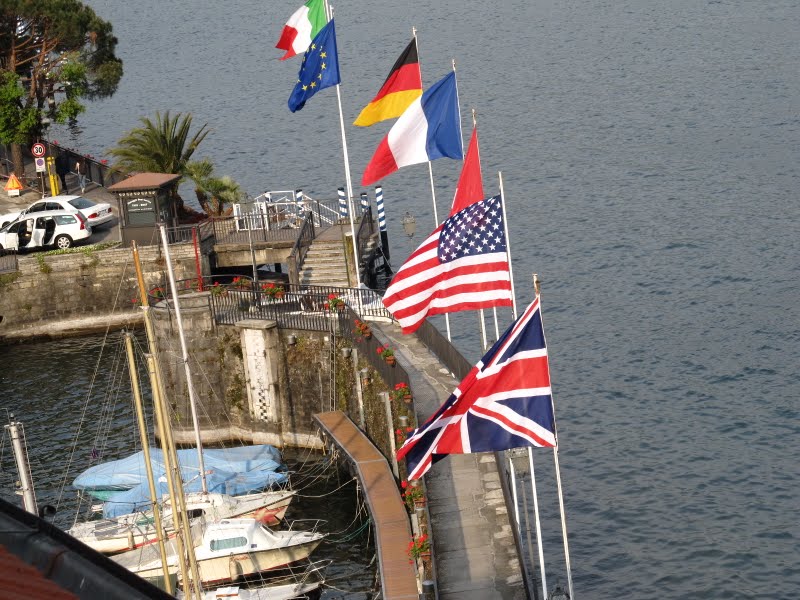
And here is another of the flags on the other side of the hotel, giving an idea of some of the nations whose citizens visit the area.

After the usual flurry of descending from the bus, getting our rooms sorted out, getting our luggage to our rooms - in our case, five floors up - in the one creaky little elevator that the hotel had, and getting freshened up, we gathered on the hotel terrace to meet our new local guide.  Because this guide also had a name beginning with P, I'll refer to him as Guide Po, to distinguish him from Swiss guide P.

After introducing himself and giving a brief overview of what was in store for the next couple days, Guide Po led us on an orientation walk around Menaggio.  After walking up from the main square, the Piazza Garibaldi, named after Italian national hero, Giuseppe Garibaldi, past numerous outdoor restaurants and gelaterias,

we headed into the old part of the city.

Menaggio was formerly a walled city and we walked along remnants of its wall

enjoying views of vine-covered villas

and their gardens

to arrive at San Carlo Church, built in the 17th century, one of the rare Italian churches built in Spanish architectural style.


From there we descended to the lakefront once again,

noticing happily that motorcycles, otherwise ubiquitous, were not permitted where we were walking.

We arrived at the lakefront in front of a sports club, converted from a villa,

and continued walking along the Lake Promenade to the monument by Francesco Somaini dedicated to the women Silkweavers.  It was donated to the city of Menaggio by the Mantero family, owners of several silk mills.  The monument is made of Carrara marble and represents a hymn to the weaving culture of Lake Como.  The Como region is still one of the silk capitals of the world.

After our very full day, we were happy to retrace our steps to the hotel, have dinner and head for a good night's sleep.  But the day still had a few treats in store for us.  Just as we were ready to turn in, we heard what sounded like explosions coming from the other side of the lake.  Sure enough, on its peninsula directly across from us, the little city of Bellagio was welcoming us to Lake Como with a fireworks display.

We watched until the display was over - what a wonderful way to be greeted!

11 June 2011

Visiting Italy's Lake District: Part VI - Lago di Lugano and Gandria

It was with both regret and anticipation that we left Stresa, our first base for so many scenic adventures.  But now we were headed north towards Lago di Lugano (also known as Lake Ceresio) and Switzerland.

Our Swiss Guide P was delighted at being able to show some of his wonderful little country to our group.   Knowing that I am a Swiss resident and having learned that I also love that country, Guide P enlisted me to help drum up enthusiasm among my fellow travellers.  Once we had crossed the border, entered the country and caught our first glimpse of the city of Lugano, it looked as if drumming up enthusiasm would not be necessary at all.

As Guide P explained, Lugano (the city) is often called the Swiss Rio de Janeiro, because it has a distinctive mountain that resembles Rio's Sugarloaf.

It is ranked 9th among Swiss cities in population and has also gotten a reputation as the "Monte Carlo of Switzerland" because in recent years it has attracted a growing number of international entertainers, celebrities and athletes.  Alas, we were never to see any of this because our bus whisked us right through the city without stopping as some of us gazed longingly at the wonderful array of department stores.  So near and yet so far!

When the bus finally stopped on the outskirts of Lugano, it was only for us to take a brief rest stop.  Alas again, to Guide P's great embarrassment - and my own as a surrogate Swiss - the Swiss rest rooms were found wanting.  It was not due to cleanliness or lack of paper or anything so simple.  The fact was that the facilities dedicated to women were locked!  What a disgrace!  Of course, the gentleman let us use their facilities - and we made good use indeed - but poor Guide P was never able to live down this situation and was roundly teased about it for the rest of our visit!

From our stop outside Lugano, we began the lakeside trek to the scenic village of Gandria - on foot.  The path, literally hewn into the lakeside rock, followed the lake and was very picturesque,

although once again, I was glad to have my walking stick handy.

The lake water was nearly turquoise in its clarity.

We finally arrived at Gandria and, after a few moments near the Church of Saint Vigilio explaining how the city center was closed to traffic, Guide P dismissed us to have lunch anywhere we wanted.

Gandria was at first famous for its production of olive oil.  But most of its olive trees were killed during an unusually harsh winter in 1709.  Recently, however, olive trees have been replanted along the Sentiero dell'olivo, the scenic lakeside trail that we had taken from Lugano.  Silk production began in the region in 1865.  But, because of the nearby border with Italy and the difficulty of guarding that border, Gandria and its area also became infamous for smuggling, with cigarettes, meat and alcohol being among the most-trafficked items.   It wasn't until the 20th century when tunnels and a new road connected the village to Lugano and Italy that Gandria truly entered the contemporary era and abandoned its sordid, if colorful, past.

The town's intriguing center is a network of hilly byways,

some offering glimpses of the lake,

others beckoning one to continue exploration into quiet corners.

Because it was lunchtime and our journey from Stresa had given us appetites, we stopped at a small terrace cafe with some friends

and enjoyed a lovely lunch there.

While I opted again for my perennial favorite salade capresi (tomatoes, mozzarella and basil or pesto sauce), HWMBO had the plat du jour, which looked and was delicious.

While we were lunching, we enjoyed our close-up view of a lakeside regatta and

continued enjoying the sight even as we explored the village after lunch.

After more sightseeing in lovely Gandria,

we clmbed back up the steps

to find that the bus had travelled to meet us and was ready to take us to Lago di Como for our next series of adventures.

10 June 2011

Visiting Italy's Lake District: Part Vb - Arrivederci to Stresa

After returning from our lovely day out, packing for next day's journey and showering, we descended en masse to the hotel dining room for our last meal at the Hotel Fiorentino, our little home away from home.  We cleaned up nice, at least for the most part!

We were sad to leave Carla and her family who had warmly welcomed us and made our stay in Stresa something very special.  But we were also filled with anticipation for the next phases of our visit.  Carla's husband, the chef, came to bid us farewell in person, while Carla hovered in the background..

Our Guide K then thanked the chef - and his son, the sous-chef - on our behalf for their kind hospitality and delicious meals.

They had prepared a very special tiramisu cake to bid us arrivederci.

I was not the only person there with a lump in her throat and certainly not alone in wanting to capture these moments.

Bright and early the next morning, the hotel's little shuttle truck trundled off with our luggage

while we ourselves walked to meet the bus that would take us to Lago di Lugano and, incidentally, into Switzerland

on our way to Lago di Como where we would stay during the rest of our visit to Italy's Lake District.