After our pleasant time in Gandria, we drove through the border crossing into Italy and towards
Lago di Como. A cheer arose from the group as we found ourselves once again on Italian soil, although this was done primarily to give Swiss Guide P grief for the women's facilities that had been locked at our rest stop outside Lugano. Poor guy!
Lake Como, also known as Lake Lario, is the third largest lake in Italy, after Lakes Garda and Maggiore. It is also one of the deepest lakes in Europe. Its bottom is more than 200 meters (656 ft) below sea level and the lake has a maximum depth of 410 meters (1,345 ft). Like the other lakes we had visited, it is surrounded both by high mountains and gentle rolling hillsides, with small cities, lakes and mountain villages in abundance. The area has always been a crossroads of intense activity between Central Europe and the Mediterranean. Various cultures have left their influences, stimulating a fascinating blend of traditions and artistic accomplishment. Lake Como is widely regarded as being one of the most beautiful lakes of Italy. Believe me, it has lots of competition! We were headed for the city of
Menaggio, which is one of three cities, the others being Bellagio and Varenna, that are situated at the intersection of the three branches of the lake.
We were to spend five nights based at the
Hotel Bellavista in Menaggio, situated right on the water, from where we would make excursions into the hillsides around Lake Como and even into the Swiss Alps. The hotel lived up to its name. Here is one view from the terrace outside our window.
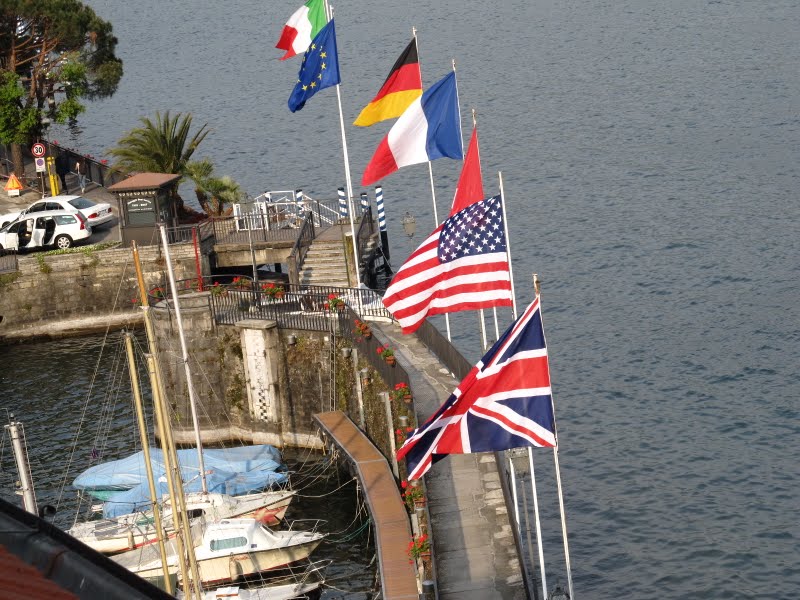
And here is another of the flags on the other side of the hotel, giving an idea of some of the nations whose citizens visit the area.
After the usual flurry of descending from the bus, getting our rooms sorted out, getting our luggage to our rooms - in our case, five floors up - in the one creaky little elevator that the hotel had, and getting freshened up, we gathered on the hotel terrace to meet our new local guide. Because this guide also had a name beginning with P, I'll refer to him as Guide Po, to distinguish him from Swiss guide P.
After introducing himself and giving a brief overview of what was in store for the next couple days, Guide Po led us on an orientation walk around Menaggio. After walking up from the main square, the
Piazza Garibaldi, named after Italian national hero,
Giuseppe Garibaldi, past numerous outdoor restaurants and
gelaterias,
we headed into the old part of the city.
Menaggio was formerly a walled city and we walked along remnants of its wall
enjoying views of vine-covered villas
and their gardens
to arrive at San Carlo Church, built in the 17th century, one of the rare Italian churches built in Spanish architectural style.
From there we descended to the lakefront once again,
noticing happily that motorcycles, otherwise ubiquitous, were not permitted where we were walking.
We arrived at the lakefront in front of a sports club, converted from a villa,
and continued walking along the Lake Promenade to the monument by
Francesco Somaini dedicated to the women
Silkweavers. It was donated to the city of Menaggio by the Mantero family, owners of several silk mills. The monument is made of
Carrara marble and represents a hymn to the weaving culture of Lake Como. The Como region is still one of the silk capitals of the world.
After our very full day, we were happy to retrace our steps to the hotel, have dinner and head for a good night's sleep. But the day still had a few treats in store for us. Just as we were ready to turn in, we heard what sounded like explosions coming from the other side of the lake. Sure enough, on its peninsula directly across from us, the little city of Bellagio was welcoming us to Lake Como with a fireworks display.
We watched until the display was over - what a wonderful way to be greeted!