We continued our trek to the top of the hill where suddenly the narrow little streets broke away
and we found ourselves in a part of the city that was residential, far from the madding tourist hustle and bustle. There were peaceful-looking churches,
although the parked cars tightly packed nearby hinted at the crowds that awaited if we headed back down the hill.
There were beautiful quiet alleys away from the commercial distractions.
There was even a well cared-for cat that came out to greet us.
There were mossy walls and countryside.
Best of all, there was a picturesque marina where sailboats bobbed at anchor
or quietly rested ashore
while the Rockefeller Foundation's Bellagio Center formed a backdrop in the distance.
Even local Guide P could sense the difference - it was as if life had slowed down for us all.
One of the houses looked as if it would gather us in to heal the various "slings and arrows of outrageous fortune" that had bedevilled our lives -
a vine-wreathed, kind and friendly god.
Sagittarius (22 November - 21 December) is a fire sign ruled by the planet Jupiter and represented by a Centaur wielding a bow and arrow. Sagittarians tend to have dreams that are very dear to their hearts and are the bases for their motivations. Their freedom to dream is essential to their well-being. Among many other things, they love children, animals and travel.
26 July 2011
Visiting Italy's Lake District: Part XI - Bellagio West Side
On the morning of our last day at Lake Como, we all rose with anticipation. We were at long last going to visit beautiful Bellagio, la Perla del Lago di Como (the Pearl of Lake Como). We had been gazing at this little jewel of a city across Lake Como for days. On our first night in Menaggio, we had been treated to a fireworks display from Bellagio. Now, we would finally see the fabled city itself. We boarded the little ferry that would take us across the lake, getting a look at Menaggio and the little hotel beside the lake that had provided us with such a pleasurable and pleasant stay.
Because the diesel fumes from the little ferry were overwhelming, some of us climbed to the upper platform for the brief journey.
We even got a glimpse of the church of San Martino, where we had climbed two days earlier. Yes, that tiny fleck midway up the mountain. We really had been there!
Some glamorous hotels greeted us as our little ferry glided up to the landing platform.
And yes, here we were, about to set foot on the little peninsula.
Bellagio is situated at the tip of a little peninsula that separates Lake Como's two southern arms and its history has largely been written by that strategic placement. The Romans, no slouches when it came to discovering leisure, pleasure and beauty in combination, were the first to use the island as a holiday resort. They also introduced the olive and laurel trees which even today flourish around the lake.
We arrived at the highly tourist-oriented landing on Bellagio's west side.
What is it about seeing tables set up for lunch or dinner that almost immediately whets the appetite?
Local Guide P ably guided us through the intricate passageways
and narrow streets of the beautiful little city,
all the while describing history, buildings and personalities - historical and otherwise -
along the way.
Every corner presented a photo op
and shops galore beckoned.
But we steadfastly continued our climb to the top of the hill.
24 July 2011
Visiting Italy's Lake District: Part Xa - Cruising Lake Como
After fortifying ourselves with lunch and coffee, we browsed through some of Como's silk stores along the waterfront. I could not resist picking out some silk scarves as gifts for family members. But after completing the little shopping I did and strolling around the area some more, HWMBO and I decided to follow the example of some of our tour colleagues and return to Menaggio on the afternoon ferry. So we boarded the ferry at the waterfront.
Some had purchased gelati for the return trip and looked as though they were thoroughly enjoying themselves.
Now we had a chance to see the villages between Como and Menaggio from the lake itself.
The view was not at all disappointing. In some cases, it was spectacular
and provided a view not at all visible from the shore.
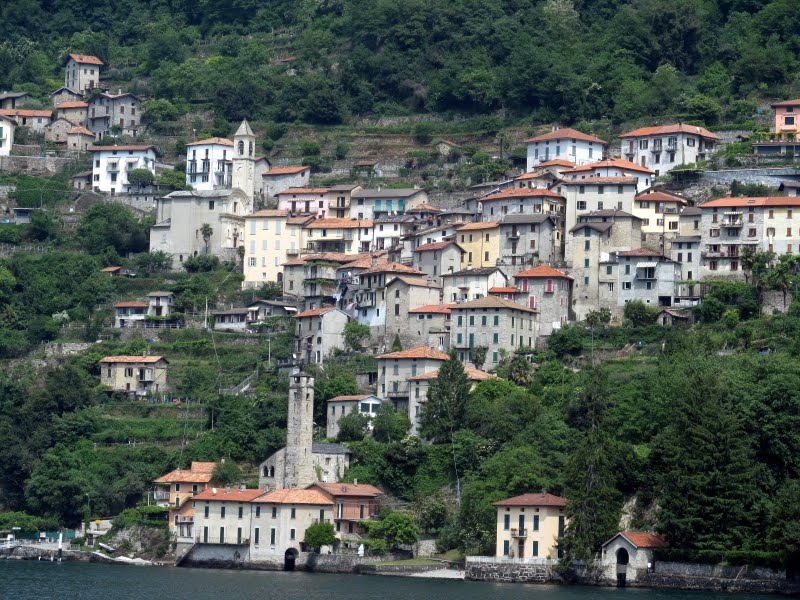
Some villages flowed down to the lake in a v-shape.
Others perched so closely to the lake edge that
it was a wonder that they were not already in the water.
We docked at several villages along the way, some tempting us to stop there at least briefly.
But we really had to get back to Menaggio by then. Once arrived, we strolled past le Grand Hotel Menaggio
on our way back to our own hotel to pack. Our wonderful visit was drawing to an end. The next day, after a morning visit to Bellagio and a meal, we were scheduled to transfer to Milan to wend our various ways back to our "regular" lives.
Visiting Italy's Lake District: Part X - Como
We had enjoyed our visits to villages situated along Lake Como and in the surrounding area, but had not yet visited the city of Como itself, so our last full day in the area was devoted to rectifying that omission. Como is situated at the southern tip of the south-west arm of Lake Como, approximately 40 kilometers (25 miles) north of Milan. It is the administrative capital of the Province of Como. Until the end of the 1980s, the city, known as la Città Della Seta (City of Silk), was world famous for its silk manufacturers. Now, tourism has become very important for the local economy and we, as tourists, were there to do our part. But first we had to get there, travelling in our trusty little bus along the narrow and very busy little lake road.
We arrived to see a bustling little city, adorned with the colorful buildings that characterize Italy's Lake District,
with old and new co-existing prosperously
and all enclosed within medieval walls.
The bus deposited us near the main square by the waterfront.
After we had refreshed ourselves from the drive, local Guide P pointed out sights of interest to the group.
Cheerful blossoms adorned balconies everywhere.
It was fun to see TV aerials and satellites sharing roof space with medieval chimneys!
One building that local Guide P pointed out to the group was la Casa del Fascio, probably the most famous work of Italian architect, Giuseppe Terragni, described as an early "landmark of modern European architecture."
In comparison to the more graceful and esthetically pleasing architecture of previous eras, the building frankly left me cold, just as the politics and policies of the Benito Mussolini regime Terragni worked for leave me with a major frisson. Mussolini, by the way, passed through Como on his abortive flight to Switzerland in April 1945. He and his entourage were captured near the village of Dongo, further north. Although the original intention had been to return them to Como to turn them over to advancing Allied Forces, they were ultimately moved to the village of Giulino di Mezzegra. There, Mussolini, his mistress and the rest of his entourage were summarily executed. In one of the more savage reminders of the hatred engendered by the horrors of his regime, their bodies were taken to Milan, hung on meathooks and stoned by the crowds.
Fortunately, there were few reminders of this terrible era throughout the city as people went about their business
of generally enjoying life in their beautiful city.
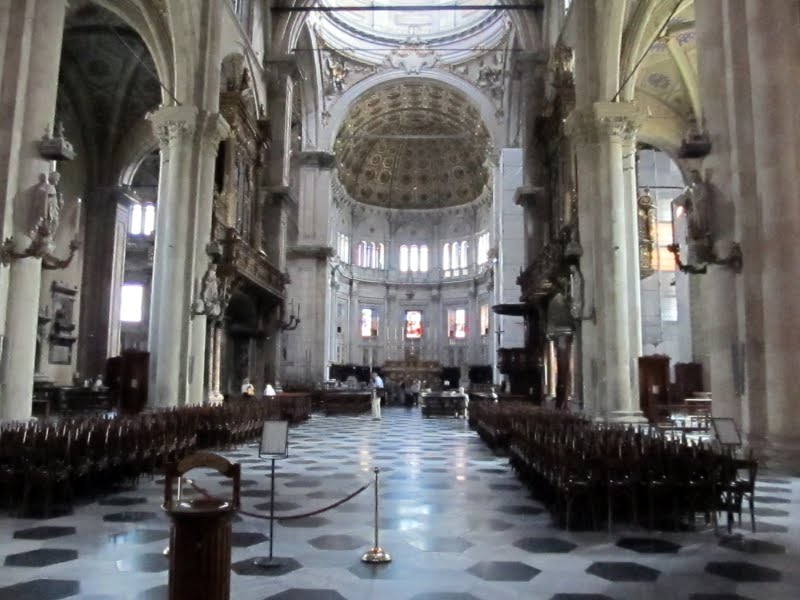
More typical of the older part of the city was the architecture of the Duomo di Como (Como Cathedral),
often described as the last Gothic cathedral built in Italy, although it was not completed until 1770,
so it contains many baroque and
rococo features.
The west front dates from the 15th century
and features a rose window.
After our busy morning, we were only too happy to follow the example of others who were enjoying the open air cafes and restaurants,
and select something delicious for our midday meal.
Subscribe to:
Posts (Atom)