02 December 2012

Vieille Ville in Montreux

Montreux's vieille ville is tiny in comparison to Geneva's, but it is truly a world away from the hustle, bustle and glitz along the lakefront. It also has some well-maintained and well-preserved buildings and was worth a walk, especially because the route occasionally provided some lovely, if slightly dizzying, vistas.
Before actually entering the Old City, however, I passed by the fairly impressive facade of a school.
Further along the same street, there was a WWI war memorial, to honor those from Montreux who had fallen in the 1914-1918 conflict.  While Switzerland itself was not invaded, apparently there were some from Montreux - perhaps dual nationals - who volunteered to fight.
But when the road became narrower and hillier, I knew that I was on my way to the Old City.
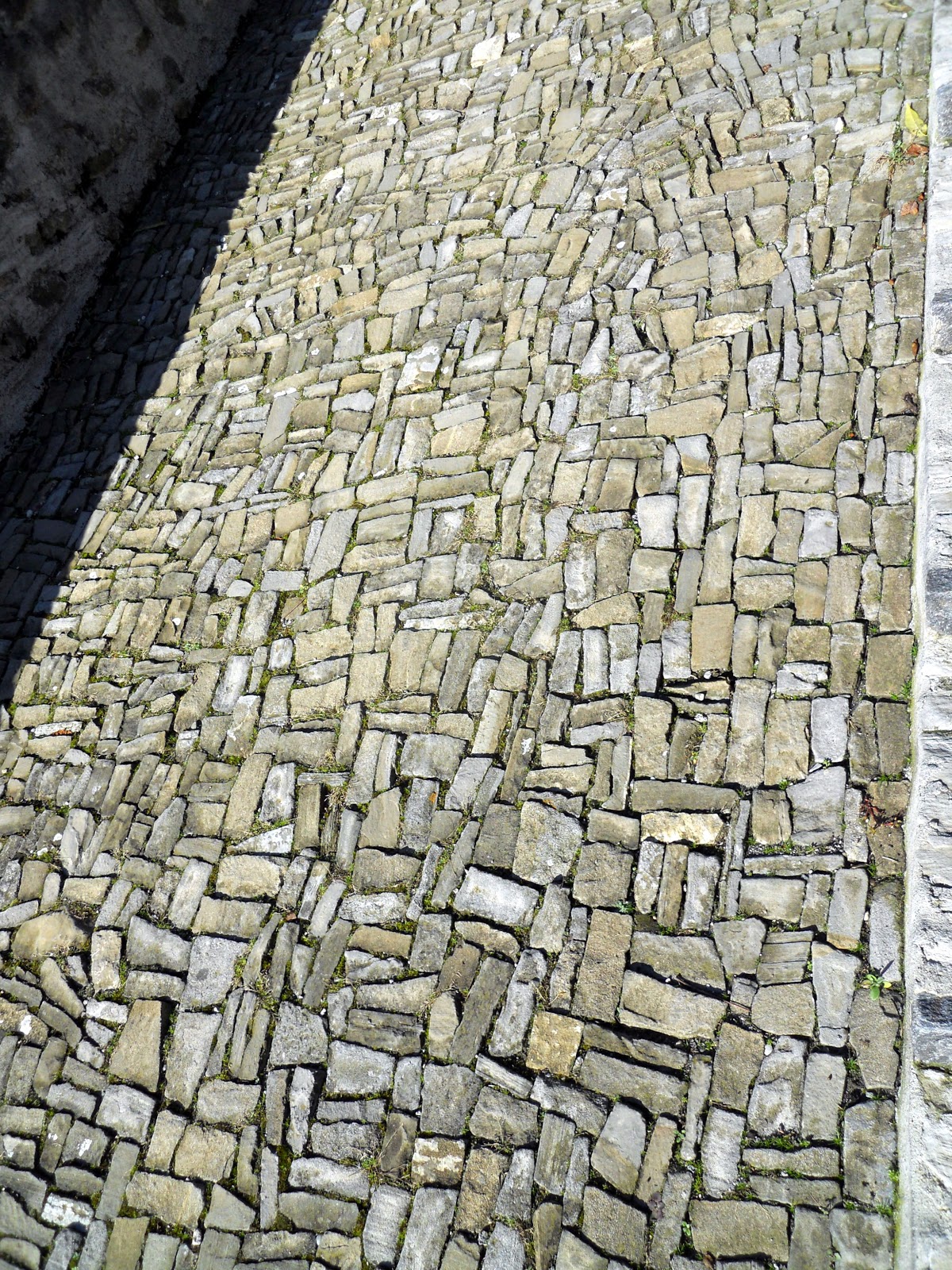
The road also had very neatly arranged cobblestones.
I could catch occasional breathtaking, albeit hazy, views of the Alps as I continued wandering uphill.
Aha! A balcony decorated for the holidays!
As well as some colorful doorsteps.
Here are some Swiss lions, carved in stone, guarding a doorway,
across the street from a charming wine cellar.
Coming down again, I was treated to yet another spectacular view.
I know that HWMBO will appreciate this shot of roofs and chimneys!
Before entering the lower city, I couldn't resist taking a photo of this house because I liked the design.
But now, it was time to head for the Christmas Market! 

01 December 2012

Views from the Gare de Montreux

The gare de Montreux (Montreux train station), like all train stations in Switzerland, is in the center of town,  perched precariously between Alpine slopes, tamed at their lower levels by construction and the terraced vineyards that are a principal feature of the area,
and Lake Geneva.
More rugged Alps, appropriately sprinkled with snow at this time of year, loom above the station platform.
Before heading towards the Christmas market, I decided that I would visit Montreux's vieille ville (old city), so I began climbing the steps on the Alpine side of the platform.
From there I could look down at one of the Golden Pass trains,
which reminded me that I definitely plan to take some Golden Pass Line excursions this winter!

Closer to Home

Because today is the first day of the last month of the year - in this case 2012 - I am going to return a bit closer to home before completing the last memories of HWMBO's trip to the Orient earlier this year.  I know that I can not do justice to his travels.  But I have enjoyed living through them vicariously myself and selected photos are now in the ether for both of us to savor, without having to bring out DVDs of photos, etc.

Yesterday, in the hopes of stimulating some seasonal sentiment, I hopped a train to the other end of Lake Geneva to visit the Montreux Christmas Market, which opened last week on 23 November.  Of course, I had a wonderful time taking photos, sipping hot spiced wine, browsing at the stalls and generally just enjoying beautiful Montreux.  I specifically chose a Friday to avoid the weekend crowds.  That ploy was quite successful for me although those who have stalls at the market would probably prefer to have crowds every day because this is how they make their living.
I loaded the photos on my computer this afternoon to discover that I had also a few photos from late September when the vines in "my" vineyard still had leaves
 - and grapes.
Of course, the grapes have been harvested since then and the vines have lost their leaves.  The vines have now been pruned back for the winter and the erstwhile lovely green area is brown.  But here are some memories of what the vineyard looked like then.
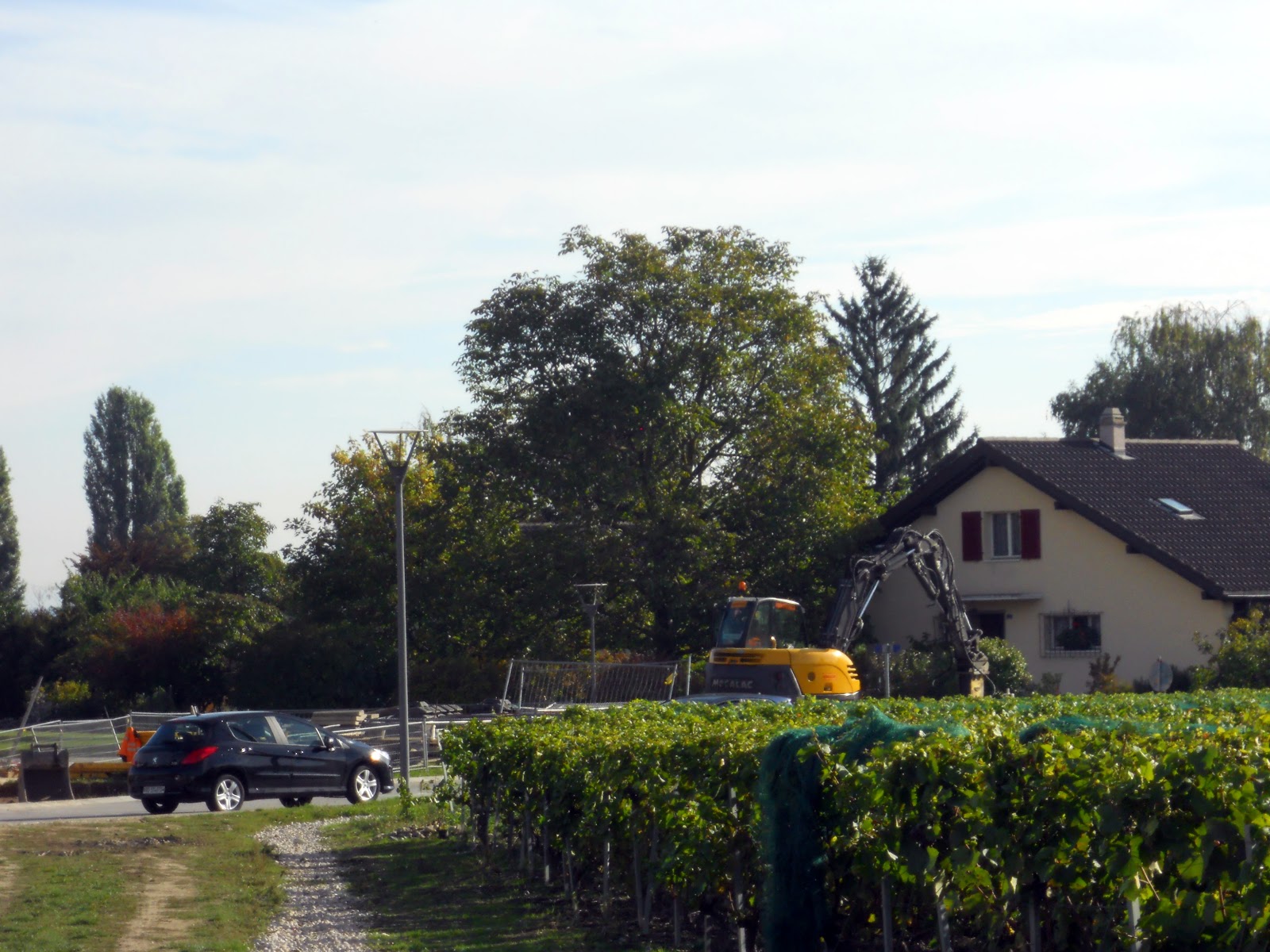
At around the same time in September, digging, earth-moving and pavement breaking began across the road from this apartment complex in order to upgrade the existing sewage system and improve it for anticipated future construction in this area, as shown here.
While there has been a lot of noise in the neighborhood since then and the project will likely continue until the end of April 2013, it's a bit of a shame that the Dynamic Duo of Prince Tyger and Prince Lightning aren't on hand to witness it.  They adore any kind of big, loud and noisy machine.  Because this project has plenty of such,
the Princes would literally be glued to these activities like white on rice.

29 November 2012

View from Jingshan Park

After strolling about the Forbidden City, the group moved on to Jingshan Park.
Jingshan Park was part of the Forbidden City until the early 1900s, when walls and several gates were torn down to make way for a road cutting between the park and the rear entrance to the palace complex.  There are five peaks in the park and it is worthwhile to climb a bit to get a view of the Forbidden City.
Or at least one could try to get that view.  As mentioned earlier, visibility was not great on that particular day.
Among other activities, one could choose to be photographed in full emperor regalia.
Or one could visit a statue of the Buddha although only the lower two-thirds are visible here.  Someone may have jostled HWMBO's elbow.
In the park, one can also see a plaque indicating where the center of the city of Beijing is located.
I wonder how that exact point was determined.  And when. 

28 November 2012

More "Forbidden" Moments

Beijing's "Forbidden City" is enormous and much too laden with centuries of history to cover in a few short posts.  As a matter of fact, all of my posts about China collectively do not amount even to a drop in the very large bucket about that amazing country and the cultures within it.  Having never traveled to China myself, I am limited to commenting about photos from HWMBO's gallery taken at places he visited.  I am thankful to have shared his experiences vicariously and am very grateful for the photos.  There are a few more scenes from his visit to the Forbidden City that I would like to share.
We share a fondness for roof photos, especially for roofs as intricately ornamental as those in the Forbidden City complex.
Here is a close-up.
And here is another roof photo.
Material used in the construction of the Forbidden City included whole logs of precious wood from the jungles of south-western China and large blocks of marble from quarries near Beijing.  The floors were paved with specially baked paving bricks from Suzhou, known as "golden bricks."  There are special ceremonial ramps leading to the terraces that feature elaborate and symbolic bas-relief carvings.   The northern ramp, behind the Hall of Preserved (aka Preserving) Harmony, is carved from a single piece of stone, nearly 55' long, hauled from miles away during the winter, when it could be slid over the ice.  It is the largest such carving in China.
Another feature that is relatively recent is the Nine Dragon Wall, built in 1773 as part of an extensive renovation of the northeastern section of the palace to create a retirement villa for the Qianlong Emperor.
With much of the complex constructed of wood, large water urns can be found about the complex so that water was at the ready for fire-fighting. purposes.
There are lions everywhere, not simply in the Outer Court.  Some look more ferocious than others.
Many ceremonial rooms were also considered sacred.
And one's eyes could also be drawn upward, towards the heavens.
Of course, one of the most impressive sights for me was this one!
Even in the Forbidden City! 

27 November 2012

The Not-So "Forbidden" City

What imp of perversity in human nature dislikes the word "forbidden" so much that whatever that description is applied to immediately becomes the object of our utmost desire?  According to the oft-told tale of the Garden of Eden, the first human beings were perfectly happy in their innocence.  That is, they were happy until one small thing was "forbidden" to them.  Ever since the taboo relating to that forbidden fruit was broken by an Eve manipulated by her curiosity and her feckless Adam, all of humankind has suffered the consequences.  One might believe - somewhat apocryphally - that an Almighty and All-Knowing Being would know exactly what would happen in this instance and that the so-called "test" was rigged from the first.  But that is a whole other story.

No matter who and where we are, the word "forbidden" too often lures us into situations where common sense might suggest we had better not go.  Fortunately, for HWMBO and his study group, the word "forbidden," used to describe the Forbidden City, the imperial palace complex used by Chinese emperors from the Ming Dynasty to the end of the Qing Dynasty, no longer has the meaning it originally held.  Then, it meant that no one could enter or leave the palace without the Emperor's permission.  The consequences of disobedience were dire.  Fortunately, that is no longer the case.
The palace complex of the Forbidden City was built from 1406 to 1420, consists of 980 buildings, and covers 720,000 square meters (7,800,000 square feet).  This makes it, according to one source, among the five most important palace complexes in the world.  According to that same source, the other "palaces" include Versailles in France, Buckingham Palace in the UK, the Kremlin in Russia and, surprisingly, the White House in the US.  I never have thought of the White House as a palace.  However we may venerate (or not, as the case may be) our Presidents, they are not royalty in the sense of the rois of France, the Kings and Queens of England, the Tsars in Russia and, most certainly not in the sense of the former Emperors of China.  In any event, the Forbidden City has its own map posted
for today's visitors, who come in multitudes.
Visitors are greeted at the outer gates by a stern depiction of the late Chairman Mao.
Statues of fierce lions are positioned about the courtyards.
And there are plaques that describe the history of areas such as the Hall of Preserved (or Preserving) Harmony,
that have been destroyed and rebuilt over the centuries.
Today, visitors from all countries of the world can wander freely among the buildings in the palatial complex.
They can even view the throne used by Emperors for centuries
and ponder how Power - no matter how long it may seem to last - is ultimately fleeting.