Showing posts with label Compassion. Show all posts

23 October 2012

Another Good One Gone

I wasn't able to vote in a US Presidential election until 1972, when I was nearly 30 years old.

The "why" of that situation is explained by the fact that, until 1971, the voting age requirement used to be 21.  However, I graduated from college in 1964 when I was 20 years old, immediately joined the Peace Corps, and was sent to teach English as a Foreign Language (TEFL) in a secondary school in Morocco.  Very shortly thereafter, I married a Moroccan teacher.  In due course, I became mother to two sons while my physical residence was in Morocco.  While I continued to live in Morocco, I was literally disenfranchised.

Even if I had been living in the US at the time, I would have missed being eligible to vote in the 1964 election by approximately a month and a half.  I didn't turn 21 until mid-December of that year.  I totally missed out on the infamous election of 1968.  Still, even from abroad we expatriate Americans followed the news of that election closely, from the rise of Eugene McCarthy (who ultimately did immeasurable disservice to the Democratic party, IMO) as an anti-war candidate, to the heartbreaking assassination of RFK, to the sad defeat of Hubert Humphrey at the hands of the dastardly Richard Nixon, whom I never liked, champion as I was of JFK, also tragically assassinated.

When we relocated to the US in 1970, one of the first things that I did was to register to vote.  In 1971, the 26th Amendment to the US Constitution, which standardized the voting age to 18, was adopted.  The Amendment was adopted in response to student activism in opposition to the Vietnam War.  The students believed that if they were old enough to be sent to war, they were certainly old enough to be able to vote.  The majority of US citizens believed that the students and their supporters had a valid point.  Thus, the implementing amendment came into being.

In spite of the anti-war activism from the late 1960s, by 1972, the anti-war movement was still not as powerful or as mainstream as it later became.  The "Hawks" still had the ascendancy in 1972.  Extracts from the devastating Pentagon Papers had been published in 1971.  But their implications had still not been totally digested by the American public.  It was at this point that George McGovern arrived on the national political scene, ultimately to win the Democratic nomination for President in 1972.

Then Senator McGovern, a native of South Dakota, was a genuine WWII war hero.  Even so, he was outspoken in his opposition to the Vietnam War.  His legislative efforts to bring it to an end were defeated each time they were proposed.  His candidacy for President was disadvantaged, in part by his own decency, in part by ideological divisions in the Democratic Party, but most certainly by a variety of "dirty tricks" by Republican political operatives.  As we all know, Senator McGovern was resoundingly defeated by Nixon.  This defeat was somewhat eased for me when Nixon himself had to resign in ignominy two years later.

But in 1972, I was very proud to cast my first vote ever for a US President for Senator George McGovern.  I am still proud of that.  For me, Senator McGovern was the epitome of modern American liberalism and I will not apologize for being an admirer.  Never, ever.

So, I was very sad to read that on Sunday, 21 September 2012, George McGovern passed away at the age of 90.  Judging by those who have gone before from among my own family members and friends, I know that he will find many friends and admirers in the Great Beyond.  And I found this cartoon to be spot on.
Rest in peace, George!  It is well deserved.  

16 March 2012

Days of Mourning

On Tuesday evening, what should have been a routine return from a ski vacation in Switzerland for Dutch and Belgian children turned to horror. The bus they were riding in, 52 passengers in all including two bus drivers and four accompanying adults, crashed headlong into the side of a tunnel between Sierre and Sion in the beautiful Valais Alpine region. Twenty-eight persons were killed, 22 of them children aged 10-12. Miraculously, 24 children survived, although some remain in critical condition. More details of the crash can be found here.

More than 200 people were involved in the rescue operation. It took eight hours to clear the scene. There have been reports that the horrified rescuers were greatly traumatized. And it is no wonder why. In spite of the large amounts of daily traffic, tunnel crashes here are relatively rare. But when one occurs, it is considered to be a worst case scenario for rescuers.  Especially when children are involved. Here is a video of some aspects of the rescue operation.

I have travelled that road myself, although not in recent years.  From from first-hand experience, I can testify that the roads and tunnels through Swiss mountains are marvels of engineering.  When there is a rare accident, it is studied in depth and lessons are learned.  If called for, the tunnels are re-engineered to incorporate additional safety features.

Ironically for this bus and its ill-fated passengers, it was one of the tunnel's safety features that proved to be their ultimate undoing.  After veering into the side of the tunnel and careering to the other side, the bus returned to its own lane, travelling along the side of the tunnel until it crashed headlong into a concrete outcropping designed to assist any passengers trapped in the tunnel during an incident make an emergency exit. Although the crash is still under investigation, it appears from video replays of the incident that speed was not a factor and no other vehicle was involved.  The bus, one of a cavalcade of three transporting the children home, was relatively new, well-serviced and equipped with seat belts, which the children were wearing.  There were no problems with either of the other two buses. In fact, there are reports that all arrived home safely, at least some unaware that there was even a problem with the third bus! Swiss authorities were concentrating on three possibilities for the cause of the accident: a technical problem with the bus, a health problem with the driver, or human error.  One report said that statements from the children who survived the crash indicated that the driver might have been attempting to change a DVD at the time.  But nothing is sure yet.

Memorial services were held in Belgium and in Sierre, Switzerland last evening. Today, both Belgium and the Netherlands held official days of mourning. All are aghast. Tragedy may reach out and tap each of us on the shoulder at such times. But we are grateful when it is just a tap and not, as for these many parents, a heart-breaking body blow.  May these little ones and those who accompanied them all rest in peace.

07 November 2010

Gallimaufry 6

It's been a while since I've had a Gallimaufry round-up - since June, In fact.  So, it's about time to gather up some bits and pieces of events that have been floating about.
*****
When HWMBO decided to visit me in Switzerland, we had some tentative travel plans during his visit.  Interestingly, our social life has been so eventful, first with planning and implementing events related to the retirement of my former boss and good friend, and otherwise with getting together with old friends and new that we haven't yet had time to squeeze them in.  He seems to be enjoying himself and we've both enjoyed seeing so many good people that we both knew together, as well as my newest neighbors here, most of whom he had never met in person until this visit.  At least my newest neighbors now seem to realize that I do have a husband - he is not simply a figment of my imagination!
*****
HWMBO is an avid tennis player and fan.  So today, we enjoyed watching Swiss TV coverage of Roger Federer and Novak Djokovic playing in the final of the Swiss Indoor Tournament in Basel - Federer's home town.  I say "we" advisedly.  I have the idea that my tension infects Roger's play.  So, to do Roger a favor today after he dropped the second set to Novak, I moved into the other room out of sight of the TV.  It must have done the trick (ha!).  Roger came through 2-1 to win his fifth title of 2010, his fourth career title for this particular tournament.   I also like Djokovic's game, however, and Novak played well today even though he had to settle for second place.
*****
On the home front, Prince Attani's real name has not yet been made public so we're still waiting to hear the final choice.  It took a while for Big T and Sweet Momma H to settle on Prince Tyger's name but they came through trumps.  So I'm sure that they'll do so again.  I remember that it took a couple of days for us to name Big T, even though the name we chose was our clear front-runner for a boy.  We had "Meryam" in reserve for a girl.  I was so sure that No 2 son, Big S, would be a little girl that I refused even to consider a male name.  The minute I saw him, however, I realized that our choice of "Sarah" would not work at all!  So it meant that his father and I had seriously to discuss names for boys right beside his little clinic cot.  When Big S's father mentioned the name that we ultimately chose, that was it.  It was obviously "cut" for him.  Although he goes by a nickname, no one who knows him can imagine him as anything but that.

Interestingly, even though those in this generation have the luxury of knowing the gender ahead of time, they seem to have a more difficult time choosing names than we did.  Of the grandchildren, only Princess Butterfly had a real first name before she was born.  Even then, her parents had difficulty concurring on a second name and I inadvertently disseminated the wrong one to other family members because minds changed even after that!  I learned my lesson.  When Prince Attani, whose real name will not feature here, gets a little older and we see how his personality develops a bit more, I'll likely bestow yet another blog name on him.  We have time.
*****
The long-predicted Republican "tsunami" did not occur in the US during the elections on 2 Nov, at least not to the extent certain so-called pundits were predicting.  Still, it was a bad night for the Democrats generally.  Yes, there were losses in the House and Senate, but Democrats did retain the majority in the Senate.  Harry Reid, the much-maligned and Republican-targeted Senate Majority Leader managed to squeak through an election that would not have been as tight had voters actually understood what they were voting for.  But Democrats did lose their majority in the House and I, for one, am very sorry about that.  My personal belief is that yes, it was a difficult year politically for whichever party was in power, but the Democratic National Committee (DNC) fell into the bad old habits of targeting certain states instead of continuing the "50-state strategy" so well implemented by Howard Dean.

As a Dean admirer, I have been appalled at how he was literally shunted aside after he had done so much for the party nationally.  It was not that he wanted to remain at the DNC.  He didn't.  But as a medical doctor himself, and as a politican who had already managed to implement health care reform at the state level when he was governor of Vermont, he should have at least had his request for the position of Secretary of Health and Human Services (HHS) treated with serious consideration.  But he was unceremoniously tossed aside because it was felt by the "Powers That Be" that he would be too "partisan."

I really hate the false equivalencies that seem to hamper liberals generally.  In the name of "free speech," some seem to believe that deliberate lies, smears, distortions and slander should be treated as respectfully as fact-based logic.  In such cases, liberals will always lose because we respect truth, as should all.  So why are fact-based "partisanship" and standing up to bullies who name-call, demean and have no interest in civil discourse bad things?  Those who ultimately defeated fascists and Nazis had to stand up to them first.  In many cases, this meant that they also lost their lives.  We should have at least a modicum of the same courage.

02 November 2010

Family politics - parental leave

In this month of November, we are expecting the births of a new grandbaby together with our very first great-niece or great-nephew.  We already know that the grandbaby will be a boy.  But the parents of the other newest family member have chosen not to know, or at least not to make public, the gender of their baby.  That is exactly the way it used to be when I had my own babies - and I am one who actually liked it that way.  But to each his or her own.  We are still very thrilled about the imminent arrival of both.

Our newest grandson will be younger brother to our very special Prince Tyger.  The Tyger's world will likely turn somewhat upside-down when his Baby Brother arrives.  Prince Tyger is used to having the undivided attention of all the adults in his family, so we'll see how things go when he learns that, important as he will always be, he now will have to share the limelight.  Those of us who were "oldest" in our families all learned that lesson - at least to a greater or lesser degree.

In light of these impending events, I was interested to read an article in last Wednesday's Tribune de Genève discussing a new initiative that is being proposed by la Commission fédérale de coordination pour les questions familiales (COFF) (the Federal Coordination Commission for Family Questions).  The proposal would introduce a paid parental leave of up to six months for working young parents - to be split between mothers and fathers.   Under this proposal, each parent would receive a minimum of four weeks of paid parental leave in addition to the regular paid maternity leave.  Although the proposal doesn't describe "paternity leave" as such, it would have the effect of validating it.

When I worked with international organizations (IOs), both paid maternity and paternity leaves were part of the benefits packages even though, while I was working there, I was long past the age where I needed them.  Several of my young male colleagues, however, especially those working fathers who were sole wage-earners for the families, used the month-long paternity leave (as contrasted with the four-month paid maternity leave for new mothers) to help bond with their newborn children, to give their wives an occasional break and also to help with routine chores (e.g., grocery shopping and cooking) usually performed by their wives who did not work outside the home while the new mothers got used to their new status and responsibilities.  I personally believe that both are wonderful ideas - especially if one truly believes in "family values" and doesn't merely pay lip service to them.  Such leaves are investments in people and in the future.

The sticking point for this proposal, of course, is the financing.  The COFF has proposed raising fees and increasing the VAT (value-added tax) slightly.  The right-wing UDC party is totally opposed to parental leave; the left is very favorable.  But neither left nor right likes the added costs.  Extraneous or tangential issues such as creating more space in day-care centers and after-school activity centers and working flexible schedules are also factors in the debate. 

In its print edition at least, the article also provided a table showing that Switzerland is less generous than other European countries insofar as parental leave is concerned.  While the table used Iceland and Germany, at nine months and 14 months respectively, as bases for comparison, the article concluded that the Swedish model is the most generous.  In Sweden, 16 months of parental leave is the rule and the leave can be divided between both parents, although for the first 13 months, the leave is paid at only 80 percent of the gross salary.  The leave can also be taken part-time.

My own country, the United States, is the only Western country not to mandate paid parental leave.  In fact, it was only in 1993, under the administration of President Bill Clinton, that an unpaid leave was mandated.  Before then, parents had to take vacation or their own sick leave days for such.  While it is true that some private employers in the US do provide paid parental leave among the benefits offered to their employees, IMO, these employers are too few and far between.   We certainly lag behind Western Europe in this respect.  And Europe is certainly economically competitive with us as well.

Rather than for my country to continue to invest in endless war, I believe that I am part of the overwhelming majority that would prefer to invest in people, in families, in education, in infrastructure, in universal health care, in improving our environment and in providing for a future where all children are valued as the wondrous creations they are, not simply as future consumers, serfs to provide obscene profits for corporate overlords, or cannon fodder for the warmongers.   

26 October 2010

After the hullabaloo ...

Whew - the past couple weeks have been Busy and yes, the capital "B" is meant!  But now the events celebrating my former boss's retirement are complete and I also seem to be recovering enough from the follow-up cold to begin picking up the pieces of my scattered psyche.

This morning at 8:15, the postman also delivered the Snapfish album that was the culmination of at least one million emails and photo dumps and CDs that I received from far parts of the globe.  It appears that a good time was had by all in the doings!  I have also been acquainted with "top-of-the-line" Rimowa luggage as it was decided by consensus that a blue-black Rimowa cabin trolley would be ideal as a group gift.  So off HWMBO and I trekked to the Balexert shopping center in Geneva, which is in the throes of its gala new opening celebrations this month after a massive makeover.  While the Buzzano shop at Balexert did not have the case we wanted, they offered to have it sent over from their Rive shop.  The case duly arrived two hours later, providing us with the excuse we needed to check out the new shops and facilities at Balexert, which has now "officially" become the largest shopping center in Geneva.   Best of all, Buzzano let us have the ten percent discount that the Balexert shop was offering even though the case actually came from the Rive shop, where the discount was not operative.  Who says that one can't bargain in Swiss shops?

It was good to see so many wonderful people and remember shared good times.  It is true that some of the shared times were also very stressful.  But the fact is that those times were unique, so special in that they involved nationals representing every continent on the globe joined together to accomplish common goals where individual human beings around the globe actually received tangible benefits.  It is unfortunate that circumstances existed where individuals had been harmed in the first place, in large part due to conflicts over which they had no control whatsoever.  But it is equally fortunate that at least some small restitution and, most of all, acknowledgement of the harms suffered by those individuals became international precedent.  We are all proud to have been a part those efforts, even though we have now all moved on to different phases of our lives.

02 September 2010

Discovery-Tarnished Silver Spring

Yesterday afternoon news programs announced the startling event, breaking into regular radio and television coverage: an armed individual who was supposedly carrying a bomb had entered the lobby of the Discovery Channel Building in nearby Silver Spring, Maryland.  Both HWMBO and I, who have frequently driven past this building on our way to visit our precious Prince Tyger and his family, stopped what we were doing to find out what was happening, literally holding our breaths and dreading the worst.

There was a tense four-hour stand-off during which three hostages  - a security guard and two other Discovery employees - were forced to lie face-down on the floor while a deranged individual stood over them with a handgun.  The stand-off ended comparatively well for the hostages, fortunately, whose traumatizing ordeal ended only when the individual, one James J. Lee, was shot and killed by police.  The stand-off likely did not meet Mr. Lee's expectations, although it is difficult to know what those expectations were.  According to an article in today's Washington Post, the Montgomery County Police Chief described Mr. Lee as having a live bomb strapped to his body.  Exactly what DID he expect to accomplish?

Excellent photos of the area during the standoff can be found here.

Mr. Lee was identified and described by some as an "environmental militant," whose world consisted of  "good" and "bad."  Human beings were "bad;" civilization was "filth."  War, global warming and pollution were "bad."  Worst of all in this manifestly disturbed person's ideology, however, were babies - "parasitic" to him.

Mr. Lee, like all those who resort to violence or terrorism in an effort to attract attention or make their points, was exactly the kind of "friend" that his self-styled causes do not need.  Many of us feel frustrated that nothing or too little is meaningfully being done at the highest levels about global warming and pollution.  We also detest war - and especially those who lie in order to provide justification for it!  We are genuinely concerned about overpopulation and its corresponding carbon imprints on this Earth that we all must share.  But we work with others and try to bring people together to solve our common problems.  We do not use weapons or violence.  Finally, we certainly do not consider any of our fellow human beings, least of all babies, "parasites." 

Mr. Lee's "creed" is available to read on the Internet.  There are some aspects with which I can agree, such as the airing of inane, if not outright insane, TV shows such as "[Jon and] Kate Plus 8"  and "19 Kids and Counting," that promote the litter-like production of  human children rather than feeding, clothing, sheltering, educating to their highest potential and improving the quality of life for the children who are already here.  I certainly support the right of responsible couples to have children.  After all, I have even had them myself and thoroughly enjoy my grandchildren as well.  I also taught children and adolescents for several years and look forward to doing so again.  However, neither of those TV shows demonstrates responsible parenting, in my opinion, and neither should be presented as any example of such.  "Nothing in excess" is one of the admonitions that greet visitors to the Temple of Apollo at Delphi.  That is a wise adage.  But such sage advice is all too easily forgotten by those who blindly follow or who seek obscene profits, either for themselves or for the corporate masters they serve.

But most of Lee's manifesto-like authoritarian ranting is patently nonsense.  He was an Internet despot who was also hypocritical, at least in part, because his targeting of the Discovery Channel likely had much less to do with his purported causes than with the fact that Discovery apparently dismissed his ideas for a TV series.

Let us neither demonize nor glorify this sad, demented man, who is currently beyond anything this world can do to him now.  Let him simply be buried in peace.  While his acts can in no way be justified, my heart goes out to any family or friends who knew and loved him.  My heart also goes out to the policeman who had the very sad duty to shoot to kill in order to preserve the lives of others.  Sadder still is that somehow our contemporary society continues to form more alienated individuals like Lee.  How that happens and why should concern us all.

18 August 2010

To build or not to build, is that REALLY the question?

Just when I believe that I've seen it all, that the crazy people who literally seem to be coming out of the woodwork everywhere in my country cannot get any worse or embarrass those of us who are at least within "normal" definitions of sanity - whatever those may be - any more than they already have, the airwaves are flooded with the latest distraction du jour.  And just what is this distraction du jour?   The fact that Muslim Americans wish to build a Muslim community center on property that they own that happens to be located a couple of blocks from "Ground Zero" in lower Manhattan is driving the wingnuts absolutely bonkers.  It is leading from one rhetorical excess to another.  The thinly disguised racism and bigotry in that inflammatory rhetoric are largely being given a pass by the US mainstream media (MSM) - and even worse, by politicians who should know better.

The project was initially reported by the New York Times in December 2009.  As the article reported:

"The location was precisely a key selling point for the group of Muslims who bought the building in July. A presence so close to the World Trade Center, 'where a piece of the wreckage fell,' said Imam Feisal Abdul Rauf, the cleric leading the project, 'sends the opposite statement to what happened on 9/11.'
'We want to push back against the extremists,' added Imam Feisal, 61.
Although organizers have sought to avoid publicizing their project because they say plans are too preliminary, it has drawn early encouragement from city officials and the surrounding neighborhood." (emphasis mine)

From that quiet beginning, thanks largely to the fearmongering efforts of what Salon (one of the few publications that still gives me hope for US journalism) describes as a "right-wing, viciously anti-Muslim, conspiracy-mongering blogger, whose sinister portrayal of the project was embraced by Rupert Murdoch's New York Post" comes a ridiculous brouhaha.  The name of its begetter is Pamela Geller.  Even before this latest media-manufactured "controversy," Ms. Geller had also been described as "the looniest blogger ever" by at least one individual who specializes in finding such loons.  Just going by the New York Post's own juxtaposition of Imam Faisal and Ms Geller, I find Ms Geller the scarier of the two.  By far.
Ms Geller has also earned a prime place on my personal Noxious Persons list, which I am sure will bother her not one whit.  But enough about her, she will have her own karmic destiny to endure at the appointed time, as will we all.   The Salon article is an excellent one and I encourage all to read it and the links it includes here.  It provides a timeline for how this story - largely positively received even by conservative personalities like Laura Ingraham - evolved and notes how the project was approved by the New York City community board committee.  Of course, the approval occurred before Geller and her vicious sycophants and cohorts got to work in earnest and ratcheted up the fear level.  Now Ingraham has fallen into line and is against the project.  Sigh - it seems that hate and fear are all too easily ratcheted up in America today.

The Founders of this Nation, who were largely Deists, understood the real problems that can occur when a religion controls or otherwise interferes with the functioning of a State.  They had studied history and the Classical philosophers, as well as the more recent philosophers of the Enlightenment.  The Enlightment had taught them that reason, not superstition or religion, should be the basis for legitimacy and authority.  Still, they believed in a Supreme Being and understood that most individuals need not only to believe in one but take comfort and inspiration from that belief, hoping in time to become worthy of being united with their God.  They also believed that the State should not interfere with the rights of individuals to choose which religion to practice.  That right was so important to the Founders that the right to choose and practice one's religion of choice (or, as it was also later interpreted, not choose and not practice) was enshrined in the First Amendment to the United States Constitution.

The text of the First Amendment is very simple.  It is also very profound.

Congress shall make no law respecting an establishment of religion, or prohibiting the free exercise thereof; or abridging the freedom of speech, or of the press; or the right of the people peaceably to assemble, and to petition the Government for a redress of grievances.

Evidently, Ms Geller and co - and the 70% of Americans who reportedly are against the building of this center - believe that the First Amendment does not apply to Muslims.  They deny that, of course.  Their disingenuous response is that the center should simply not be built at that particular location.  Apart from that, they conveniently forget that New York City approved construction of the center and approved it for that location. Moreover, the center is to be on private, not public, property.  Their standing to object is decidedly lacking.  But that is perhaps too "rational" for them to understand.

The question here is not really "to build or not to build."  It is rather what kind of nation have we become, when the political rhetoric, fear-mongering and promotion of hatred, diviseness and "other-ness" have become more reminiscent of 1930s fascist and Nazi leaders than of our Enlightenment-inspired Founders?  What kind of nation indeed?

11 June 2010

Peaceful actions and laudable goals

Today's Tribune de Genève has two stories juxtaposed that evidence real concerns and actions that have been, and are being, undertaken to alleviate, in small and peaceful ways, the humanitarian disaster that exists in Palestine.  One story discusses the strategy advocated by "Boycott Désinvestissement Sanctions" (BDS).  Created in 2005, BDS initiatives have been multiplying throughout the world in order to encourage boycott, divestment and sanctions actions dealing with Israeli-produced goods and services.  These actions are not only intended to have an economic impact, but more precisely to be successful in changing opinions and political positions. According to the promoters, such campaigns should be evaluated by a series of measures, including economic impact, greater exposure of the issue in the media, shifts in popular discourse over understandings and dynamics of the Palestinian struggle, and the psychological impact upon the offender that the behaviour causing the boycott is not acceptable.  The Swiss BDS group is implementing such a boycott throughout Switzerland.  A sidebar accompanying the article lists the three main supermarket chains and the specific products that are targeted.

The second article is more heartening, if also heart-breaking.  After two years of letters, packages, hundreds of stamps and overwhelming expenditures of time and energy, 12 students of a Geneva school are meeting their Palestinian pen-pals face to face.  The 16 Palestinian children, ranging from 8 to 13, have for the first time in their lives set foot on soil other than that in the Balata refugee camp.   Balata was established adjacent to the city of Nablus in the northern West Bank in 1950.  Entire generations have matured within its confines since then - with nowhere to go.  Therein lies tangible and desperate despair  - apparently inexplicable to too many who are otherwise logical and goodhearted persons.

The 10-day visit is intended to show the young Palestinians that there is something in life other than an enclosed space, that other lives and possibilities are possible far from conflict.  It is hoped that the visit will provide them with hope, friendship and a vision for a better future.  The visit is being sponsored by the Meyrin Foundation for the promotion of cultural, social and sports activities, the Department of Culture of Geneva City, the Permanent Mission of Palestine to the UN in Geneva and by Royal Jordanian Airlines.  Getting the young Palestinians here at all was a remarkable achievement, with packages lost or stolen, customs charges required at several different times, and visa problems,  In fact, two of those who were to accompany the group were denied visas and thus not allowed to leave.

Between the 16 Palestinians and their 12 Genevan "hosts," it was love at first sight, in spite of language barriers.  Would that there could be many other such meetings!  It's a small world, after all, and it is very hard to hate a person with whom one has shared pleasant experiences.  Perhaps that is why so much energy and effort are spent in dehumanizing and demonizing so that some may always be considered "other."  And that is tragic.

07 June 2010

Peace and the environment

On 5-6 June, there were even more crowds than usual at the Place des Nations in Geneva.  In order to celebrate World Environment Day, gates were opened wide for entrance into the Ariana Park at the Palais des Nations, also known as the European headquarters of the United Nations.  This area has for many years been closed to the general public, thanks in good part to the disastrous foreign policy practiced by the previous US Presidential administration, which did not make the world any safer for humans - or for the environment - at all.
Ariana Park is described as "an award-winning example of biodiversity in landscape management."  The 46-hectare park was bequeathed to the City of Geneva in 1890 by Gustave de Revilliod de la Rive, with three conditions:  first that the park always remain accessible to the public; that he be buried in the park; and that peacocks roam freely on its grounds, although this last condition is in dispute.  The City of Geneva granted the site to the League of Nations and later to the United Nations.  Peacocks do still roam there today, but it is a rare tour group that catches a glimpse of them because the official visitors' tours of the UN buildings and grounds have been scaled back a lot from when I first arrived in Geneva in 1994.
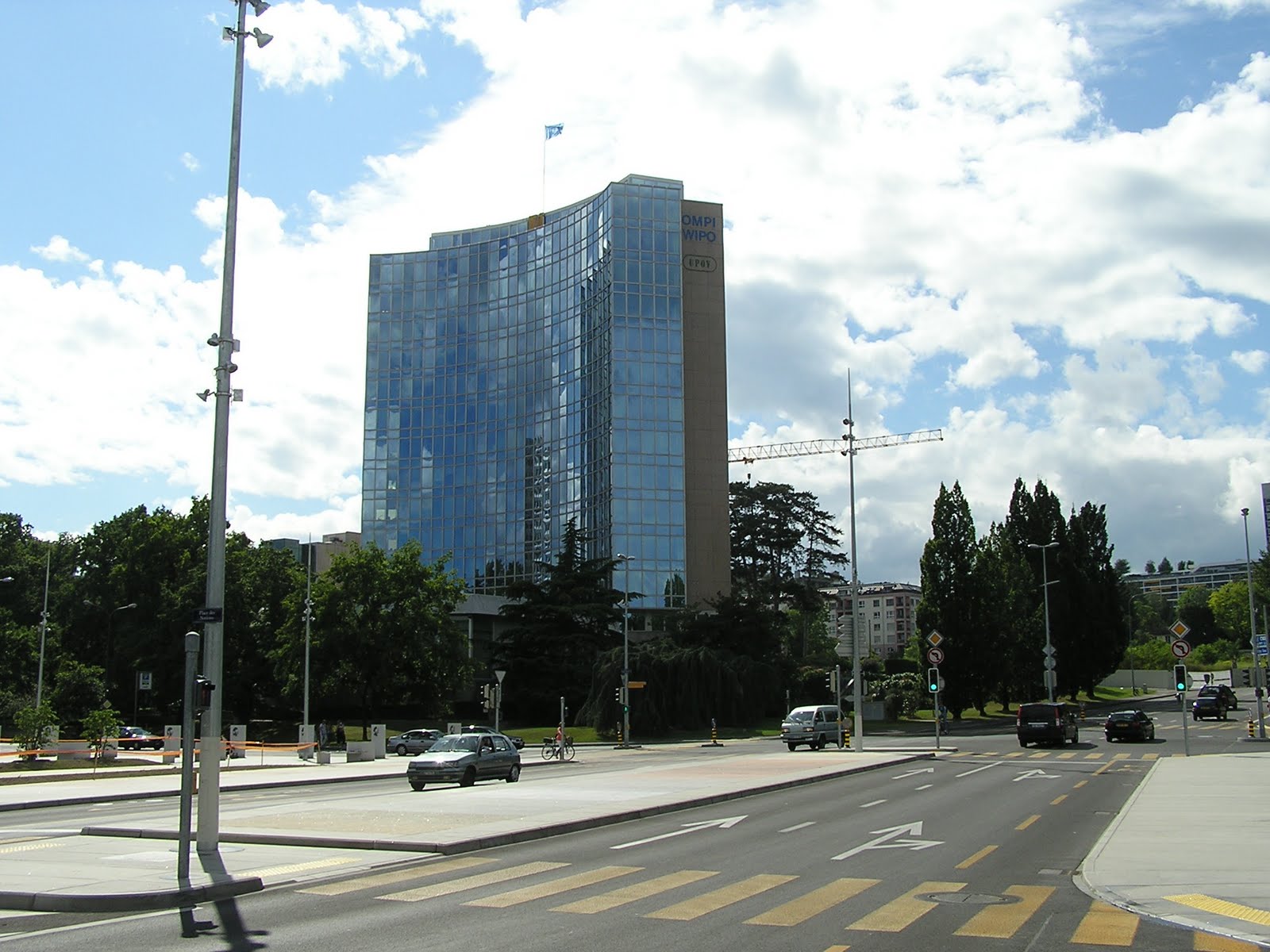
At the same time, the World Intellectual Property Organization (WIPO) also opened access to its observation deck from which one of the most spectacular views of Geneva can be had.   Facilities at the Regional Office of the UN Environment Programme (UNEP) and the International Peace Bureau (IPB) were also open to the public in order to celebrate both the environment and the centennial of the Nobel Peace Prize received by the IPB.
Geneva's international community comprises some 200 ambassadors serving at national missions to the United Nations and international organizations, 30 international organizations, 300 non-governmental organizations, some 35,000 jobs and contributes about CHF five billion annually to the gross national product of Geneva canton.   But international Geneva is more than these structures or individuals or their economic contribution to the Swiss economy.  It is a crucible in which the rules of social, commercial, sanitary, humanitarian, climate-related, technical and military governance are elaborated.  It is literally at the heart of multilateral diplomacy - one of the two or three world centers of "soft power."

I believe that is the principal reason why I not only enjoy living here but have done my best to stay here as long as possible.  In a world where military might, weapons and bad behavior are rampant, all too often trample roughshod over human rights and dignity and, by so doing, harm us all as well as the world we live in, it helps me to realize that there are indeed many who not only wear "white hats" but who continue with all the power at their disposal to help and encourage those who have been trampled upon.  That our progress is all too often one step forward and two steps back is not the point.  The point is that we continue, in spite of all, to speak out for the alternatives.  After all, someone must.

02 June 2010

Music makes the world go round

Last week through Saturday night was Eurovision Song Week.  Saturday night was the finale.  German singer Lena won the 2010 Eurovision Song Contest, hosted this year in Oslo, Norway, for her country.  Under contest rules, Germany will host the 2011 Eurovision Song Contest.  Her winning song, "Satellite," was written by American songwriter Julie Frost and Danish songwriter John Gordon, so international collaboration was clearly a feature of the contest.  Lena's first album, "My Cassette Player," was released in May and debuted at number one among German albums.

Following Germany, the top-ranked country finishers this year were Turkey, Romania, Denmark and Azerbaijan.   That's quite a group.

The Eurovision Song Contest, open to all active member countries of the European Broadcasting Union (EBU), has been held annually since 1956.  The first contest was hosted in Lugano, Switzerland.  Full active members are broadcasters based in countries from Iceland to Russia and include most European countries.  Associate members include countries from around the world.  Associate members from the USA include the major non-cable broadcast networks, the Corporation for Public Broadcasting and Time Warner, among others.  The Contest has been broadcast each year since 1956, is one of the longest-running television programmes in the world, and is also one of the most-watched non-sporting events in the world.  Audience figures have been quoted in recent years as anything between 100 million and 600 million international viewers.  Since 2000, the Contest has also been broadcast on the Internet.

Probably the most famous Eurovision Song winning group whose career was directly launched into the spotlight following their win was ABBA.  They won the Contest for Sweden in 1974 with their song "Waterloo" and went on to become one of the most successful bands of all time.  Their music has also been featured in the long-running musical, "Mamma Mia!" and the film of the same name.  Another notable winner was Céline Dion, who won the Contest for Switzerland in 1988.

The Eurovision Song Contest was originally started as a way to bring then war-torn Europe together by means of light entertainment.  It has been remarkably successful in doing that throughout its history, although it has been no stranger to controversy on occasion.

I read all too often in the news headlines about the horrific events that occur when people do not practice the basic principle of treating others in the way that they themselves wish to be treated.  I wish that there could be a Worldvision Song Contest - to bring ALL of us together - and to remind us all that we are human beings who share a common destiny and the globe - regardless of our differences.

Music is one language common to us all.  It speaks to our hearts and moves us.  I wish that it could move us all to peace and prosperity.  Oh, how I wish that! 

04 May 2010

In Memoriam

Today I received word that the husband of my very dear Friend G passed away in his sleep.   There was no warning; he just didn't wake up in the morning.

I was maid of honor at their wedding - like mine and HWMBO's, the second for each.  Like us, they were a blended family, with all the extended family connections that are part and parcel of a blended family.  I know Friend G well, having met her at around the same time as I met HWMBO.  Like me, she loves travel and different cultures.  She continues to work with the public education system in the state of South Carolina.  Her three grown children, whom I first met when they were all younger than my own, have all done exceedingly well professionally.  They have also made her a grandmother four times over.  Here we are together with a mutual friend the last time that we saw each other, in the late summer of 2007.  She is on the left.
After parting from her first husband, she began working outside the home, as a single parent.  She also continued graduate studies and met her second husband around the same time as she completed them.  They relocated to South Carolina with the two younger children and she began her career in education there.  She has been especially good at inspiring the younger generation to look beyond their parochial surroundings and to examine and realize opportunities available around the globe.  She has led student travel tours, including tours to Europe, in order to open minds that need to be more aware of our interdependence and reliance on each other and on the same natural resources.  She has been a special counselor and friend to students from other countries who spend school years as exchange students in the South Carolina public school system.

Her husband was a good man, a kind man who encouraged her in all of her endeavors and was a major part of her success.  In all things, he was her best friend and support system even though he didn't accompany her in all of her travels.  He helped her to become the person she has become.  She will miss him greatly.  Here are the three of us together in 2007.  At the time, he needed surgery and I helped to convince him that he would feel much better after having it, having undergone a similar procedure myself.
My own heart is heavy for her now.  No matter how inevitable we know that death is and no matter how prepared we believe that we are, we are never ready to lose those whom we love - no matter how far apart we may be from them.

12 April 2010

Intimations of Mortality

I did not like the foreign policy of Polish President Lech Kaczynski, although it did seem to me that he appeared a tad more reasonable than his older twin brother Zaroslaw.  The political climate has also thawed generally from what was rapidly approaching former Cold War temperatures since the election of Barack Obama as US President in November 2008.  I am most certainly not the only person in Western Europe to breathe a heartfelt sigh of relief about that!  And Polish relations with arch-enemy Russia had also improved significantly in recent weeks.

Despite my dislike of and unease with President Kaczynski's foreign policy, never, ever would I have wished upon him, his wife and their entire entourage the terrible fate that awaited them early last Saturday morning!  Like so many, my heart goes out to the Polish people for the tragic loss not only of their President, but of their entire government, practically speaking.  In one horrific "fell swoop."

The President's body was repatriated to Warsaw on Sunday.
That this happened at all is awful.  That it happened in connection with an event that was to commemorate a terrible massacre of Polish citizens is especially poignant, as the Geneva Tribune editorializes today.  That it happened at a time when prospects looked good for relations between Russia and Poland to continue their thaw will perhaps remain a tragically missed opportunity.  That it happened, as it seems, as a result of human error is horrendous.  Finally, that it happened when there were other options available that were communicated to the pilots, that the same pilots had already aborted three previous attempts to land in pea-soup fog conditions, and that they still continued to attempt to land a fourth and fatal time is frankly incomprehensible.

Among those of us who have been frequent - or even infrequent - fliers, who has never known a few moments of absolute panic when an airplane hits rough weather and begins to pitch around?  Fortunately, for the great majority of us, moments of discomfort and fear remain only that: moments - however long they may have seemed at the time.  Once we are safely aground at our destination, we tend to forget them for the most part.  But many of us retain enough residual memory to identify quite closely with moments as we imagine them for those who have not been as fortunate.  For example, as someone who had been a passenger on Swissair Flight 111 from JFK to Geneva (it was literally referred to here as the "U.N. Shuttle") and who had had several visiting family members and friends take the same flight number and route, I, like so many here, was literally in shock about its tragic crash on 2 September 1998.  I had also visited beautiful Peggy's Cove in Nova Scotia, near where the plane crashed into the Atlantic, so it was especially touching.
Another more recent example is that of Air France Flight 447, from Rio de Janeiro to Paris, that crashed into the Atlantic Ocean on 1 June 2009.  What made that crash memorable for me was that one of my good friends and neighbors here is a career pilot with Air France.  He explained the routine procedures for such circumstances to me and described firsthand the horrific experience in Paris as families and friends desperately awaited - most often fruitlessly - any news of their loved ones and Air France employees awaited news of their lost colleagues, all too easily able to imagine themselves in their places.  One of the most difficult things about that crash is that the cause will likely never be known.  Investigation has been severely hampered by the lack of the flight data recorders, eyewitness accounts and radar tracks.  Messages from the plane simply stopped arriving somewhere between Brazilian and Senegalese-controlled airspace.  Only 51 bodies were recovered.
One nephew, son of Healer Sis, is of Polish descent on his father's side.  I also attended secondary school with children from the many Polish families, often Holocaust survivors, who were resettled in the United States after WWII.  The last major project I worked on dealt extensively with Eastern Europe and I had as colleagues several Polish nationals, principally because their linguistic skills were absolutely required.  They were delightful colleagues, with an impressive and conscientious work ethic coupled with a willingness to learn and share that inspired my latent teaching tendencies to new heights.   They helped to ensure that my final pre-retirement work experience was one of my most memorable and definitely one of my most pleasant.

My heart goes out to the Polish people and their country.  You have already proven that you can rise again from some of the most terrible tragedies inflicted on mankind.   I have no doubt that you will do it again, although it is immeasurably sad that you must do so.  Take the time to mourn and reflect.  You have many friends who want only to support you and to let you know that they admire and love you in this most recent instance of your national mourning.

02 April 2010

Clip-clopping into a Green era

Our favorite morning walking route takes us past an area that was formerly known as a "Parc Avicole" because some years ago it was the site of a poultry farm.  Up until late fall of 2009, there were still some few chickens there, together with several donkeys.   One day last fall, however, we realized that the chickens were gone and the donkeys, previously numbering around five, had become three.  We also noticed that thorough cleaning and airing out of the buildings was ongoing, as was a lot of renovation work.

The renovation is continuing.  It is now clear that the former poultry farm is to be transformed into a nice stable.  So far, the new inhabitants are seven draft horses.  Six are chestnuts with flaxen manes and tails.  One, by far the largest, is dark bay with a black mane and tail.  They appear to be quite gentle and tame.  Hand-lettered signs have been posted to request that passers-by please not feed them.

I was downtown in our little bourg on Wednesday morning and there two of them were, pulling a long cart with high sides.   Everyone was stopping to pet them and chat with the drivers.  I had heard rumors that they might be available for various functions.  By this, I assumed functions where they would be festooned to pull people around in carts during various celebrations or festivals, much as they do in central Switzerland for weddings and family celebrations, or even as happened while I was on an excursion to the Emmental in the summer of 2008.
But I was wrong ... or at least I was wrong about their main functions.  As reported in yesterday's Tribune de Genève, our horse neighbors will perform dual duties.  Not only will they make weekly rounds throughout our tiny commune with their carts to pick up bulky or cumbersome furniture, trash or garden clippings, they will also be cared for by alienated adolescents from Geneva canton.  Studies and other programs have shown that working with and training animals such as horses or dogs can help problem adolescents to empathize and feel empowered.  Here is a picture of some, who, while like most adolescents who hate to get out of bed early, are still very excited about getting up, grooming, feeding and working with these lovely animals.

The horses themselves are a special and ancient breed, le Comtois, which is thought to have existed in France as far back as the fourth century.  Today, they are primarily bred in the Jura regions of both France and Switzerland.  They are versatile horses.  While most often used in rural regions for farm work even today, before the days of modern warfare, they were also favored by the French military for both cavalry and artillery.  Some even accompanied Napoleon's army to Russia.

In my mailbox yesterday, I received a notice from the commune, announcing that the removal service will begin this month, that the commune had been divided into four zones (I fall into Zone 1), and that the service dates would vary depending on the zone assignments.  Our little village is apparently one of the first, if not the first, in Switzerland to have such a program.  It appears that similar removal programs in France and Germany, using horses instead of motorized vehicles, have become widespread.  This one, however, may be among the first anywhere to combine the removal service with rehabilitation of troubled adolescents.  What a great idea to combine a "green" initiative with a program that aims to improve young lives!

I stopped by to see my now "famous" neighbors this afternoon.  They were enjoying their Good Friday break and were not nearly as pretty as they were for their village debut Wednesday.  They had clearly been rolling in the mud.  But I have seen them often enough after they've just been brushed to know that they are well cared-for generally.  And what fun to have them close by!

29 March 2010

Teaching and learning

Many years ago, in an earlier professional incarnation, I was a teacher.  In all, I spent about 15 years as a classroom teacher.  I was primarily a teacher of French, but I also taught English as a Foreign Language (TEFL), English in a US secondary school - where it sometimes seemed as if I were teaching a foreign language - and history.  For one interesting, if unexpected, two-year period in Tangier, Morocco, I even taught third grade.  I loved teaching.  My experience comprised both public and private systems, elementary to university and even non-university adult education.  In my opinion, fully buttressed by historical example, a society that does not encourage and value good teachers and public education is a society that will fail sooner rather than later.

One of many good things that Napoleon Bonaparte established for France was to revolutionize its education system.  However laudworthy, Napoleon's motives came with an agenda.  He believed, for example, that the breakdown in public social order and the resulting chaos and instability during France's revolutionary days was, at least in part, caused by insufficient education.  As he explained, "Of all social engines, the school is probably the most efficacious, for it exercises three kinds of influence on the young lives it enfolds and directs: one through the master, another through con-discipleship, and the last through rules and regulations."  He also believed public schools should form intelligent yet obedient citizens and assist the middle class, in particular, to become successful, making members of the class less likely to revolt in the future.  Acting on these pragmatic and common sense beliefs, he established the bases for France's commendable system of contemporary public education.

I am also a firm believer in public education.  While I recognize that some private schools are also excellent, or at least prestigious, so long as the public schools are well-maintained, well-staffed and allowed to do their most basic job of imparting and nurturing knowledge about the world, the society in which they exist can remain healthy.  If that is not the situation, then a society will ultimately fail, no matter how many elite private institutions may seem to flourish there.  It's as simple and as profound as that.

I could write volumes about the public education system in my own country today, which I believe is ailing for many reasons.  I will perhaps do so in future posts.  But today, my topic instead is a French actor, Gérard Klein, whose long-time role as l'instituteur Victor Novak has personified for many the role of a dedicated teacher, all the while focusing on contemporary problems in French society.  Klein's series, "l'Instit," debuted in February 1993 and ran until June 2004.  Episodes are frequently shown as re-runs on French and Swiss TV channels, as recently as yesterday.

His character, Victor Novak, became an elementary school educator later in life, after first being trained and acting as a magistrate for children's matters.  He does not have his own class in a single school, but rather is assigned to replace elementary educators throughout France, and even in some former colonial French possessions where France still provides staff for schools, who are temporarily absent for whatever reason.  And yes, he does travel to those locations on a motorcycle, to the delight of his young charges.  Each episode is therefore filmed in a different geographical region, is approximately the length of a feature film, and has at least one contemporary social issue or problem that is fully discussed in that context.  That the issue or problem may not always be resolved is more a reflection of reality than a failing of the series.  In brief, the series itself is a wonderful teaching vehicle, both for the French language and for French culture with a small "c."   Most of all, the episodes demonstrate the basic similarities and common concerns among all human beings, French or not.

Novak has his own personal tragedy in that, in his travels from school to school, he is always hoping to have news of his wife, who fled from him years ago, taking their only daughter with her.  While one understands this to be merely a story device, one wonders what on earth could have precipitated his wife's departure, since Novak is, to all appearances, a pretty darn decent guy!

Klein himself is also a pretty darn decent guy.  After announcing his departure from "l'Instit," Klein narrated another educational series called "Va savoir" (Go learn).   Children travelled with him in a yellow bus to learn about various trades and crafts in rural France.  Since then, he has narrated another series called "Gérard Klein autour du monde" (Gerard Klein Around the World), where he shows viewers unusual or little-known places of the world, together with individuals who are working in social or environmental projects there.

In addition to these, he and his wife, Francoise Vallon, have a website known as "Humain sans frontières" (Human Without Borders) on which their 52 minute features of different places in the world ... and the humans who live there ... can be seen. 

If I were still teaching French, I would literally beg, borrow or steal to have these resources for my French classes.

07 March 2010

Dreaming of access for all to good health

While it is unfortunate, it is also true that like the poor, the sick will always be with us.  So helping to prevent sickness and treating it effectively when it does occur would seem to be proper concerns of civilized societies.  Or at least, one could be forgiven for reasonably believing so.

Health care reform is currently a pressing issue in the United States, as well it should be.  So long as insurance company administrators, instead of medical professionals, determine what health care should be provided to those who need it, the system there simply doesn't work as it should.  One would think that is a no-brainer. 

Having watched the antics on all sides for the past year, I am particularly unhappy with the behavior of those who clearly don't want to do anything to improve the situation.  They seem conveniently to find no conflict of interest in the fact that they are also receiving significant campaign contributions from the very health insurance companies that have abused the current situation.  They use a variety of scare tactics and shamelessly misuse terms.  In this, they are aided and abetted by several in the conventional media.  This is unforgivable, in my opinion.

I share the consternation of those on this side of The Pond, indeed of many in the US itself, who find the whole circus extraordinary.  What on earth has happened to logic in America?  Accessible and affordable health care is -- or should be -- a right for all citizens in a civilized society.  That is simply the bottom line.  The only question should be: how can accessible and affordable health care for all, or as many as possible, best be accomplished in the shortest possible time?  Any person or group that is putting obstacles in the way of this goal is quite simply reprehensible.  To say the least.

Perhaps we all need reminding of how health care institutions came to be -- at least in western cultures.  In medieval cultures, where the forerunners of today's hospitals began, hospitals were usually begun and managed by religious orders, or charitable individuals or leaders.   Many charitable individuals were moved by thoughts of their potential reception in the hereafter and decided to hedge their bets in that hereafter by doing good works while still here on earth.  Religious orders often performed such good works because they believed that "tending the sick" was a mandate of their faith.  Leaders were often the most immediately pragmatic.  After all, persons who were ill tended to infect others.  If everyone became ill, who would provide the practical skills for society to function ... and for commerce to flourish so that there would be money to pay taxes?  Whatever the initial motivation, the most successful systems were results of coordination and commitment among all concerned.

Within a few hours' drive of Geneva, there is one of the most unique, beautiful and successful examples of what developed in medieval times.  That is the Hôtel-Dieu of Beaune in Burgundy, France, literally an architectural jewel and a wonderful place to visit.

The Hôtel-Dieu was founded in 1443 by Nicolas Rolin, Chancellor to Duc Philippe le Bon of Burgundy, and Rolin's wife Guigone de Salins.  It was a time near the end of the Hundred Years' War when roving bands of marauders were still looting and pillaging, generally provoking even more misery and famine among the people.  Those who lived in Beaune and the surrounding area were for the most part destitute.  So M and Mme Rolin determined to create a hospital that would also serve as a refuge for the poor.
The hospital opened its doors in 1452, some 40 years before Christoper Columbus discovered America.  Elderly, disabled and sick people, orphans, women about to give birth and the destitute have all been uninterruptedly welcomed for treatment and refuge, from the Middle Ages until today, although no longer in the part housing the museum.  They were tended there by the Hospital Sisters of the Hôtel-Dieu.  Visitors today can view the Grand Hall, where the poor were tended, each in an individual bed with curtains.  The patients, except for those who were so clearly bedridden that they could not leave their beds, would eat at huge tables set up in the center of this hall.  While the tables are no longer there, there are explanations and depictions of what it looked like then, together with examples of utensils.   As part of the visit, one can also see the kitchen where meals were prepared.

For the poor in the area, this was unimaginable luxury and the care they received there was greatly appreciated, especially during various ravages of the plague.  Patients of greater means and members of the aristocracy were also accepted, but were expected to contribute towards their upkeep.  They thus had more luxurious trappings.  But no individual rated a private room.

Many donations -- farms, property, woods, works of art and of course vineyards --  were made to the Hôtel-Dieu, by grateful families and generous benefactors.  Because of its long tradition of caring for the poor, it was among the few properties that were spared the ravages of the French Revolution.  Bands of peasants destroyed properties belonging to aristocrats and the Church elsewhere in Burgundy because they were widely seen as symbols of oppression.  But both the Hôtel-Dieu and Beaune were seen as exceptions.

France today has a health care system that is widely seen as one of the most accessible and with the best quality of care in the world.  It is not without its problems, but it certainly is head and shoulders above the health care system in America insofar as universal and affordable access to care are concerned.  Don't let anyone tell you otherwise, because it simply isn't true.  Other systems that have emulated the French system are also ranked higher than our own.

Perhaps we simply needed a much earlier beginning.  But let us no longer waste time in doing whatever is necessary to move health care reform forward.  Please!

01 March 2010

Mortal moments

While the damage here in Switzerland has, for the most part, been nothing like that caused by the hurricane force winds and accompanying rain that hit several countries in Europe this past weekend, it appears that some parts of Vaud, the canton where I live, experienced gusts of wind up to 160 km per hour.   Trees were felled so that roads were impassable in some regions.

The storm, called "Xynthia" by the press, caused seven deaths throughout Europe in Portugal, Spain, Belgium and Germany.  But France received the brunt of its force.  The death estimates for France, which are still being revised upwards, are being reported around 50 right now, with 29 of those occurring in the French département of la Vendée.   There were more than 500,000 households throughout France without electricity because of downed lines.  Some reports place that number at a million.  French President Sarkozy has officially decreed that the damages caused by Xynthia are a "national catastrophe."  The designation is required so that victims may be compensated for their damages by their insurance companies.

According to the Tribune de Genève today, most deaths were attributed to extremely high tides, which swept into coastal areas, completely flooding entire neighborhoods.  One sad example that was mentioned dealt with a pair of vacationing retirees, aged 77 and 83, who had parked their camping van near a seaport.  When the tide that had surrounded their vehicle began to carry it away, they succeeded in getting themselves out, but were ultimately drowned.   Several people in la Vendée, who were in bed when the flooding happened, had just enough time to climb to their roofs, still in their pyjamas.   Most were saved by others who evacuated them in canoes or barges.  Some were rescued by helicopter.
These stories bring back too many memories of the nightmare that was Hurricane Katrina in the city of New Orleans in 2005.  Such events remind us all how fragile our lives are, how subject we all are to circumstances beyond our control, and that no matter how safe or comfortable we feel wherever we are, even in the most developed areas of the world, our situations can change in a matter of moments, of seconds even.  Our lives can be changed forever by events that we never anticipated.

Fear is not the appropriate response to this.   There is a time for each of us when the sands in the hourglass will run out.  That will happen, no matter what, wherever we are, and whatever we are doing at the time.  So, in the time that we are here, let us enjoy life for the wonder that it is!  Let us do what we love!  Let us never harm another!  Let us enjoy our loved ones and see them for the precious gifts that they are!  Let us remember that the best way to live is to try to treat others in the way that we ourselves wish to be treated!   If we can do that, then we should never be afraid of what may come next.

24 February 2010

"Hang 'em high!" no more ... hopefully

Beginning today and continuing to Friday, some 1,500 representatives of governments, international organizations and the legal sector are meeting in Geneva as part of the fourth international congress against the death penalty worldwide.  Spanish Prime Minister Jose Luis Rodriguez Zapatero opened today's session.  He believes that the 2015 target date for an international moratorium against the death penalty is achievable.


As shown graphically in the print edition of today's Tribune de Genève, and as also noted in the article in today's online edition, 90 per cent of the world's executions occur in five countries:  China, Iran, Saudi Arabia, the United States and Pakistan, in that order.  IMO, it is not enlightened company for the United States to be in.

China and Iran are, by far, the leaders in this very dubious category; Saudi Arabia's numbers are in triple digits; and the figures for the United States show that 52 executions were carried out in 2009.  By way of contrast, the death penalty has been abolished throughout the European Union, Canada, Mexico, most of Latin America, South Africa, Australia and several countries in South America, among others.  While the death penalty is in force in Russia, the great Cold War enemy of the United States, no execution has taken place there within the last ten years.

To be sure, there are several states in the United States that no longer have a death penalty, or enforce it if they still have one.  Most of those states are in the Northeast and Upper Midwest regions.  They are also generally areas with large population centers, so lack of a death penalty there does not seem to be adding to the criminality generally.  It is certainly not the entire United States that should be tarred with this tawdry brush.  But it does not speak well for how we conduct ourselves in a democracy, especially in a democracy where life is purportedly valued.

The largest number of executions (24) in 2009 can be attributed to the state of Texas.  I was born and raised in the state of Montana, although I have not lived in that state since 1980.  The death penalty is still in force there, although only two individuals have been executed since 1976.  According to the latest statistics that I can find for that state, there are four individuals on death row there.  All of them are white.  My US residence is currently in Maryland, where five individuals have been executed since 1976.  According to the Maryland statistics, there are currently nine persons on death row: six are black and three are white.  By contrast, the statistics for the state of Texas show that 357 persons have been put to death since 1976 and 413 are currently on death row.   The majority of those on death row are black and other minority group members. 

Today's Tribune article contained an interview with Arnaud Gaillard, the general coordinator for the Congress.  When asked why the Congress was taking pace in Geneva rather than in an area of the world where the death penalty actually exists, M. Gaillard answered that the meeting is being held here in part because Micheline Calmy-Rey, the Swiss Foreign Minister, had proposed in 2007, while she was President of Switzerland, that it be held here.  Considering that Geneva is also where the Human Rights Council and other international organizations are headquartered, it seems a logical place to meet in order to consolidate and coordinate international efforts to have the death penalty abolished worldwide.

M. Gaillard also is optimistic about prospects for abolition of the death penalty, citing the progress that has been made in the past 25 years as an example.   I, for one, sincerely hope that his optimism is justified.