Neighboring city Nyon (about 5-10 minutes along the lake road) has just finished hosting the 2010 Visions du Réel - Nyon International Documentary Film Festival. "Réel" in French means "real" or "reality." The Festival was held from 15-21 April and was very well attended. Its name also represents a bilingual double-entendre when one considers that "reel" in English is what used to be the standard for film before the digital era effectively rendered metal spools redundant.
The Festival program always includes meetings and dialogue to discuss every form of cinéma du réel, which includes experimental films, essays, diaries, family films, major reports, historical inquiries, and epic or fragmentary stories. As described here, the Festival attempts to be a crossroads, presenting opportunities for new discoveries, encounters and discussions. Working in French, German and English, it acts an axis which provides a link between French and German-speaking cultures especially. Its objective is to show the world as it is perceived - to break away from the mainstream. To do so, it "offers a diversity of committed and inspired points of view while making it possible to correlate experiences, reflections and aspirations."
While several prizes were awarded to films in various categories, the Grand Prix Visions du Réel, in an amount of CHF 20,000, was awarded to Danish filmmaker, Michael Madsen for his film, "Into Eternity," dealing with problems associated with a facility for storing nuclear waste in Finland.
English-language reviews of several films shown at the Festival can be found here. The Prix du jury du public was awarded to "Salaam Isfahan," a film giving voice to individuals living in Isfahan, Iran, allowing them to express their hopes and aspirations, letting the humanity that we share in common shine through. A review can be found here.
One of the films opening the Festival was "Aisheen (Still Alive in Gaza)," showing life in Gaza after the January 2009 Israeli offensive there. This film received a brief mention in Variety in February 2010 and a standing ovation from the live audience in Nyon last week, especially because there were a few surprises along with the showing, as narrated in the review here. A trailer can be found here.
The variety of documentaries and points of view represented at this Festival is not only impressive but hopeful. Large parts of the global community are being mobilized in a positive manner to recognize issues and problems and to present and discuss them in an articulate and thorough manner, without censorship. With too many mainstream media outlets and brain-dead politicians or "talking heads" with draconian agendas articulating points of view on the airwaves, often without factual basis or logic and often to the extent of literally dehumanizing other human beings, it is welcome to see other fora and competent individuals receiving due recognition. These fora inform, do not preach, identify problems, pose thoughtful questions and get people to think about what common positive steps should be taken to make meaningful changes. Well done, Nyon!
Sagittarius (22 November - 21 December) is a fire sign ruled by the planet Jupiter and represented by a Centaur wielding a bow and arrow. Sagittarians tend to have dreams that are very dear to their hearts and are the bases for their motivations. Their freedom to dream is essential to their well-being. Among many other things, they love children, animals and travel.
22 April 2010
Under the volcano
Planes are in the skies here once again. The poignant situations for thousands of stranded travelers are beginning - just barely - to lumber slowly toward resolution. The logjams are beginning to become unstuck. The airlines have racked up nearly USD two billion in losses. To date, however, there appear not to have been human casualties, at least not directly resulting from the volcano, although it is still spewing ash. There are also still major concerns that neighbor Katla could erupt, as indeed has been the case each time after Eyjafjallajökull has erupted. They're saying that Katla has the potential to be much more disruptive than its sister volcano.
While the ash cloud that arrived here Saturday morning obscured the view of the surrounding mountains and even of the lake for a while, it remained at high elevations and never manifested as anything tangibly physical. It was nothing like my previous experience with Mount St. Helens. But photos and videos of Iceland, and even of parts of Scotland and northern England, with passing vehicles causing gray ash to rise in clouds or to drift like dingy snow certainly reminded me of the week that we spent under the volcano.
The photos also showed some of Iceland's livestock. As one who has always been fascinated by horses, I was moved to learn something about the history of Icelandic horses, also referred to as ponies because of their small stature. These sturdy animals were first brought to Iceland by Scandinavian settlers in the 9th and 10th centuries. They are known for their sure-footedness and their ability to cross rough terrain. They also are known as a "five-gaited" breed. In addition to having gaits such as the walk, trot and canter/gallop, they perform a four-beat ambling gait known as the tölt. It is a comfortable and ground-covering accelerated walk comparable to the running walk of the Tennessee Walking Horse. The fifth gait is the flugskeið or "flying pace," used in pacing races. While the breed is recognized by organizations in at least 19 different nations, once a horse leaves Iceland, it is never allowed to return. This may seem extreme but it helps to ensure that diseases affecting the horses remain practically non-existent in Iceland itself.
These gallant little horses have borne the eruption of this most recent volcano, as they have borne earlier eruptions, with forebearance and steadfastness. They had little choice in the matter, to be sure. Indeed, in the 1780s, the breed was nearly rendered extinct by a volcano! But seeing these little animals, together with the other animals and humans who must endure proximity to disaster on a daily basis, is somewhat reassuring. So far, they have survived. Long may that survival continue!
20 April 2010
Easter memories 2010
O frabjous joy! I received word yesterday that photos of Prince Tyger's Easter festivities had been posted. Of course, I had to rush to the site and scroll through. It was clear that the Tyger wasn't quite sure what all the fuss was about. But he certainly enjoyed it. He learned, for example, that if one hunts for plastic eggs on the ground - and why on earth would anyone in his right mind want to do that in the first place? - one might just find goldfish crackers inside. And Prince Tyger, like most little ones of my acquaintance, is very, very fond of goldfish crackers. So he entered into the spirit of the hunt with gusto, to say the least, especially when there were also little girls to chase around giant plastic bunnies.
Having Proud Papa Big T there to point things out (and to give instruction on how to behave towards little girls) was also helpful.
Prince Tyger also liked some new items that magically showed up in his house on Easter morning. I don't believe that he'll have any trouble blowing out his birthday candles this year, at least not if this is any indication.
Prince Tyger just took it for granted that he should be among the favored few who were able to participate in the Easter Egg Roll on the White House lawn on Easter Monday. OK, so he didn't get to have a photo op with this guy or his family ...
but he still had great fun and so did everyone else. Here he is with Big T and Momma H, enjoying events from his Papa-created vantage point, just before the real action began.
I've already reported about his egg rolling technique - which wasn't really a rolling technique but more of a tossing style. And he's also learned about delegating tasks to his "minions." Big T was the officially designated basket carrier.
To finish things up on this very satisfactory day, he checked out some cherry blossoms with Proud Papa. Then he went happily home to a well-deserved nap. And so did his parents!
19 April 2010
Airs above the ground
With all the flurry and ado (or rather, the problematic lack of ado) in and about the air above us these days, it is a nice change to focus on events closer to the ground. From Thursday to yesterday, Geneva hosted the 2010 World Cup of show jumping. Top riders from around the globe and their magnificent steeds were featured in a grueling competition. Fortunately, all had arrived before the flight ban throughout Europe was imposed. At least some are still among the many hapless individuals who are stranded here now.
The winner of this year's competition was the German rider, Marcus Ehning. Swiss rider Pius Schwizer came in second and another German rider, perennial top finisher Ludger Beerbaum, took third. [Correction: Schwizer and Beerbaum were co-second place finalists.] Of course, none of them could have done as well as they did had it not been for their mounts - Plot Blue, Carlina and Gotha respectively. Ehning was especially happy because he now joins the select group of riders who have a World Cup final three times: Hugo Simon of Austria; Rodrigo Pessoa of Brazil; and Meredith Michaels-Beerbaum, Ludger's American-born sister-in-law who is now a German national.
I watched the events on television this year. Because I love to watch this beautiful sport - especially to see the horses and to watch how well the horses and riders work together - I have attended the World Cup Final in person during other years. The event is usually held in Geneva in December. Receiving tickets for it has been one of my favorite birthday presents. While I love the whole atmosphere of the Final, the exhibits on display, people-watching in general, and the ability to stroll around and see the horses warming up, it is also very satisfying to watch it on television because the coverage here is excellent.
There is controversy about this event this year because one of the favorites, American McLain Ward, an Olympic Gold Medal team winner, and Sapphire, his best horse, were disqualified before Sunday's final, allegedly because of hypersensitivity in one of Sapphire's forelegs. Apparently a condition such as this can be and is sometimes caused deliberately so that a horse will pay special attention to ensuring that its forefeet will clear the jumps. The results of various blood and urine tests should provide more definitive information. While I hope that that this allegation is not true, it is a shame that there are people in horse-related sports who administer drugs or otherwise mistreat these beautiful and steadfast animals in any way so as to even raise a suspicion. It's even worse for those who have done nothing but who are suspected of doing so. I hope that Mr. Ward's name will be cleared and that the hypersensitivity, if it exists, was due to one of many other potential causes. Even more, I hope that Sapphire is well.
My favorite of the World Cup final competitions that I personally attended was that in 2000, when Rodrigo Pessoa won his third victory on the legendary French stallion, Baloubet du Rouet. It was poetry in motion. All Pessoa had to do with the wondrous Baloubet was to hang on, or at least that was the way that it seemed. I have never seen anything like it. It was magic. Meredith Michaels-Beerbaum's Shutterfly is another dream horse. But Baloubet du Rouet, even at the ripe old age of 21, is literally fantastic.
18 April 2010
Suspended animation
If one does not have to travel by air over the next few days or if one does not work for or own shares in an airline company, one could possibly be forgiven for finding some glimmers of a silver lining in the shutdown of airports all over western Europe right now. That is, if one leaves aside the general chaos of people trying to get to wherever they want or need to go by alternate means of transportation, or does not think too long or hard about those unfortunate staff members working at ticketing or travel information counters or telephone hotlines who certainly should be earning the equivalent of "combat pay" right now, or if one does not think ahead about the general economic disruption caused by the failure of air cargo traffic to move expeditiously (rotting/ruined produce or raw materials, missed shipping/receipt deadlines, etc.).
While it is reasonable to anticipate that a volcano in a tiny country located far to the north might have adverse effects on lives and economies here in Europe as we are, relatively speaking, close by, it is literally amazing to realize that the adverse effects here are not only affecting people and economies around the globe, but are affecting them almost as directly and chaotically as they are affecting us. It reminds us all of how interconnected we all are, no matter how physically far apart we are or how differently we may think. What is more immediately beneficial is that those who live near major airports have realized how blessed and golden this unexpected silence is. Fortunately, I do not live under one of Cointrin's major flightpaths.
There are many reports that this event has been the most disruptive to air traffic since 9-11. That tragic and awful event was much more terrible to my mind because it was deliberately caused by men and either negligently (the "best" case) or deliberately (the worst) "allowed" to happen. What has worsened that tragedy beyond bearability for all since was that it was subsequently used as an excuse to roll back US Constitutional guarantees and civil liberties in a manner unprecedented since the Alien and Sedition Acts in order to conduct a so-called "War on Terror." It also was used to stampede a traumatized nation into two unnecessary wars, at least one of which is illegal by any acceptable norm. The thing with this volcanic eruption is that it is a force of nature. There is nothing deliberate about it. It simply is. Politicians with an agenda cannot drum up support for a "War on Volcanoes" or a "War on Earthquakes." To be sure, given the low intelligence levels exhibited by some of the loudest political figures who are given the most attention in the US media, that is likely not for want of trying.
Like so many others, I remember all too well the aftermath of 9-11. While neither HWMBO and I lost close friends or family members in the tragic events that occurred that day, we know many who did. Too many. That senseless tragedy haunts our nation now and always will. But what we also remember is the airline shutdown, particularly flights to the United States, from Europe. Big T, #1 Son, was scheduled to marry #1 Daughter-in-Law H in Washington, DC on 22 September 2001. We, of course, had planned to attend. The couple were torn as to whether they should postpone the wedding or not. They finally decided to go ahead with it, given all the planning involved and the difficulty with finding alternatively convenient schedules. We were among those who encouraged them to do so. Right up until the day of our departure for Washington on 20 September, we were not sure whether our flight would be cancelled or not. In fact, it was not cancelled and we were able to attend the wedding without incident. It was also fortunate that all members of the wedding party from various parts of the US and our family members from Montana and elsewhere who had planned to attend were able to rebook flights into Baltimore or Dulles airports, given that the most convenient Washington airport had been closed. It is difficult to believe that this event occurred nearly nine years ago. The little ones who were so proudly part of the wedding party are now teenagers!
There are recent reports that the flight bans may be reviewed. KLM, Lufthansa, and Air France, among others, have conducted test flights, apparently with no adverse consequences to their jet engines. British Airways plans to conduct its own test flight tomorrow. Swiss authorities have decided that Swiss airspace will not reopen before 14:00 Monday. But if more companies decide to put planes into the air and the ash flows do not worsen, travel disruptions should dissipate. In the meantime, life goes on.
16 April 2010
Waiting for ash
It didn't attract too much mention two days ago. There were a few news reports about a volcano erupting in Iceland and how some people were being evacuated from the immediate area, which wasn't too well populated. There had already been an earlier eruption there, on 21 March, and life had continued as usual. There also didn't seem to be major concern about human casualties, such as happened with the earthquakes in Haiti, in Chile, and most recently in China so far this year. But I should have been paying more attention.
The name "Eyjafjallajökull" doesn't exactly trip off the tongue. It isn't as easy to say as "Mount St. Helens," for instance. But if the news reports are correct, Eyjafjallajökull is another volcano that will literally bring fallout into my own life. Swiss channels are now reporting that, beginning at midnight tonight through Saturday morning, Swiss airspace will be closed. Right now they're saying until 07:00; that could possibly go until later. Major airports have been closed and are continuing to close throughout western Europe since yesterday. Air traffic in Geneva was affected yesterday, but that was due to airports being closed elsewhere rather than here, specifically in London, Paris, Germany and the Scandinavian countries.
So far, the major concerns with this disaster are economic rather than humanitarian. The airlines stand to lose millions of euros each day during the shutdowns. Related business and tourist traffic is also being affected. The ash cloud continues to drift this way and is expected to arrive in the Jura around midnight tonight. Because the ash is remaining primarily at high altitudes, it is considered a very real danger to jet aircraft engines. If it descends, the silicone particles in its composition could pose serious problems for human beings, especially for those who already have respiratory difficulties. WHO has recommended that everyone stay inside and at home.
I will never forget 18 May 1980, the day that Mount St. Helens erupted. That was the deadliest and most economically destructive volcanic event in the history of the United States. Fifty-seven people were killed; 250 homes, 47 bridges, 15 miles (24 km) of railways, and 185 miles (298 km) of highway were destroyed. The ash cloud that the early morning eruption created drifted far to the east for hundreds of miles, reaching Missoula, Montana, where I was living at the time, by mid-afternoon.
For nearly a week, it was like living in a nuclear winter. Some described it as a gray lunar landscape. They are using similar language to describe the area near this recent event. Then, schools and business were closed. Only those services considered "essential," such as hospital and emergency services, grocery stores, and pharmacies, were open. People were requested not to drive, except in emergencies, to stay inside as much as possible, and to wear masks or scarves on their faces if they did have to go outside. Towards the end of the week, we were also asked to hose down roofs and vehicles so that the ash would be absorbed either into the earth or into the city sewer system.
At first, my sons thought it was a great lark - not to have to go to school. But by Wednesday, they were literally "climbing the walls" and school never looked so good. I couldn't go to work either so we were all cooped up together. That was almost more difficult than the volcano itself! But it was during that week at home that I received the telephone call that would literally change my life. It began the very long and winding road that ultimately led me to HWMBO and to where I am now. I had no answering machine at the time. And it was before the public had access to widespread and immediate electronic communication. Had I not been closeted at home for that week, who knows how my life would ultimately have played out.
In the summer of 2008, HWMBO and I visited the Mount St. Helens National Volcanic Monument together. It was very meaningful to me to be there with him. It was also literally amazing to see what destruction Nature accomplished then and what its healing power has accomplished since.
Scientists are saying that the current volcanic eruption in Iceland could last anywhere from days to years. There is also concern that because this volcano is erupting through a glacier, there could be major rises in water levels in coastal areas. While we have little choice but to bow to and accept forces of nature, we can only hope that the destruction there can be contained and that humanitarian costs, at least, will be minimal.
15 April 2010
More from Morges
As it turned out, it was a good thing that I visited Morges yesterday while we had the sun. We were supposed to have sun today, but didn't. Rain is expected again tonight. So I have memories of yesterday to post today. At least, they help to remind me of how beautiful the weather can be.
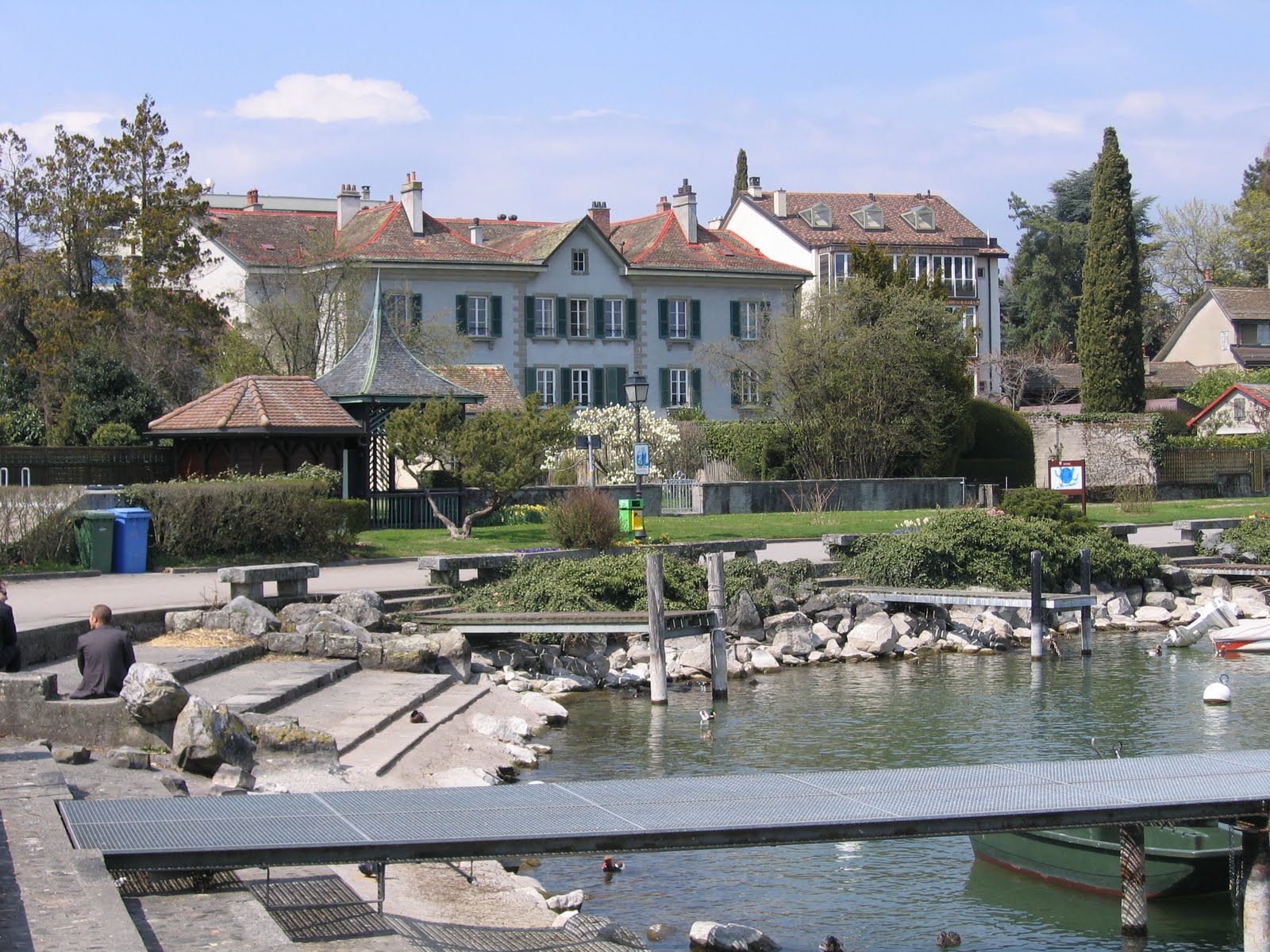
I spent some time yesterday meandering along the lake front while I was visiting the town. There are some nice apartment buildings along the shore.
As might be expected, there were several ducks swimming nearby. But I was quite surprised to see a pair of redheaded ducks among them. So far as I can remember, it's the first time that I've seen them here. I'm not sure whether they are redheads or canvasbacks, or another species entirely. This one seems to have features of both. Redheads and canvasbacks are native to North America and are, at least in the case of redheads, "rare vagrants" to Western Europe. Rare vagrants or not, they are here now. I hope they have residence permits.
I wasn't the only passerby enjoying the view.
There were flowers, including tulips, everywhere, not simply in Independence Park where the major Tulip Festival is held.
The boats at their moorings appear ready to set sail. And the small boats in the distance are part of an afternoon sailing class.
This little sidewalk cafe was well occupied.
I can hardly dare to believe it. But apart from a few stutters and halts, Spring is finally here!
Subscribe to:
Posts (Atom)