Showing posts with label Discoveries. Show all posts

02 July 2012

"Mem'ries ...."

There are few nuisances as frustrating as trying to find something that you absolutely know that you have but that is somehow missing from where you thought it was. Believe me, that is something that happens more often than not as my years climb inexorably higher and "senior moments" become ever more frequent.

Healer Sis, prompted by years of Catholic theology, insists that she has often had success by calling - somewhat informally - on Saint Anthony, the patron saint of lost things, to wit: "Tony, Tony, look around, so that what is lost can be found!"  Because I'm not too sure of how my stock in The Hereafter is perceived, I usually do not call on Saint Anthony but follow what I believe is an old adage: "if you want to find something, look for something else." It more often than not works for me.  Unfortunately, neither "Tony" nor the looking for something else has yet helped me to retrieve the wedding ring I misplaced - or that slipped off my finger unbeknownst to me - in June 2011. But I still hope.

But last summer, I needed to locate my diplomas to complete my faculty file. Employers in Europe like to see facsimiles of the actual "sheepskin," so to speak. I was sure that they were here, but when I had looked everywhere I could think of, I came to the conclusion that I must have included them in the shipment of personal effects that was sent to the US in early 2008. Luckily, that was true of the most important - the highest value diploma academically - which had been framed. That, together with transcripts from the other universities I had attended, were satisfactory to my employer. But I still wondered where the others had gotten to, that is, until a few weeks ago. To prove the adage, I was searching for something else entirely, and eureka! There they were, together with several other papers from my penultimate employer! The pesky things have now been scanned so that if I ever misplace them again, at least I have the facsimiles.

Among the other treasures that I discovered at the same time was the photo below. HWMBO and I were visiting Venice together after he had just spent three weeks with a group, cataloging the condition of Venetian bell towers as part of an Earthwatch "public art" project.
If he looks tired, it's because there were a LOT of bell towers that needed to be located, cleaned off well enough to decipher dates and inscriptions (lots of pigeon droppings were involved), described in detail and rung so that their tones could be recorded. Still, he had a wonderful time. Once his project was finished and I was able to get a few days off to join him there, we both enjoyed our visit to Venice very much. As I recall, the Doge's Palace is to the left in the picture.

Those memories are still quite fresh so I was amazed to see the date on the back of the picture: August 1996! That is 16 years ago. Where on earth did the time go?

More importantly, what has happened to the world in the meantime? That was a comparative Age of Innocence. 

25 May 2012

China Dreams

Yesterday morning, HWMBO left Maryland for his Great Adventure. He will be on a study tour in China for the next few weeks. I am sorry that I am not with him this time. Perhaps another time ...

He should be in Shanghai right now, hopefully getting acclimated and catching a breath or two after the long - LONG - flight from Washington, DC to Shanghai, from which I suspect he is not only feeling quite jet-lagged but also very cramped. HWMBO is a tall man (although we both seem to have shrunk a bit in recent years, in my case, two whole inches!). Scrunching those long legs into airplane economy seats for the duration of the flight was likely not the most comfortable situation for him, but I hope that all went well. Interestingly, he and the other members of the group were offered flight upgrades. He didn't take the option precisely because the flight upgrade cost was double that for the entire tour, which also included the economy fare! I hope that he has not had reason to regret that decision since.

If all goes as scheduled, tomorrow he will tour the city - China's most populous and, according to Wikipedia, the most populous in the world - seeing such sights as the Shanghai Museum, the Oriental Pearl TV Tower, the Yuyuan Garden and the Bund, among many, many others, I am sure.

On Sunday, the group will visit the city of ZhouZhuang, also known as the "Venice of the Orient" because of its canals. They will return to Shanghai to spend one last night and on Monday, they will travel to Xi'an for the next phase of their journey.

To participate in this study tour, HWMBO had to take courses in oriental art at our local community college in Maryland, which sponsors the tour on an annual basis. He is not taking the tour for college credit, but for personal growth - to experience a new culture, albeit one that is very different to any that either of us has had the privilege of experiencing so far.

I look forward to hearing from him about his experiences. Once he has returned and downloaded his photos, I look forward to sharing them here.

27 September 2011

Relativity and Time

The scientific world has been rocked on its heels with the revelation that at nearby CERN, some neutrinos (and I never even realised that such things existed) that whizzed from Rome to Geneva seemingly at a speed faster than light have disproven Einstein's Theory of Relativity, one of the great constants upon which modern physics is based.  Of course, since my understanding of physics borders on nil, I have probably not explained that correctly at all.  In the meantime, the scientists at CERN are waiting - with bated breath, one presumes - to see whether their observations and conclusions can be independently verified.

What will this mean?  Probably not a whole lot to those of us who are in our twilight years - just another example of shifting sands, if proven correct.  Those of my generation and older have seen so many shifting sands that it is difficult to believe in any constant at all.  But this discovery apparently will have major consequences for those who may attempt future long-distance space odysseys, as well as disrupting umpteen theoretical presumptions.  I am perverse enough to hope that it will at least shake up the Scientologists - whose so-called "religion" is based on the science fantasies of L. Ron Hubbard and who have a cult-like grip on their adherents.  But zealots, particularly religious zealots, always find a way to explain away anything that doesn't fit into their notions of the universe.  So that is likely a forlorn hope at best.  Anyway, we'll all see what develops.

What I have discovered in my own situation is that, whatever the scientists at CERN may have discovered and whether their experiments may be validated or not, time does have consequences.  For example, my at first good-looking hourly pay seems to have dwindled substantially when I add in the amount of research and preparation time that I spend for my course.  If I calculate correctly, I am probably earning less than minimum wage!  Still, I have been learning a lot of new things and even some new skills.  If nothing else, I'll probably be able to teach a course in preparing Powerpoint presentations very soon.  It's been fun, although somewhat fatiguing.  So far, the class - somewhat disgruntled because not enough course textbooks were ordered - which has resulted in my having to shift emphases and concepts around, has been friendly enough.  Some actually seem interested, which is always a joy.  Unsurprisingly - based on my experience generally - it is principally my female students who appear the most serious to this point, but we'll see how things play out in the long run. 

Tomorrow is my first official faculty meeting.  Back to the future indeed!

11 August 2011

Les Cascades du Hérisson

While HWMBO was still visiting me in Switzerland, but before our other summer visitors began arriving, we decided to check out a few spots that had been recommended to us for ourselves so that we could give our visitors the "real scoop."  So one day early in June, we headed into the nearby Jura Mountains for a drive into France to visit les Cascades du Hérisson (the waterfalls of the Hérisson river). 

The Hérisson has its source on a high plateau (805 meters = 2,641 feet) in the Jura Mountains between France and Switzerland.  The river then tumbles down a series of slopes for 280 meters (almost 919 feet) in a distance of three kilometers (1.86 miles), forming numerous waterfalls along the way.

When the water is high, the falls are spectacular.  When the water is low, as it was when we visited, the falls themselves are not quite as spectacular and the torrents are mere trickles, but the trail is much less slippery

and one also has time to appreciate the beauty of the other natural scenery that abounds there,

as well as the multi-storied cave systems.


We began with a visit to the visitors' center where we learned about the history of the region, the development of the falls and the industries that once utilized their power,  together with the customs, traditions and legends of the people who have lived there for centuries.  We also viewed a film that showed the falls during the seasons.

We also learned about the various hiking paths.  We could take the entire route, which would last about three hours, or we could break off at any point.  We actually went about three-quarters of the full route.

The site itself has been a listed natural heritage site in France since April 2002 and is also referred to as the "Valley of Seven Waterfalls" for obvious reasons.

We had been warned to wear appropriate footgear (hiking boots or shoes) and to be dressed appropriately.  If the weather is at all damp, the trail can be very slippery.  It is also very steep at points and I was extremely happy to have my walking stick with me.  HWMBO, of course, was too proud to use a walking stick!

We finally stopped at this point,

close to a cave which, according to one of the stories we had been told, had been used by smugglers.

While searching for some of the links that I used in this post this afternoon, I was delighted to discover that a YouTube link from a more recent visit was posted just last week by "drumpiedumpie."  The link gives an idea of what the cascades are like in full spate.  I am much obliged to the poster, so please click on the link and enjoy!

31 May 2011

Visiting Italy's Lake District: Part IIb - Sights in Stresa

Stresa's first appearance in historical documents occurred just before the end of the first millennium, when it existed as a small community of fishermen and peasants.  Despite the natural beauty of the area, survival was fairly difficult for the people living there.  During the Middle Ages, the town was a fiefdom of the lords of Castello and Visconti.  But it was when the Borromeo family - part of the Milanese aristocracy - became its rulers, that the magnificent buildings that have since made Stresa famous were added.  The Borromeos obtained part of the territory in 1441.  By 1653 the entire district was reunited under their rule. Throughout the 16th and 17th centuries, the Borromeos commissioned palaces to be built on the islands of Bella and Madre.  Here is a glimpse of lovely Isola Bella from the Stresa lake promenade.

Stresa passed into Austrian hands in 1719, before coming under the rule of the House of Savoy in 1748.  The town began to achieve its reknown as a tourist destination at the beginning of the 19th century, when glamorous villas such as the Villa Pallavicino and Villa Vignolo were built.  In 1906, the opening of the Simplon Tunnel facilitated widespread international travel from northern and western Europe. Trains on the London-Paris-Milan line began to call at Stresa station, and travellers and writers from all over Europe came to sing the praises of Stresa and Lake Maggiore, spreading their fame far and wide and enticing an ever larger number of people to visit.  Every year, Stresa now welcomes hundreds of thousands of tourists from across the globe.

Now we were in this beautiful spot, visiting one of the lake areas that has inspired so many, especially poets, writers, artists and landscape architects from other parts of Europe.  Guide P led us along the lake promenade, pointing out sights of interest, including fine hotels,

where tourists - like us, although lodged much more expensively - lounged in the Italian sun.

Some used the lake as a backdrop for keepsake wedding photos.

One of our stops was to the Villa Ducale, built in 1770 by Giacomo Filippo Bolongaro after returning to Stresa once having made his fortune in tobacco. At that time the villa's gardens reached as far as the lake shore. When Bolongaro died in 1780, his property was passed on to his granddaughter who was a close friend of the Abbott Antonio Rosmini.  She convinced him to make the villa his official residence.  When she died, the villa was inherited by the Rosmini family and became a prestigious cultural center.  Over the years the villa changed hands many times and became known as the Villa Ducale when it was in the hands of the Duchess of Genoa (part of the Italian Royal Family).  After the Rosmini family reacquired the villa in 1942, it was restored and inaugurated as the International Center for Rosminian Studies in 1966. The villa houses a vast library containing over 100,000 volumes.  It was undergoing reconstruction when we visited and we could not visit the library or even enter the building.

The Duchess of Genoa’s daughter, Margherita, who later became the first Queen of Italy, also used to stay at the Villa.  In 1889, the Margherita pizza, where red tomatoes, green basil, and white cheese represent the colors of the Italian flag, was named after her.

The Villa's once vaunted gardens, now somewhat overgrown, needed some tending

although there were ongoing efforts at watering during our visit. 

Not wanting to be overlooked by their neighbors, the residents of the Villa Ducale constructed a wall, apparently believing, as Robert Frost's neighbors did, that "Good fences make good neighbors," even as Frost ruminated that, "Something there is that does not like a wall ... ."

But we did enjoy our introduction to this beautiful area.

30 May 2011

Visiting Italy's Lake District: Part IIa - More Stresa

And yes, the jet-lagged group had arrived, after having been shuttled from Milan by bus.  Because Stresa's back streets, including the one where the Hotel Fiorentino is located, are so narrow, large tour buses cannot come into town.  So the bus had parked in the lakeside parking lot where I had recently been walking and the weary travellers had to make their way to the hotel on foot.  Fortunately, their luggage was ferried to the hotel in a tiny pick-up.

At the hotel, I met HWMBO, who had arrived safe and sound with the group from Milan, despite a harrowing series of connecting flights from the US.  It was the first time that we had seen each other in person, other than virtually via Skype, since February, so the welcome was warm!

HWMBO then introduced me to the other group members.  Including me, there were 20 of us.  There I also met our guides.  Guide K was a young German woman married to an Italian and who lives in Umbria.  She had accompanied the group from Milan.  Guide P was Swiss, originally from Zug in Switzerland, but who now resides in Minnesota in the USA.  He was to assist K, who was an experienced group guide, in order to learn the ropes because this was his first season with the company, European Walking Tours, contracted by Road Scholar for the visit to the Lake District.  Both guides would accompany us everywhere we went.  However, we would also have local guides who knew the regions well.  They were scheduled to give field lectures during our walks to acquaint us with the sights that we were visiting.

The Bolongaros deftly assigned room numbers and there was a lot of bustle and hustle as the travellers checked in, collected their baggage and left to explore their rooms and freshen up.  We reconvened at 12:30 pm for an alfresco lunch on the hotel's terrace and some tentative and exploratory conversations, as people do when they are getting to know one another.  After lunch, Guide K made the welcome announcement that everyone could rest for a while, if they wanted.  We would meet our local guide at 4:30 pm for a walk through Stresa.  And thus it was that we met Guide P, an effervescent Italian woman who was very knowledgeable about and proud of the Lake Maggiore region.

At first, we retaced my steps from the morning, stopping in front of the Stresa city hall

where the flags of Italy, the European Union, Piedmont (Stresa's region in Italy), and Stresa were displayed.

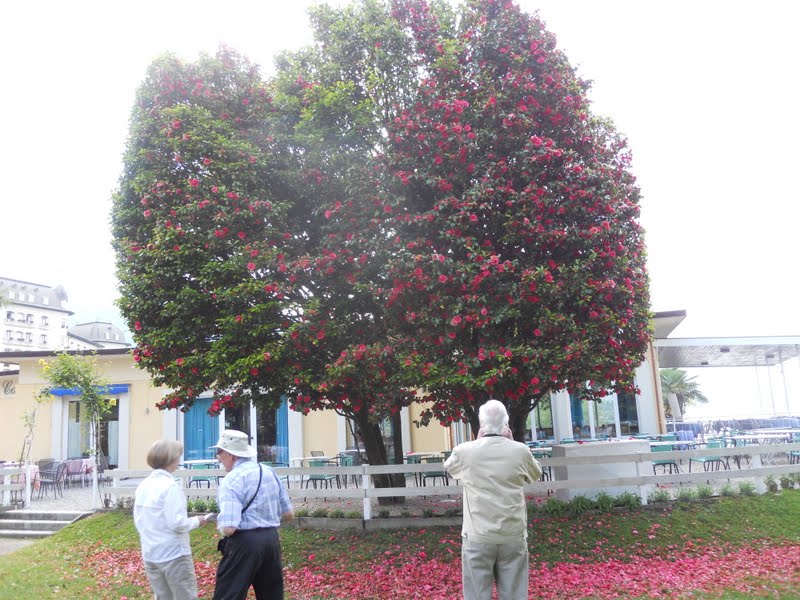
Then we strolled along the lakeside, stopping for photos of some of the trees that were still in bloom,

with occasional close-ups.

Visiting Italy's Lake District: Part II - Morning in Stresa

Well, I had arrived in Stresa safe and sound and successfully located the hotel - Hotel Fiorentino - tucked into one of the streets leading off Stresa's Piazza Cadorna.

The Hotel Fiorentino is a cosy restaurant hotel, owned and operated by the Bolongaro family since 1958. 

Hostess Carla, whose husband and son are the chef and sous-chef respectively, and who takes pride in looking after her guests personally, greeted me at the door.  Taking pity on my halting Italian, she asked me (in English) whether I was one of "the American group."  When I responded that I was, she led me to the dark mahoghany reception desk, obviously an antique, and checked the register.  I told her who I was and that my husband would be arriving from Milan with the rest of the group.   Here is a photo of Carla with her granddaughter.

I had not expected to be able to check in at my early arrival hour.  Because my early morning train had left Geneva at 5:45 am, it was still not quite 9:00 am in Stresa.  I had intended merely to request whether I could leave my suitcase, backpack and various other encumbrances at the hotel, and perhaps wash up, etc., until it was time for check-in.  To my great relief, however, Carla announced that our room was ready and that I could check in right away.  So I did.  After I had seen my room, unpacked my suitcase for our four-night stay, rid myself of everything superfluous and washed up, I felt greatly refreshed and ready to explore.  The group was not scheduled to arrive before 11:00 am.  Because the hotel breakfast period had finished by then, I headed for the piazza to find a cafe that was still serving breakfast.

There I had my first Italian cappuccino of this visit to Italy, together with the Italian version of a croissant.  The croissant was dusted with sugar and had a jam filling, which I had not expected.  But it was delicious and the piazza was a pleasant place to sit.  The coffee and croissant really hit the spot because I had not eaten at all since rising.  Most of all, I liked the sentiment expressed in the froth!

Once I had gotten my bearings from a small map that I had picked up at the hotel, I headed towards the lake, Lago Maggiore, and the main pier in Stresa, which is also where the Tourist Office is located - right underneath the Italian flag.

Lake Maggiore is Italy's second largest lake; Lake Garda, which we did not visit on this trip, is larger in surface area.  But Lake Maggiore is the longest lake.  I spent some time strolling along the lakeside where there are several sculptures

and photographing Stresa from the lakeside.

Then I wandered back into town.  Although the day was hazy, the weather was very pleasant and it was interesting just to browse through the tiny winding back streets, chock full of interesting byways,

where I noticed several Pinocchio wooden doll souvenirs displayed in shop windows. 

Because it was getting time to meet up with HWMBO and make the acquaintance of our guides and the rest of the group, I then headed back to the hotel.

28 May 2011

Visiting Italy's Lake District: Part I - Travelling from Switzerland

Nearly a month ago - and no, I can't believe that it's been that long - I managed to get myself out of bed at around 3:30 am to finish my packing, close up the apartment and trudge to the local train station.  Rising that early was a true challenge!  I even managed to carry my wheeled medium-size suitcase for a time so that its noise wouldn't disturb my neighbors' sleep.  My backpack, containing among other things, my telescoping walking sticks, was slung on my back.  Fortunately for me, rain that had earlier been forecast for that date did not materialize and my short trek to the station passed without incident.  Unsurprisingly, given the hour, I was the only person waiting at the station, which looked pretty dark and deserted.

My suitcase looked pretty lonely in the passenger waiting area by the track, well lit in the circumstances.

The local train arrived on time at 5:00 am - this is Switzerland, after all - and took me into Geneva's Cornavin Station, a trip lasting about nine minutes because the train made no other stops.  From there, I made my way to the track where I was to board the Eurocity Train à Grande Vitesse (TGV) - high speed train - to Stresa, in Italy.  In Stresa, I was to join HWMBO and a group of individuals I had never met before.  We were part of a walking tour group sponsored by an organization that used to be known as Elderhostel, which has since 1975 provided lifelong learning opportunities at a significant value for older adults.  The organization has now changed its name to Road Scholar, a not-so-subtle play on "Rhodes Scholar."  This was to be my first "Road Scholar experience" although HWMBO was a veteran, having travelled solo on a cruise through Alaska's Inland Passage in 2009, a voyage similar to that described here.

When we had planned our travel in the December-January timeframe, while I was still in the US, we had discussed different possibilities.  One had been for me to drive over to the meeting place in Italy.  From there, we had planned that we could return to Switzerland after the tour through the Italian-speaking Swiss cantons, which I have never really visited during my time here.  But we rethought that idea when we realized that, considering the price of gas, the timing and logistics of getting together with the group at Milan's Malpensa Airport, and the expense of parking, a different course of action was warranted.

After informing myself about discount plane fares - none appeared to be available for travel to Milan during the period I was interested in - and discussing train fare possibilities with the Swiss Railways (SBB-CFF), I discovered that travelling by train was not only the most convenient alternative.  It would also be the least expensive.  The same train that travels from Geneva to Milan also makes a scheduled stop in Stresa, which is where the group was scheduled to be lodged for four nights and to begin the tour.  Meeting the group in Stresa would save the hassle of travelling all the way to Milan and then trying frantically to get out to the airport to meet the bus, scheduled to depart at 10:00 am, that would take the group - back to Stresa.  Best of all, because I was purchasing my ticket well in advance, I was eligible for a SuperFare of CHF 25!   The Superfare is excellent value.  The down side is that the ticket is only good for the train scheduled and on the date scheduled.  If one misses that train, no refunds are available. 

After discussing the train possibilities with HWMBO, it was decided that I would plan to meet him in Stresa with the group.  After the tour, we were scheduled to be dropped off at a hotel near Malpensa Airport - a night's lodging there was included in the tour price.  After having had a good night's rest after the tour, we would take the shuttle bus into Milano Centrale station and board the Eurocity train for Geneva to return here.  As a Swiss resident, I also have a half-price train subscription (demi-tarif abonnement, known colloquially as the "demi-abo"), which allows me to travel anywhere on Swiss trains at half-price for the duration.  HWMBO is not a Swiss resident and cannot use a demi-abo but was eligible for the Superfare!  But there was only one SuperFare ticket available for our train.  So, the return trip for both of us from Milan cost CHF 88 (CHF 35 for him with the SuperFare and CHF 53 for me with the demi-abo).

The first part of my early morning train ride was so dark that I couldn't see outside.  But gradually, dawn entered the mountains and the day began so that I was able to take a few photos of the Swiss countryside from the train.  Many did not turn out.  Those that did were primarily vineyards - terraced

and otherwise - in the Valais.


My train made brief stops in Lausanne, Montreux, Sion, Brig and the Italian city of Domodossola before arriving at Stresa.  There I hopped in a taxi for the very short trip to the hotel.

The long-awaited trip had begun! 

22 March 2011

Biking Woes

In the grand scheme of things with nuclear reactors breaking apart and all the human misery in Japan and with mad dictatorial tyrants being stymied from killing their own people wholesale - momentarily at least - my little biking woes are certainly not important.  Nonetheless, they are the ones that are impacting me most currently and directly. 

Having managed to replace my bicycle seat - and yes, it's working beautifully so far - I thought that my biking excursions would no longer pose a problem.  I was too optimistic.  This morning, as I approached Céligny-Gare, about 5k from home, I felt an ominous bumpety-bump.


Sure enough, my rear tire was rapidly going flat.  There was nothing to do but to dismount and walk the bike home, hoping that the tire wouldn't wear out on the way.  I guess it was time.  Both the tire and the inner tube, which is the likely culprit, have served me well for 20 years.  But now the challenge is how to change a tire.

Having learned from my last experience, I checked what expertise Google could offer me.  Sure enough, first there was this advice from Wikihow.  Then, there was this exellent video from Expert Village.  Unfortunately, the only problem with that video was that the demonstrator was changing the front tire.  Rear tires are somewhat more complicated.   Google didn't let me down.  This little video from Ehow showed me how to do remove the rear wheel.  Then I found another comprehensive description of changing a bicycle tire, this time without using the levers that all the other instructions had provided for.

I had the choice of repairing my inner tube or replacing it.  Considering its age, I decided to replace it.  The information that I found stressed that I had to use the right size inner tube, which meant that I had to measure my wheel and tire width.  Then there was a quick trip to my trusty Jumbo store to pick up the new inner tube, which set me back CHF 5.95.  That amount fell within the price ranges that I had seen on the Web so it seemed reasonable.  The only thing that I am worried about is whether I have the right kind of valve.  I never realized that bicycle inner tubes were quite as complex as they seem to be.

After I've run through my video tutorials and other information one more time tomorrow morning, I'll try to change the tire.  If I'm successful, you'll see it here!  If I'm not ... let's just say that I probably won't be trumpeting my failure.

19 March 2011

Back in the "Saddle" Again

Thursday morning, Friend J and I went grocery shopping together - her husband is currently on a work trip to the Far East - so I missed my early morning bike ride.  Upon returning from shopping and thinking that I might still take a quick jaunt, I was dismayed to discover that my bicycle seat (selle in French, which also means "saddle") was finally showing the wear and tear of the past 20 years.  Of course, my having taken a couple tumbles in the past couple weeks - more embarrassing and undignified than harmful - hadn't helped.


The damage was irreparable.  Unless I was willing to endure sharp nails in a very sensitive part of my anatomy as well as tear my bicycle shorts to shreds, it meant that I couldn't ride my bicycle at all until I had a new bicycle seat.

So I set off for my neighboring Jumbo DIY store, because in addition to all sorts of DIY items, it stocks bicycles and cycling gear at reasonable prices - reasonable for Switzerland, that is.  The prices would most likely seem hair-raising elsewhere.


Sure enough, I was able to find a new bicycle seat.  In the 20 years since I've last been in the market for one, I didn't realize what changes had occurred.  There are now specialized seats for women, as well as men, children and adolescents - racing seats, mountain bike seats, seats with gel padding (always nice to have extra, IMO), etc.  The choices were enough to make my head spin.  But I finally settled on a reasonably-priced women's 20 per cent gel seat that will serve for my everyday riding needs.  Arriving home with my new seat, however, I realized that I had absolutely no idea how to remove the old one and attach the new one.

I described my dilemma to HWMBO later on during one of our Skype conversations.  Usually, in such a situation, I would merely ask him to do it for me.  But since he is 3,000+ miles away right now, I needed to go to Plan B.  As always, he provided me with a suggestion by googling "how to change a bike seat" - with this result.   Unfortunately, this description was sparse, to say the least.  It was also not helpful because it instructed me to look for a nut and a bolt and to use a wrench.  Try as I might, I could find no evidence of a nut or bolt or anything for which a wrench would be appropriate.  On the same website, however, I found a much more helpful set of instructions, complete with video, under "How to Install a Bicycle Seat."

But now, the problem was that I needed a special tool.  I sifted through the many tools in HWMBO's trusty tool bucket.  The most promising were some of the special "keys" (Friend J calls them "Allen keys") that I have in various sizes courtesy of my many IKEA purchases.  As things turned out, however, none of the sizes that I had worked.  This meant another trip to Jumbo.


Once at Jumbo, I asked for help - reasonably it seemed to me - from the young man in charge of bicycles.   He determined that I was not worthy of his attention once he ascertained that a) I didn't want to purchase a new bicycle or b) I was not interested in having my bicycle repaired at a cost of CHF 70 per hour.  And yes, you read that figure correctly!  He merely waved me back to the tool department, saying something about a "machin 6" (roughly "thing-a-ma-jig 6") that should solve my problem.  So I hied myself to the tool department where I was quite simply and thoroughly lost before a seemingly endless wall of tools.  Fortunately, there was a gentleman there who looked very much as if he knew what was what.  So I explained my predicament to him.  He kindly pondered the situation, then chose a tool that I never would have selected in a million years.  He even walked back to the bicycle department to show me how to use it.


I have no idea what the "machin's" real name is.  Even the description on its tag (clef = key) hasn't enlightened me.  But it was quite reasonably-priced.  Best of all, it did the trick perfectly.  I had a very comfortable ride yesterday.  And I look forward to many more!

14 March 2011

Celebrating New Life

Last week, I visited a good friend in Geneva, Sweet Momma I, who had just given birth to her third daughter, Princess C.  Princess C and her older sisters, Princesses L and E, are all beautiful, healthy and intelligent children.  They are very much loved by their proud parents and other family members.


But it took a lot of effort, patience and modern technology - for them to be here at all.

All three girls are happy results of in vitro fertilization (IVF), where eggs are removed from the woman's ovaries, fertilized by sperm in a fluid medium and then transferred back to the uterus so that the fertilized egg can grow and develop normally, hopefully to become a living baby.  This technique first succeeded in 1978, with the birth of Louise Brown, the first "test tube baby."  Since then, IVF has enabled couples to become parents who would otherwise have remained childless unless they were able to adopt.  In 2010, Dr. Robert G. Edwards, who, working with others, successfully pioneered the treatment, was awarded the Nobel Prize in Physiology or Medicine. 

So this was not only a visit to a special friend, but also a tribute to her steadfast determination and perseverance.   All three girls were born in this tranquil clinic.


I visited with two other friends and former colleagues.  Sweet Momma E has a daughter of her own, just a couple weeks younger than my very special Prince Tyger.


While Sweet Friend H does not have children of her own, as one of nine siblings, she is an aunt who is much in demand..  It is clear that both are accustomed to babies!


Best of all, Sweet Momma I also made it through this delivery well, was in fine form and delighted to welcome her visitors.


Having a third daughter necessitated the purchase of a new family car: a VW Sharan.  Their former vehicle was simply not large enough for the three carseats that three precious little girls - aged almost 4, 1.5 and less than one month respectively, require.