Today, Swissinfo has an interesting report about Brother Thomas Fässler, a scholar who, in order to receive his degree in theology, is writing his thesis on the history of the Benedictine Abbey of Einsiedeln, from 1934 to the present. In the course of his research in the Abbey archives, Brother Fässler has discovered a number of interesting narratives. While not necessarily germane to the subject of his thesis, he believes that it would be a shame if some of the stories he has found in his research were not told.
One such story is that Fahr Abbey, a Benedictine nunnery that is associated with the monastery at Einsiedeln, sheltered Jewish women refugees during the Holocaust. To his surprise, he “stumbled upon the story of how Convent Fahr took in refugees during the Second World War – including Jewish women.”
His was not the only surprise. The Archives of Contemporary History at the Federal Institute of Technology in Zurich (ETHZ), which has files on Jewish Holocaust refugees who found shelter in Switzerland, has no references whatsoever to such a role for the convent. Brother Fässler speculates that the nuns, who were in a strictly cloistered order, probably knew nothing of the events happening outside the convent walls. The refugees lived apart from the nuns and were looked after by members of the Swiss women’s aid service. The convent was responsible for room and board, so the meals came from the convent kitchen.
“The only living witness, 93-year-old Sister Regula Wolf, was the nun who had the most contact with the refugees. She was the liaison between the refugees, the women’s aid service representative and the convent,” explained Fässler. Most of the time, the refugees were on their own. To keep busy, they occupied themselves with handicrafts. While the archives show that all refugees had to leave in the spring of 1944 because the convent then opened a school for female farmers, it is unclear what happened to the refugees after that period.
There are many untold stories from the Holocaust Era, where ordinary people performed extraordinary deeds of courage simply because they were the right things to do. It appears in this case that the religion of the refugees was literally of no importance either to the nuns or to the Swiss women (and men) who aided them, nor were the events that made them refugees. It was merely the fact that they sought refuge that counted and these people believed that they should assist. It was as simple, and as profound, as that.
Where I live in Switzerland, France is literally within a 5-10 minute drive. There are still some concrete bunkers that we see when we make the drive, mere curiosities now, serving as sinister mementos of perhaps the darkest era of recorded history - an era that actually occurred during my own lifetime. Because of the proximity to France, particularly to Vichy France where the Nazi Regime did not officially occupy the area until August 1944, the Swiss borders were somewhat "porous," and literally provided lifelines to persecuted individuals. Yes, some were refused entry. But others were not.
There have been many righteous screeds directed towards Switzerland, towards France - and towards Europe in general - especially from those who were comfortably far from any battlefronts at the time - for unpardonable actions and omissions of Europeans during that horrific era when some six million persons, preponderantly Jewish, died because fascist ideologues and zealots held sway. There has, however, been too little illustration of the profiles in courage that also existed, even if these profiles in courage were somehow unwitting. So long as their actions resulted in lives being saved, even if only for a time, their examples should be publicized and honored. It was the right thing to do then. It is the right thing to do now.
Sagittarius (22 November - 21 December) is a fire sign ruled by the planet Jupiter and represented by a Centaur wielding a bow and arrow. Sagittarians tend to have dreams that are very dear to their hearts and are the bases for their motivations. Their freedom to dream is essential to their well-being. Among many other things, they love children, animals and travel.
26 May 2010
24 May 2010
Whit Monday and the "Transhumance"
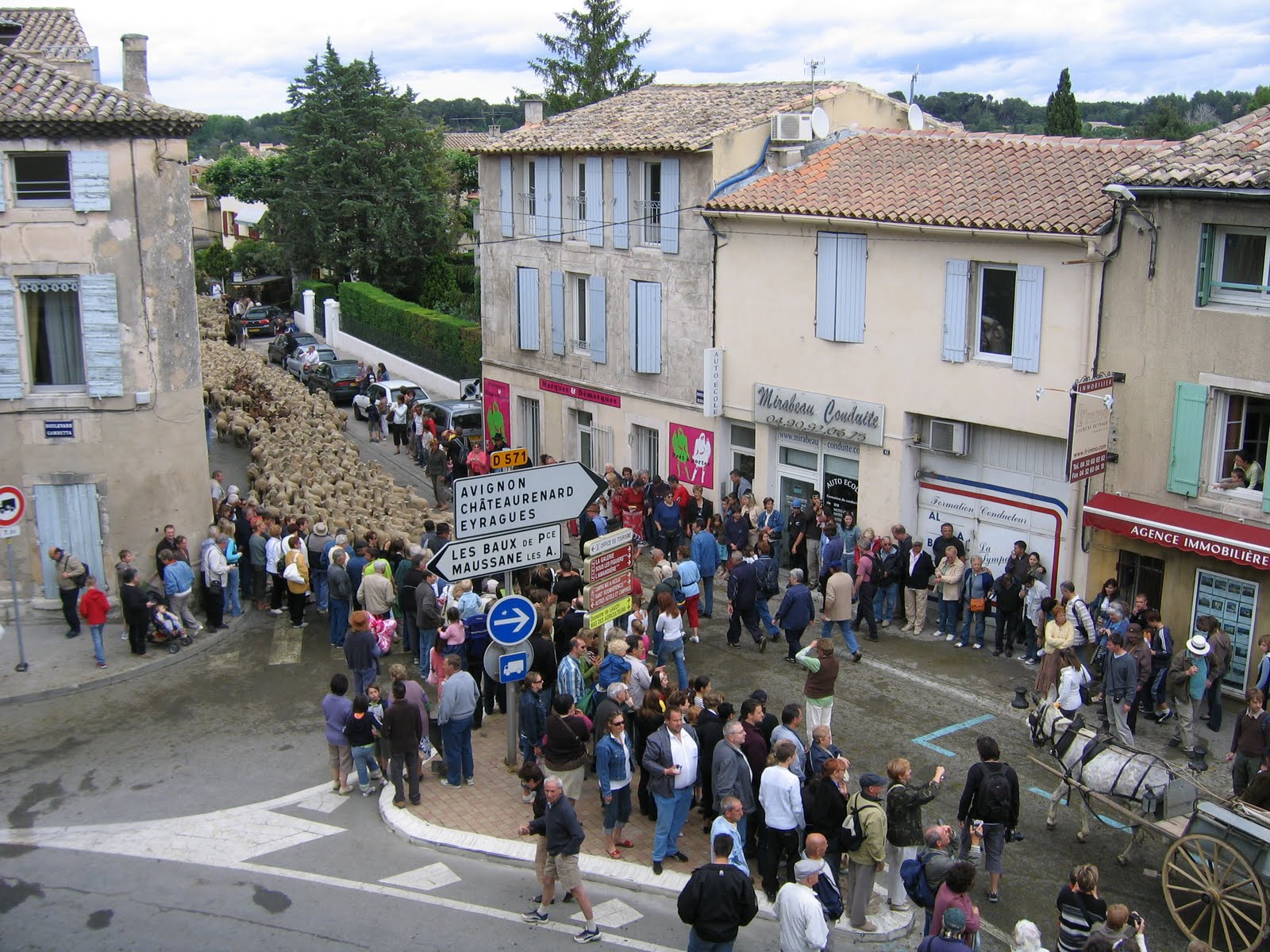
In addition to memories of good food, good wine and good friends, thinking about the 2007 reunion in Saint Remy-de-Provence also brings back memories of the "Fête de la Transhumance " that is traditionally held there on Whit Monday (aka Pentecost Monday). "Transhumance" in its most general sense refers to seasonal movements of livestock, generally from lower to higher pastures in summer and from higher pastures to the plains in winter.
Saint Remy-de-Provence is situated in the rocky, hilly region of southern France known as the Alpilles. To celebrate the Transhumance, thousands of sheep are trucked to Saint-Remy (they used to be herded on foot and the walk could take up to ten days), together with goats, donkeys, shepherds and sheep dogs. There, the whole lot parades twice around the town center in the morning and then officially moves up to higher pastures. In the afternoon, there is a demonstration of how the sheep dogs work, a community barbecue and traditional dancing. It goes without saying that lots of wine and other spirits also flow there.
While I wasn't able to stay for the afternoon festivities, needing to hie myself back to Geneva and my workplace the next day, I was able to see the parade. Our group had a wonderful vantage point, being ensconced in an apartment right at the point where the flocks enter and leave the village. Here is the "before" view.
Hark, are those sheep that I see?
Yes, I definitely see a few sheep there.
Indeed, I see quite a few sheep there.
Wow, glad that I'm up high - just in case those sheep turn surly.
They just keep coming ... and coming - a veritable ocean of fleece.
Here they're coming round, just about to turn for their second loop.
Ah now, I begin to understand how they can tell which sheep belong to whom. There are markings on their backs.
These gals, dressed in traditional costume, don't seem too concerned about maintaining a quick pace.
And there they go. Off to the afternoon's festivities and then to their summer pastures.
It doesn't take long at all. The village center isn't all that large. But the parade is great fun to see.
23 May 2010
Whitsunday
Today is Whitsunday (aka Pentecost) and, together with tomorrow, Whit Monday, serves as one of the last opportunities in the academic year for a long weekend because Whit Monday is also a holiday throughout most of Europe.
It is somewhat ironic that European countries that pride themselves on being primarily secular - and long may they continue to do so - celebrate as "holidays" so many festivals that form part of the liturgical calendar. For example, ten days ago Ascension Thursday was also celebrated as a holiday here, with many taking leave on the following Friday in order to have a four-day weekend. Yet, in my own country, where a certain part of the population literally becomes incensed when some do not want to say a "Pledge of Allegiance" including the phrase "under God," the only two liturgical festivals that are celebrated - and with much commercial fanfare to boot - are Christmas and Easter. In fact, I cannot think of any other country where I have lived in which citizens routinely make a pledge of allegiance at all. It is also true that most commercial establishments in Europe, apart from restaurants, cafes and small shops, still close on Sundays. Are we to infer that Europeans are, in reality, more "godly" than Americans!?
The question is meant rhetorically. It is not something that I wish to discuss here. At all. I doubt that a meeting of minds would result. But what I most wanted to share today are my memories from a few years back - Whitsunday of 2007, in fact - when a group of alums from one of my grad schools and I reunited for the long weekend just outside the charming French village of Saint-Rémy-de-Provence. Time was spent in visiting, catching up, meeting new friends, sightseeing, but mostly in enjoying the beautiful setting. Best of all, the Whitsun activities included a cooking lesson with a cordon bleu chef. After preparing the meal, we enjoyed it in an alfresco setting.
We cooks not only set the table and prepared the meal, we also served the food. In this case, it's the appetizers.
And here we are, ready to make way for the ravenous horde. This table will never look the same.
After the appetizer, the chefs had to scamper back to the kitchen to help put the finishing touches on the main course.
The ravenous horde was most appreciative. Their appreciation was heartily assisted by good wine, flowing a-plenty, and bouts of riotous laughter.
And then the desserts - simply divine!
If you can believe it, after all that, some of us were still up for a visit to the site of the former asylum, now a museum and art gallery, where Dutch painter Vincent Van Gogh spent one of the most difficult yet artistically prolific years of his life - after cutting off his own ear. Here is one of the areas that Van Gogh found especially restful and soothing. It was almost too restful for some of us, after all the excellent food and wine!
All in all, however, it was a most satisfactory day!
22 May 2010
Le vin, le soleil et le beau temps
Today was one of those days when everything comes together, when the weather is no less than sublime. As such, it was a perfect day for the Caves Ouvertes Vaudoises (Open Wine Cellars in Vaud) for 2010. This is the first year that some 300 wine producers in the canton of Vaud have all opened their cellars at the same time. Visitors can visit the Appellation d’origine contrôlée (AOC) (controlled designation of origin) area(s) of their choice and taste what the vintners have on offer. The AOC in French-speaking Switzerland works in much the same way as it does in France.
Certainly, the idea is to get people into the open air and into the cellars to taste, and purchase, the excellent local wines. But it is also a social occasion for the whole family to enjoy the countryside together, especially when the day is as glorious as today was. Free shuttle buses ran from the train depots up into the rolling countryside along Lake Geneva in an effort to encourage people to leave their cars at home.
Since three of the participating wine producers were actually within walking distance, I took the opportunity to see what my neighbors were doing. Each of the three had people coming and going, several with children happily in tow.
Our lake microclimate allows palm trees to grow, even to flourish, here. Reminder: this IS Switzerland.
One of the caves had special entertainment. A local sculptor was giving a demonstration of his skills with shaping wood. Fittingly, his subject was a wine bottle.
Exciting for young and not-so-young alike, a helicopter was making short sweeps of this scenic area, with passengers lining up at CHF 50 a pop to see the sights.
This particular wine producer tends the grapes in "my" vineyard.
There is a friendly rivalry next door, with parasols set up in the courtyard.
Even the old wine presses can be recycled.
And a good time was had by all.
19 May 2010
Keeping the circuses going
"The public have an insatiable curiosity to know everything. Except what is worth knowing. Journalism, conscious of this, and having tradesman-like habits, supplies their demands." (emphasis mine)
The article entitled "Would Bloggers Have Cracked Chandra's Case?" looks at a new book, "Finding Chandra," that discusses the number one summer news story in the US in 2001 - the disappearance of a 24-year-old intern, Chandra Levy, who, as it happened, was also having an affair with a US Congressman, Gary Condit. The disappearance caused a media frenzy that obscured what actually was happening, did not advance the investigation or solve the mystery, and smeared a politician whose behavior was certainly unethical and unsavory, but hardly criminal. The MSM so misreported the facts and misrepresented the truth that it was not until May 2009 that Ms Levy's remains were found, near a place where her computer had clearly indicated that she was planning to go - based on searches for jogging paths - and that a suspect in other similar assaults finally confessed to hers.
Blame does not fall only on the MSM. There were serious, even shocking, blunders by the police, who failed to retrieve security-camera footage showing Levy's final departure from home and who somehow were unaware of a pattern of similar attacks on other female joggers. But the press corps failed to ask smart questions, instead "jockeying for scoops concerning the most intriguing suspect: congressman Gary Condit," whether those scoops represented the truth or not.
In the final analysis, anyone who followed only the US MSM would have been hard pressed to learn that anything else was happening in the world at the time. As many of us remember all too well, however, the summer of 2001 was a time when alarming pieces were being published elsewhere about fanatically zealous religious groups that were determined to attack within the US. It was a time when responsible counterterrorism experts such as Richard Clarke were trying desperately to get attention from feckless, lazy and incompetent leaders who had their own ideological agendas in mind even then. As a result, that summer culminated, once and for all, in the worst terrorist attacks ever on US soil: 9-11 and the horrible aftermath. The reverberations and consequences from those deliberate omissions and failures to report are still being felt and will continue to be for some time to come. Tragically.
While my heart literally aches at all the media-manufactured frenzy about this particular story, which is representative of too many silly or sordid tempests in a teapot which perform the same distractive function as did ancient Roman circuses, I take heart that one journalist believes that she has learned a lesson. I hope that she has. I also thank her for pointing out the site Web Sleuths, which will henceforth become one of my own sources. Unfortunately, too many other journalists have learned nothing. They will continue to follow the same pack mentality and post the same distorted stories in an effort to achieve ratings or notoriety.
We are all the poorer for that. And our so-called "free press" will remain a myth.
---Oscar Wilde 1854-1900
**********
There is a recent article in Newsweek magazine (US) that is nearly ten years overdue. When I read it this morning, I could only shake my head and feel so infinitely sad that I nearly wept at how the wondrous and wonderful idea of a "free press" in my country has been so subverted that it keeps "the public" distracted from real issues by sideshows, no matter how tragic, silly or entertaining, so that they aren't paying attention to what is "worth knowing." The piece describes, at long last, one example where one journalist in the US "Mainstream Media" ("MSM") has had an epiphany. Will it become perhaps the first tentative step for other MSM journalists to have theirs and finally to begin doing their jobs, to investigate the facts of a story rather than the "spin" or what passes as popular wisdom? Or will this piece, like so many others of its kind, simply sink into oblivion? At least, it's actually been reported in a MSM publication.The article entitled "Would Bloggers Have Cracked Chandra's Case?" looks at a new book, "Finding Chandra," that discusses the number one summer news story in the US in 2001 - the disappearance of a 24-year-old intern, Chandra Levy, who, as it happened, was also having an affair with a US Congressman, Gary Condit. The disappearance caused a media frenzy that obscured what actually was happening, did not advance the investigation or solve the mystery, and smeared a politician whose behavior was certainly unethical and unsavory, but hardly criminal. The MSM so misreported the facts and misrepresented the truth that it was not until May 2009 that Ms Levy's remains were found, near a place where her computer had clearly indicated that she was planning to go - based on searches for jogging paths - and that a suspect in other similar assaults finally confessed to hers.
Blame does not fall only on the MSM. There were serious, even shocking, blunders by the police, who failed to retrieve security-camera footage showing Levy's final departure from home and who somehow were unaware of a pattern of similar attacks on other female joggers. But the press corps failed to ask smart questions, instead "jockeying for scoops concerning the most intriguing suspect: congressman Gary Condit," whether those scoops represented the truth or not.
In the final analysis, anyone who followed only the US MSM would have been hard pressed to learn that anything else was happening in the world at the time. As many of us remember all too well, however, the summer of 2001 was a time when alarming pieces were being published elsewhere about fanatically zealous religious groups that were determined to attack within the US. It was a time when responsible counterterrorism experts such as Richard Clarke were trying desperately to get attention from feckless, lazy and incompetent leaders who had their own ideological agendas in mind even then. As a result, that summer culminated, once and for all, in the worst terrorist attacks ever on US soil: 9-11 and the horrible aftermath. The reverberations and consequences from those deliberate omissions and failures to report are still being felt and will continue to be for some time to come. Tragically.
While my heart literally aches at all the media-manufactured frenzy about this particular story, which is representative of too many silly or sordid tempests in a teapot which perform the same distractive function as did ancient Roman circuses, I take heart that one journalist believes that she has learned a lesson. I hope that she has. I also thank her for pointing out the site Web Sleuths, which will henceforth become one of my own sources. Unfortunately, too many other journalists have learned nothing. They will continue to follow the same pack mentality and post the same distorted stories in an effort to achieve ratings or notoriety.
We are all the poorer for that. And our so-called "free press" will remain a myth.
18 May 2010
Here comes the Sun!
I hope that I haven't jinxed everything by using the S-word. But today, I woke up to it. What a strangely wonderful feeling it was after days and days ... and days ... of cloudy skies, wind and rain! According to the paper, we should have more sunny days, at least for the rest of the week. What a lift to the spirits! It's like finally coming out of a dark tunnel.
Temperatures are still cooler than usual for this time of year. Personally, I'm not complaining. Having been raised in a northern climate, I prefer cool to HOT. But it's apparently wreaking small havoc on some of the wildlife, specifically the birds. It's awfully cool for new nestlings. Perhaps even worse, the insects aren't hatching as they should so that the adult birds find foraging for food more difficult.
Of course, I am just as happy not to see lots of insects, even though insects have their place in the grand scheme of things. But how nice it is finally to see the colors of May! Even the trains seem to rush by with panache.
And how I love the romantic wisteria blossoms!
If I wake to sunshine again tomorrow, I will begin to believe!
17 May 2010
Bless the beasts . . .
In an effort to assist rare and endangered species of animals and plants that are only categorized as such because of man's influence on their environment, the Swiss have created foundations specifically to promote the genetic heritage of those that are native to Switzerland. One such, ProSpecie Rara, was created to safeguard the diversity of plants cultivated for crops and animals raised or used on farms.
Some success stories recently reported have dealt with poultry, sheep, goats and even one horse breed. The poultry group, for example, includes chickens known as "la barbue d'Appenzell" ("the bearded Appenzeller"), which comes from the Swiss region of Appenzell. Here they are generally black, with a tufted crest on top with two hornlike little red flaps. Their feathers are long and they are actually able to fly, preferring to roost in trees when possible. They are more like wild birds than are ordinary domesticated chickens, but are good layers. Unfortunately, the eggshells are so hard that their chicks are occasionally unable to break through and, instead, smother inside. The Foundation has managed to create a genetic reserve in order to ensure their survival.
Included among the goats is a species called the "chèvre bottée" (booted goat). The breed originated in the Swiss Oberland, are very much at home on steep slopes and are also known by the German name "Stiefelgeiss." They are able to find nourishment in brush and weeds to the extent that small herds of them have been used to clear areas along the mountainous railroad lines more efficiently than can be done using men and machines.
There are two breeds of sheep among the Foundation's success stories. First, there is the "rouquin du Valais," also known as the "roux du Valais," a rusty-coated sheep with long horns curled behind its ears which comes from the Swiss canton of the same name, the Valais. It has had to prove hardy. Many breeds related to it no longer exist. It has only survived because it was specifically integrated into a rehabilitation project at the beginning of the 1980s. Like the booted goat, it can also be used for weed control since it likes to graze on weeds.
The other breed is the "mouton de l'Oberland Grison," small, agile and hardy. These sheep are similar to the Tavet sheep which dated from the Stone Age, but which no longer survives. They are also horned sheep. Because their numbers are so few, they are still classified as "scarce.
While it is certainly not the last animal that has been helped by the efforts of ProSpecieRara, the last that I will discuss today is the horse. Of course! The "cheval des Franches-Montagnes," from the Franches-Montagnes district of the Swiss Jura, is the only horse breed that originated in Switzerland. Today's horses are the result of cross-breeding of indigenous Swiss mares with stallions from other European countries, most notably France. While the Franches-Montagnes is primarily a draft horse, it is also versatile emough to be used for all styles of riding and has a gentle disposition. It's often used in the sport of "attelage" (horse-drawn vehicles), a video of which can be seen here. The Swiss Army also still uses it for certain tasks. But its numbers are diminishing.
Bravo to ProSpecieRara for its efforts! May those efforts continue to bear the fruits of diversity.
Subscribe to:
Posts (Atom)