Since Friday, my village has been hosting the 33rd Giron de la Dôle, a gathering together of 12 choral groups, approximately 400 singers, from the district of Nyon. Events have included concerts, aperitifs, meals and dances. Today the groups also paraded through the town center. The weather has not been at all cooperative these days with wind and rain grimly whipping up waves on the lake. The events have been well-attended nonetheless.
Because rainy weather was predicted, protective measures were taken. Tents were erected so that meals and some events that would otherwise have been held outdoors could be hosted on schedule no matter what happened.
People didn't really seem to mind. Good music magically brings out good spirits.
Some events had already been scheduled for indoor venues, such as the château and the Protestant Temple.
This particular youth group, getting ready to assemble for the parade, was dressed in peasant style.
The little parade had a little lead car - red, of course - a good Swiss color.
The uniforms of the first marching band were also red.
The first choral group sang a medley of hymns in front of the impromptu reviewing stand before continuing.
Then the full youth group marched by, enjoying themselves in spite of the dampness, and waving to an appreciative audience whose apartment windows provided views of the festivities.
This group was dressed in traditional Swiss festival costume, although the umbrellas aren't usually part of the costume.
Then came the second marching band, this one uniformed in blue. I got a kick out of a couple marchers who managed to use their digital cameras to get shots of themselves playing, but my reactions were not quick enough to catch them in the act..
There were several other groups that participated in the little parade, but the photos I've posted give an idea of what was happening. The finale consisted of a cart of people holding flags for each of the communes whose choral groups were participating in the giron.
By that time, the staunch flagholders were getting pretty soggy. Festivals truly are much more fun in the sun!
Sagittarius (22 November - 21 December) is a fire sign ruled by the planet Jupiter and represented by a Centaur wielding a bow and arrow. Sagittarians tend to have dreams that are very dear to their hearts and are the bases for their motivations. Their freedom to dream is essential to their well-being. Among many other things, they love children, animals and travel.
30 May 2010
29 May 2010
Cousins having fun!
Princess Butterfly's Sweet Mom just sent some photos of Butterfly's newest craze - Slip 'n Slide!
She and cousin Prince A carefully ponder strategy. Slip 'n Slide is a matter of careful strategy, after all. Note the "resemblance" - at least around the middle!
And what a sense of accomplishment when one slips and slides satisfactorily!
She and cousin Prince A carefully ponder strategy. Slip 'n Slide is a matter of careful strategy, after all. Note the "resemblance" - at least around the middle!
And what a sense of accomplishment when one slips and slides satisfactorily!
27 May 2010
"Les Justes" de France
In yesterday's post, I used the expression "les Justes" to refer to the individuals associated with the Swiss convent who gave refuge to Jewish women from 1942-1944. In fact, the expression comes from "Les Justes parmi les nations" ("the Righteous Among the Nations"), as it is used at Yad Vashem, the official memorial in Jerusalem to Jewish victims of the Holocaust. The title is used to describe and honor non-Jews who risked their lives during the Holocaust to save Jews from being exterminated by the Nazis. Since the 1960s, some 22,000 individuals have been awarded the title. Nearly 2,000 of these individuals are French. I have had the honor - and distinct pleasure - of meeting one of them.
The history of Jews in France dates back over 2,000 years. However, it wasn't until the 18th century, during the French Revolution, that France emancipated its Jewish population. Still, France was the first European nation to establish legal equality for Jews. Even with that, anti-Semitism remained an issue, as illustrated vivdly in the late 19th century by the shameful Dreyfus affair. Today, France has a Jewish population of around 500,000 - the largest Jewish population in Europe. Most live in metropolitan areas.
In the early months of WWII, it is estimated that there were approximately 350,000 Jews residing in France. Some had fled pogroms in Eastern Europe in the late 19th and early 20th centuries. In addition to French Jews and Eastern European Jewish immigrants, others were more recent refugees from Nazi-occupied areas. Their situation did not grow perilous until after the defeat of France by Nazi Germany in June 1940. Even without prompting from the Nazis, as early as October 1940, the Vichy Government began working with the Gestapo to round up Jews for deportation to concentration camps. In all, some 76,000 Jews were deported from France. Only a small fraction of that number survived deportation.
Still, given the pre-war numbers, it is interesting to note that most Jews in France, in contrast to what happened in other Nazi-occupied areas of Europe, were not deported at all. Several sources also report that, until great pressure was put on the Vichy Government by the Nazis, those who were deported were generally non-French Jews, who were considered not to have "assimilated." The fact that so many were not deported and, indeed, even survived the Nazi Occupation was due in large part to segments of the non-Jewish French population who either hid them, often in plain sight, or helped them escape to a neutral third country such as Switzerland. Those non-Jews who assisted with this heroic, albeit "passive," resistance literally risked their lives to do so. If caught, they were either summarily imprisoned, executed, or themselves deported to concentration camps where they met the same horrific fates as did Jewish deportees.
I met the still lively and vivacious Jeanne Brousse in 2006 when she came to my workplace to speak about her experiences and those of others she knew who are no longer here to speak for themselves. In 1939, when Nazi Germany invaded Poland, Jeanne was 18 years old. By 1942, she was 21, a French civil servant, working in administration at Haute-Savoie headquarters in Annecy. Fortuitously, she worked in a modest office position with refugee services. In that capacity, she was able to obtain forms in order to forge identification documents and other necessary papers. In some cases, these forged documents would describe Jews as Gentiles so that they were able to live among the population without attracting undue official attention. In others, she was able to forge work papers and permits so that individuals could pass for seasonal workers on farms in the region. In some cases, she helped to provide school identification documents so that Jewish children could attend school. As she pointed out, however, she could only function effectively as part of a much larger network of individuals who collaborated to keep persecuted people hidden, who passed them off to nosy neighbors as visiting relatives and who, in extremis, assisted them to get across the border into Switzerland. Whether they were rural farmers, businessmen, Muslim or Christian, they all helped out. Their convictions, determination and their consciences were stronger than their fear.
In some cases, Jeanne herself made courier runs, carrying supplies and medicines to individuals participating in the French Resistance - although this was much rarer since her primary value was as an office worker. She also described how, in certain instances, her superiors - who almost certainly knew or at least suspected what she was doing - simply turned a blind eye. She realized how fortunate she was because she could very easily have been betrayed. Her tales are literally hair-raising. They also renew one's faith in the essential decency of most human beings.
About her efforts, she says simply, "Je n'ai fait que mon devoir ... ." [I just did what I had to do ... what had to be done], although she has spoken in more detail about her inspirations at the time and her continuing relationships with those whom she saved, most of whom she had never known before.
Many of her experiences are described in "Les Armes de Jeanne ["Jeanne's Weapons"] (1940-1945)." It goes without saying that the world is indeed a better place so long as people like Jeanne exist.
26 May 2010
"Les Justes" de Suisse
Today, Swissinfo has an interesting report about Brother Thomas Fässler, a scholar who, in order to receive his degree in theology, is writing his thesis on the history of the Benedictine Abbey of Einsiedeln, from 1934 to the present. In the course of his research in the Abbey archives, Brother Fässler has discovered a number of interesting narratives. While not necessarily germane to the subject of his thesis, he believes that it would be a shame if some of the stories he has found in his research were not told.
One such story is that Fahr Abbey, a Benedictine nunnery that is associated with the monastery at Einsiedeln, sheltered Jewish women refugees during the Holocaust. To his surprise, he “stumbled upon the story of how Convent Fahr took in refugees during the Second World War – including Jewish women.”
His was not the only surprise. The Archives of Contemporary History at the Federal Institute of Technology in Zurich (ETHZ), which has files on Jewish Holocaust refugees who found shelter in Switzerland, has no references whatsoever to such a role for the convent. Brother Fässler speculates that the nuns, who were in a strictly cloistered order, probably knew nothing of the events happening outside the convent walls. The refugees lived apart from the nuns and were looked after by members of the Swiss women’s aid service. The convent was responsible for room and board, so the meals came from the convent kitchen.
“The only living witness, 93-year-old Sister Regula Wolf, was the nun who had the most contact with the refugees. She was the liaison between the refugees, the women’s aid service representative and the convent,” explained Fässler. Most of the time, the refugees were on their own. To keep busy, they occupied themselves with handicrafts. While the archives show that all refugees had to leave in the spring of 1944 because the convent then opened a school for female farmers, it is unclear what happened to the refugees after that period.
There are many untold stories from the Holocaust Era, where ordinary people performed extraordinary deeds of courage simply because they were the right things to do. It appears in this case that the religion of the refugees was literally of no importance either to the nuns or to the Swiss women (and men) who aided them, nor were the events that made them refugees. It was merely the fact that they sought refuge that counted and these people believed that they should assist. It was as simple, and as profound, as that.
Where I live in Switzerland, France is literally within a 5-10 minute drive. There are still some concrete bunkers that we see when we make the drive, mere curiosities now, serving as sinister mementos of perhaps the darkest era of recorded history - an era that actually occurred during my own lifetime. Because of the proximity to France, particularly to Vichy France where the Nazi Regime did not officially occupy the area until August 1944, the Swiss borders were somewhat "porous," and literally provided lifelines to persecuted individuals. Yes, some were refused entry. But others were not.
There have been many righteous screeds directed towards Switzerland, towards France - and towards Europe in general - especially from those who were comfortably far from any battlefronts at the time - for unpardonable actions and omissions of Europeans during that horrific era when some six million persons, preponderantly Jewish, died because fascist ideologues and zealots held sway. There has, however, been too little illustration of the profiles in courage that also existed, even if these profiles in courage were somehow unwitting. So long as their actions resulted in lives being saved, even if only for a time, their examples should be publicized and honored. It was the right thing to do then. It is the right thing to do now.
24 May 2010
Whit Monday and the "Transhumance"
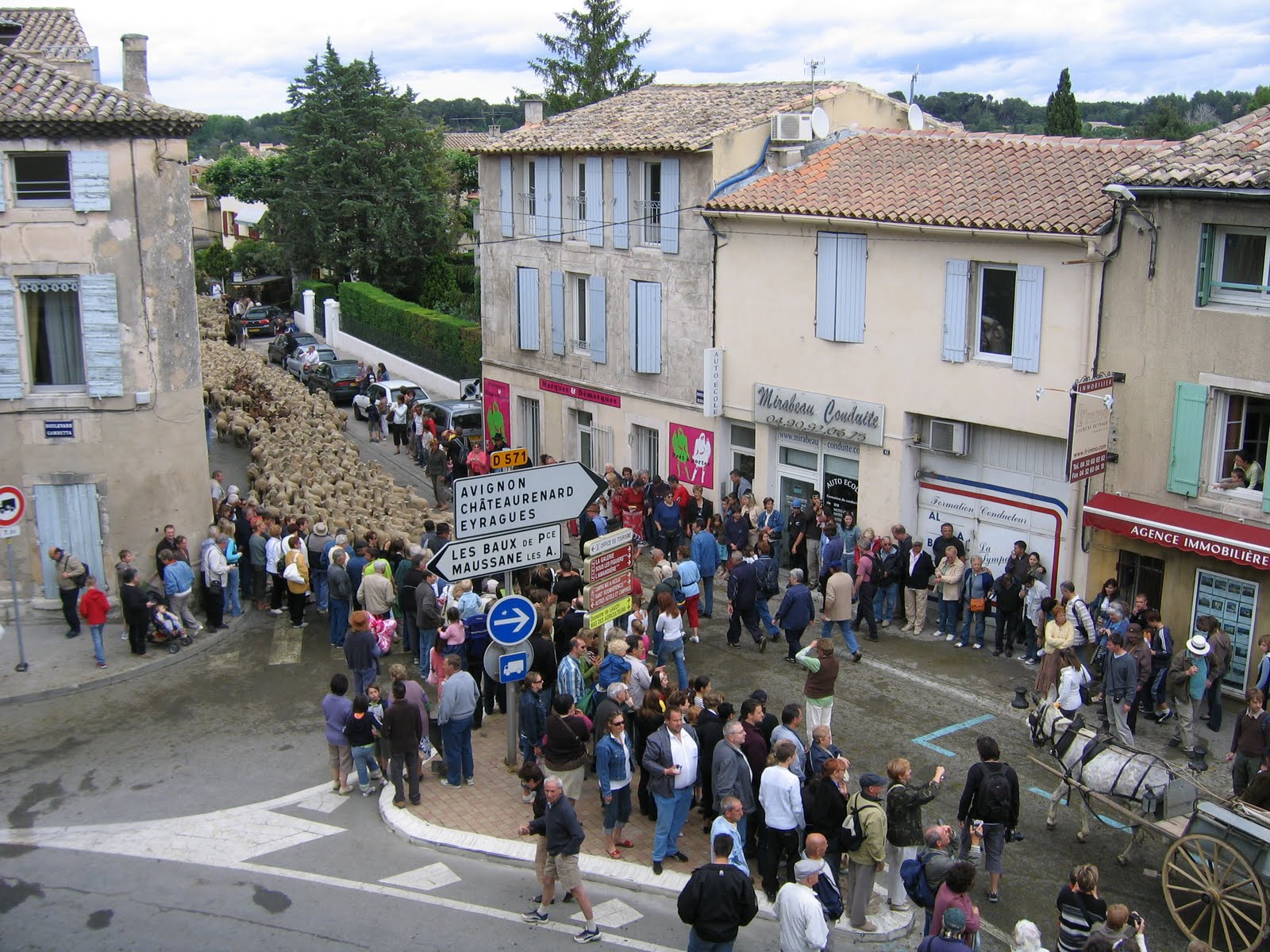
In addition to memories of good food, good wine and good friends, thinking about the 2007 reunion in Saint Remy-de-Provence also brings back memories of the "Fête de la Transhumance " that is traditionally held there on Whit Monday (aka Pentecost Monday). "Transhumance" in its most general sense refers to seasonal movements of livestock, generally from lower to higher pastures in summer and from higher pastures to the plains in winter.
Saint Remy-de-Provence is situated in the rocky, hilly region of southern France known as the Alpilles. To celebrate the Transhumance, thousands of sheep are trucked to Saint-Remy (they used to be herded on foot and the walk could take up to ten days), together with goats, donkeys, shepherds and sheep dogs. There, the whole lot parades twice around the town center in the morning and then officially moves up to higher pastures. In the afternoon, there is a demonstration of how the sheep dogs work, a community barbecue and traditional dancing. It goes without saying that lots of wine and other spirits also flow there.
While I wasn't able to stay for the afternoon festivities, needing to hie myself back to Geneva and my workplace the next day, I was able to see the parade. Our group had a wonderful vantage point, being ensconced in an apartment right at the point where the flocks enter and leave the village. Here is the "before" view.
Hark, are those sheep that I see?
Yes, I definitely see a few sheep there.
Indeed, I see quite a few sheep there.
Wow, glad that I'm up high - just in case those sheep turn surly.
They just keep coming ... and coming - a veritable ocean of fleece.
Here they're coming round, just about to turn for their second loop.
Ah now, I begin to understand how they can tell which sheep belong to whom. There are markings on their backs.
These gals, dressed in traditional costume, don't seem too concerned about maintaining a quick pace.
And there they go. Off to the afternoon's festivities and then to their summer pastures.
It doesn't take long at all. The village center isn't all that large. But the parade is great fun to see.
23 May 2010
Whitsunday
Today is Whitsunday (aka Pentecost) and, together with tomorrow, Whit Monday, serves as one of the last opportunities in the academic year for a long weekend because Whit Monday is also a holiday throughout most of Europe.
It is somewhat ironic that European countries that pride themselves on being primarily secular - and long may they continue to do so - celebrate as "holidays" so many festivals that form part of the liturgical calendar. For example, ten days ago Ascension Thursday was also celebrated as a holiday here, with many taking leave on the following Friday in order to have a four-day weekend. Yet, in my own country, where a certain part of the population literally becomes incensed when some do not want to say a "Pledge of Allegiance" including the phrase "under God," the only two liturgical festivals that are celebrated - and with much commercial fanfare to boot - are Christmas and Easter. In fact, I cannot think of any other country where I have lived in which citizens routinely make a pledge of allegiance at all. It is also true that most commercial establishments in Europe, apart from restaurants, cafes and small shops, still close on Sundays. Are we to infer that Europeans are, in reality, more "godly" than Americans!?
The question is meant rhetorically. It is not something that I wish to discuss here. At all. I doubt that a meeting of minds would result. But what I most wanted to share today are my memories from a few years back - Whitsunday of 2007, in fact - when a group of alums from one of my grad schools and I reunited for the long weekend just outside the charming French village of Saint-Rémy-de-Provence. Time was spent in visiting, catching up, meeting new friends, sightseeing, but mostly in enjoying the beautiful setting. Best of all, the Whitsun activities included a cooking lesson with a cordon bleu chef. After preparing the meal, we enjoyed it in an alfresco setting.
We cooks not only set the table and prepared the meal, we also served the food. In this case, it's the appetizers.
And here we are, ready to make way for the ravenous horde. This table will never look the same.
After the appetizer, the chefs had to scamper back to the kitchen to help put the finishing touches on the main course.
The ravenous horde was most appreciative. Their appreciation was heartily assisted by good wine, flowing a-plenty, and bouts of riotous laughter.
And then the desserts - simply divine!
If you can believe it, after all that, some of us were still up for a visit to the site of the former asylum, now a museum and art gallery, where Dutch painter Vincent Van Gogh spent one of the most difficult yet artistically prolific years of his life - after cutting off his own ear. Here is one of the areas that Van Gogh found especially restful and soothing. It was almost too restful for some of us, after all the excellent food and wine!
All in all, however, it was a most satisfactory day!
22 May 2010
Le vin, le soleil et le beau temps
Today was one of those days when everything comes together, when the weather is no less than sublime. As such, it was a perfect day for the Caves Ouvertes Vaudoises (Open Wine Cellars in Vaud) for 2010. This is the first year that some 300 wine producers in the canton of Vaud have all opened their cellars at the same time. Visitors can visit the Appellation d’origine contrôlée (AOC) (controlled designation of origin) area(s) of their choice and taste what the vintners have on offer. The AOC in French-speaking Switzerland works in much the same way as it does in France.
Certainly, the idea is to get people into the open air and into the cellars to taste, and purchase, the excellent local wines. But it is also a social occasion for the whole family to enjoy the countryside together, especially when the day is as glorious as today was. Free shuttle buses ran from the train depots up into the rolling countryside along Lake Geneva in an effort to encourage people to leave their cars at home.
Since three of the participating wine producers were actually within walking distance, I took the opportunity to see what my neighbors were doing. Each of the three had people coming and going, several with children happily in tow.
Our lake microclimate allows palm trees to grow, even to flourish, here. Reminder: this IS Switzerland.
One of the caves had special entertainment. A local sculptor was giving a demonstration of his skills with shaping wood. Fittingly, his subject was a wine bottle.
Exciting for young and not-so-young alike, a helicopter was making short sweeps of this scenic area, with passengers lining up at CHF 50 a pop to see the sights.
This particular wine producer tends the grapes in "my" vineyard.
There is a friendly rivalry next door, with parasols set up in the courtyard.
Even the old wine presses can be recycled.
And a good time was had by all.
Subscribe to:
Posts (Atom)