After a very busy day visiting the UN and Geneva's Vieille Ville, there was still an early wake-up call the next morning so that we could drive to Meyrin (a commune in Geneva canton) for our scheduled visit to the European Organization for Nuclear Research (CERN). Although the tour itself would not begin until 10 a.m., we had been advised to view the Microcosm, CERN's interactive museum of particle physics, prior to the tour in order to have a better idea of what we would be seeing. Had our visit been scheduled in July, we would have been among the first visitors to view the displays in the new visitor center which opened 1 July and is now housed in this building.
As someone who attended schools in an area of the US during an era where females were, if not actively discouraged from studying classes in higher mathematics or sciences, generally not encouraged to do so, my background in particle physics is virtually non-existent. So I am extremely happy to see that the Double Cs find higher mathematics and science fascinating, as indeed they are. With HWMBO as a grandfather, I would expect nothing less from them.
In any event, they appeared to enjoy the interactive displays.
They even had some fun with the mock-up of the Large Hadron Collider (LHC), where scientists are accelerating two beams of particles in opposite directions to more than 99.9% the speed of light to produce head-on collisions in order to create the kinds of conditions that scientists believe existed after the "Big Bang." Nice try, Prince C, but no cigar, I'm afraid.
Our tour began with a short bus trip to one of the CERN facilities located in France. The LHC itself is installed in a tunnel 27 kilometers in circumference, buried from 50 to 150 meters underground between the Jura mountain range in France and Lake Geneva in Switzerland. Because the LHC is now in operation, visitors are no longer allowed underground. So we had to visualize what was happening there from our experience with the Microcosm, the various models on the tour and the explanations given by the guide.
The facility that we visited is the location where the superconductor magnets used in the LHC to accelerate the particles are tested.
There are thousands of different magnets of different sizes and varieties inside the LHC. They include 1,232 dipole magnets of 15 meters in length which are used to bend the beams,
and 392 quadrupole magnets, each 5–7 meters long, to focus the beams. Here is a model showing the interior of the LHC.
And here is one of our last looks at superconductor magnets that are destined to be used in the LHC.
More than 10,000 scientists and engineers from around 500 academic institutes and industrial companies worldwide are contributing to the LHC project. Equipment has been built in many European countries, as well as in Canada, India, Japan, Russia and the United States. CERN's projects and experiments are encouraging examples of what international cooperation and collegiality can accomplish.
Sagittarius (22 November - 21 December) is a fire sign ruled by the planet Jupiter and represented by a Centaur wielding a bow and arrow. Sagittarians tend to have dreams that are very dear to their hearts and are the bases for their motivations. Their freedom to dream is essential to their well-being. Among many other things, they love children, animals and travel.
04 July 2010
03 July 2010
From the towers and the ramparts to dinner
While three of us were ready to rest our weary bones in the sanctuary of the cathedral, energy-filled Son B and Princess C decided to climb up to the cathedral towers.
There, they had some breath-taking views of Geneva, such as the Right Bank here
and the Left here.
Unfortunately, Geneva's famous jet d'eau (fountain) was turned off at the time. But the view of the lakefront was still quite spectacular.
A cute human gargoyle (a contradiction in terms?) is featured in this landscape.
When they had redescended, we all wended our way down from the Old Town
with a last fond glance back at the cathedral spire
and made our way to Place Molard for dinner.
There we were serenaded by a street musician with an accordeon, giving a real flavor of Paris to little Geneva.
And then all the weary travellers gladly headed back to the apartment.
La Cathédrale Saint-Pierre - À l'intérieur
After beginning our visit to la Cathédrale de Saint-Pierre at the very bottom with the archaeological dig, we left the archaeological museum to view the inside of the cathedral. While Geneva was a Catholic stronghold until the early 16th century, it was greatly affected by the Protestant Reformation. The last Roman Catholic bishop of the city was forced to leave in 1532. The city officially declared itself Protestant in 1536. That same year, the French theologian, Jean Calvin, was invited to help reform the church in Geneva. While his ideas were not popular originally so that he spent a short period in exile from the city, Calvin ultimately spent the greater part of the period from 1536 to his death in 1564 in Geneva and became its spiritual leader. Since 1536, la Cathédrale de Saint-Pierre has been known as Calvin's adopted church. The cathedral currently belongs to the Swiss Reformed Church.
While the cathedral is an eclectic mixture of styles, its interior today is one that is striking in its simplicity
and uplifting with its soaring vaults and columns.
Apart from some stained-glass windows, decoration is confined to wood carvings, as here.
Geneva remained a Protestant stronghold from 1536. It became a haven for Huguenots (French followers of Jean Calvin) fleeing religious persecution in France. Geneva's best-known historic festival is l'Escalade (literally, the scaling of defensive walls) which commemorates the city's successful rout of troops sent by Charles Emmanuel I, Duke of Savoy in December 1602 in an attempt to crush Protestantism. While it ultimately happened that a large part of the historic Geneva diocese returned to Catholicism in the early 17th century despite the events of l'Escalade, this return was due largely to the teachings and influence of St. Francis de Sales, appointed Bishop of Geneva, rather than to any military action.
Geneva adopted a strict separation of Church and State in 1907. Today, it is deservedly regarded as a city of religious tolerance that extends beyond tolerance of Christian religions only. Other cities and countries - and individuals - would do well to follow its example. But it seems so far that all too many will never, ever learn. If anything, I have seen the world grow much worse in my own lifetime, especially in the last ten years. And that is literally tragic.
La Cathédrale Saint-Pierre - le dessous
From the 4th to the 16th century, the city of Geneva served as a seat for Catholic bishops so it was only natural that a cathedral be established there, even if it took a long time for construction of the cathedral as it is known today to begin. Construction for la cathédrale de Saint-Pierre (St. Peter's Cathedral) actually began in the 12th century. Prior to that time, the cathedral had been one of three to coexist on the same site. The other two buildings were subsumed into the present-day structure, as shown in this model of the early days.
What is extremely interesting, however, is that the area beneath the present-day cathedral has been excavated to a large extent and reveals a rich history dating back to Roman times.
As it seemed to be a good idea to go inside until the sun returned, the suggestion to view the archaeological site met with general enthusiasm. So, under the cathedral we went, happy to discover that the audiotour was included in the entrance fee, instead of as an extra charge.
There were also videos showing the stages of construction of the cathedral, as well as some of the early experiences with the dig.
There were vestiges of the building's romanesque history and
even an incomplete mosaic floor that dated back to the early Romans, who had constructed a temple on the site before being converted to Christianity.
The visit was a reminder of how ancient the area is. Even as deeply as the archaeologists have dug, they have still not reached the level of the earliest settlements.
02 July 2010
Genève - la Vieille Ville
From Cornavin, we made our way over to Geneva's Rive Gauche (Left Bank) and la Vieille Ville (Old Town). With a greater metropolitan area population of just under 1,300,000, Geneva is Switzerland's second largest city after Zurich. The name "Geneva" refers both to the city and to the canton. Geneva is also the global "mother lode" for work in diplomacy and international relations.
While today's Geneva is cosmopolitan, urbane and very important as a world financial center in addition to being an international diplomatic hub, its global role is a comparatively recent one for the city. It first appeared in history as a small border town, taken by the Romans as a fortification against the Celto-Germanic Helvetii around 121 B.C. The international abbreviation for Switzerland, "CH," (Confoederatio Helvetica or, in French, Confédération Helvétique) refers to the Helvetii.
We began our introduction to the Old Town by passing by the Clock Tower and into the Place du Molard (aka "Place Molard").
People were generally eating there in a leisurely manner, as they will continue to do all summer, weather permitting. It was a far cry from our interlude at McDo's. They had silver table settings along with crystal and linen. Of course, their "lunches" likely cost quite a bit more than ours had.
From there, while my visitors purchased stamps at the post, I took a few shots of the carousel
some clothing for sale in a stand nearby
and the road leading up into the Vieille Ville.
My soccer fan visitors noticed that this particular restaurant appeared to be supporting several World Cup teams, judging by the display of flags in its upstairs windows, so we decided to memorialize the moment.
Then we continued on to the Place du Bourg-de-Four, pausing for a moment by the fountain,
and noticing that people were also sitting outside in the many cafes dotting the square, such as here, in front of the Palais de Justice (courthouse).
From there, we made our way along the Grande Rue to les Armures (the Armory), across from the Hôtel de Ville (City Hall) and my visitors posed for a photo in front of the mosaic depicting the arrival of the Romans.
It was a good time to take shelter as it began pouring, so we spent a few more moments taking photos. We weren't alone.
As Prince C and Princess C discovered, the lunch hour is sacrosanct and will continue in spite of the pouring rain.
We thought briefly about continuing our visit on the tour train rather than on foot, but the downpour seemed to be diminishing.
Still, it seemed like a good moment to head inside. So that's what we did for the next part of the afternoon.
01 July 2010
More internationalism and an interlude at McDonald's
After the UN visit, Friend G, Son B and the young'uns walked down to the Place des Nations for a few photo-ops. They could not miss this classic view of the main entrance, flanked by flags of UN member states.
Nor this one. The "Broken Chair" is a monument to victims of land mines and symbolizes opposition to the use of land mines and cluster bombs. It was designed by the Swiss artist Daniel Berset, constructed by carpenter Louis Genève and was given by the artist to Handicap International Suisse. To the right of the chair, one can see the International Telecommunications Union (ITU) building. At the far right of the picture is the World Intellectual Property Organization (WIPO) building.
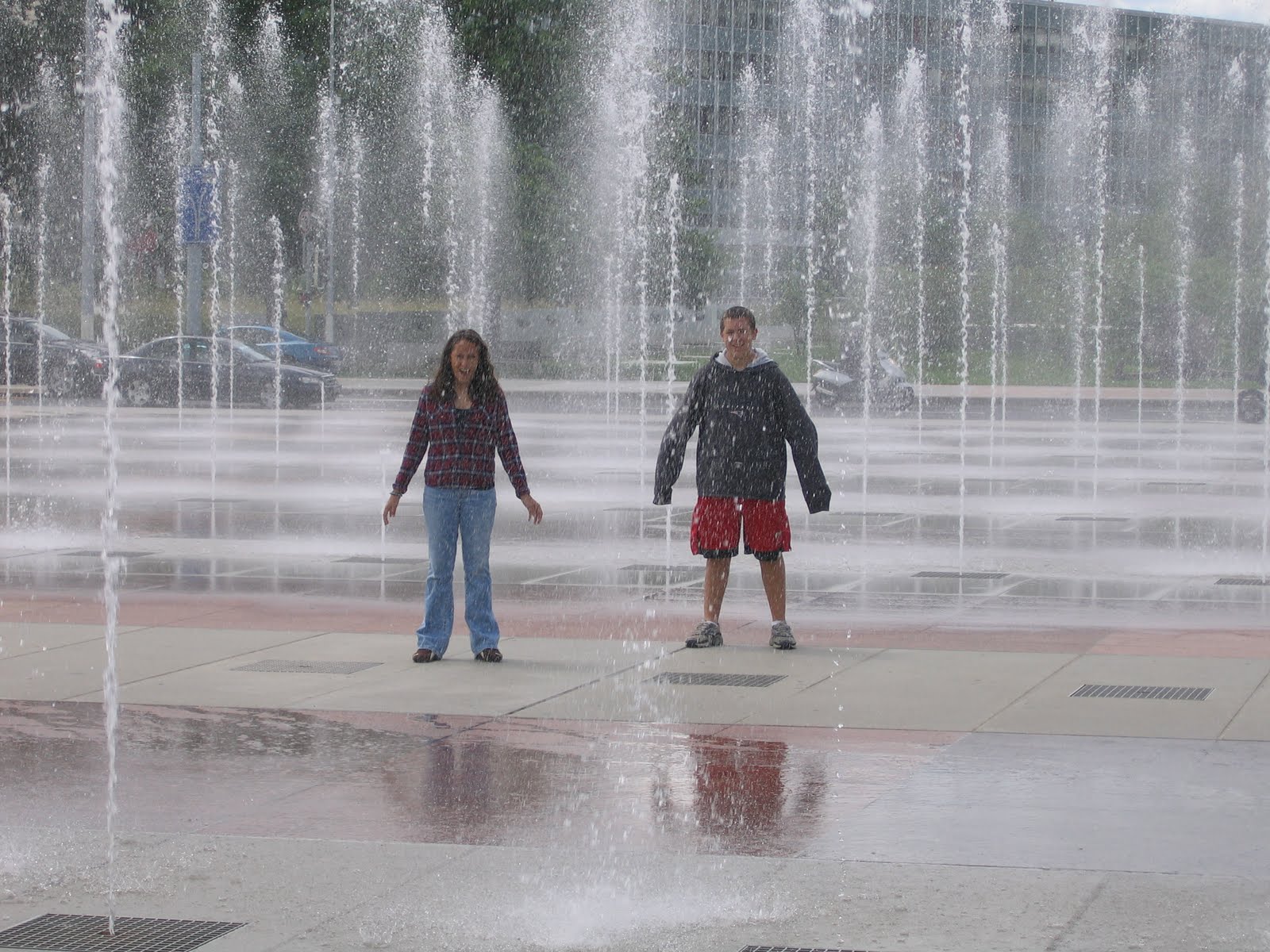
It was a cool day, so the young'uns didn't really get wet although it might look here as if they did. They were strategically placed to avoid the water. But I have seen parents bring their little ones to run through the waterworks here when the weather is much hotter. And the evident glee of those little ones is contagious.
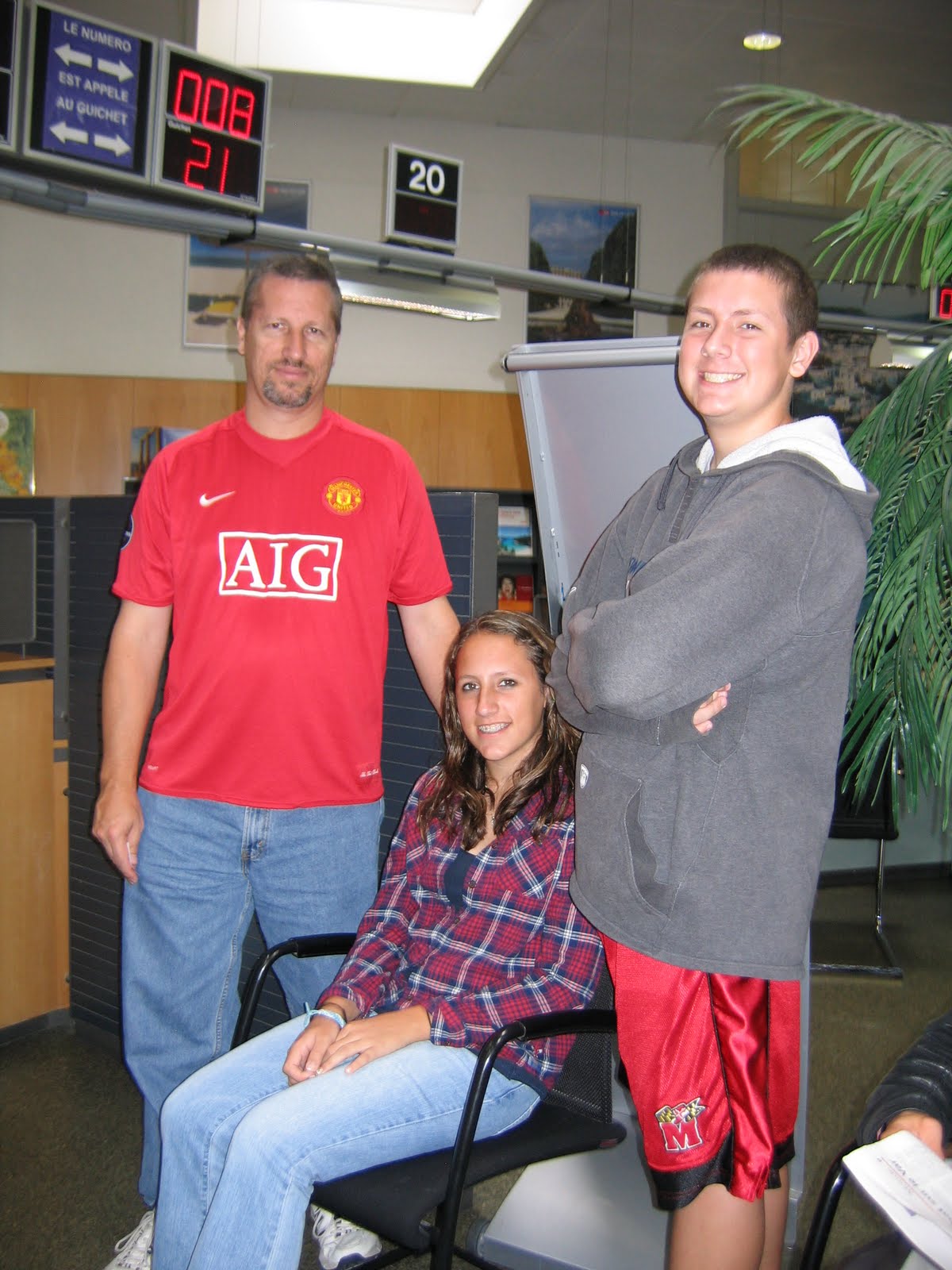
From the Place des Nations, we travelled to Cornavin (Geneva's central train station) to purchase train tickets for departures for the following week. Friend G needed a ticket to Zurich and Son B and family wanted to purchase tickets on the TGV to Paris. It turns out that our brief wait here was worthwhile. The ticket agent managed to get TGV tickets and reservations in first-class that actually cost less than the usual second-class fare.
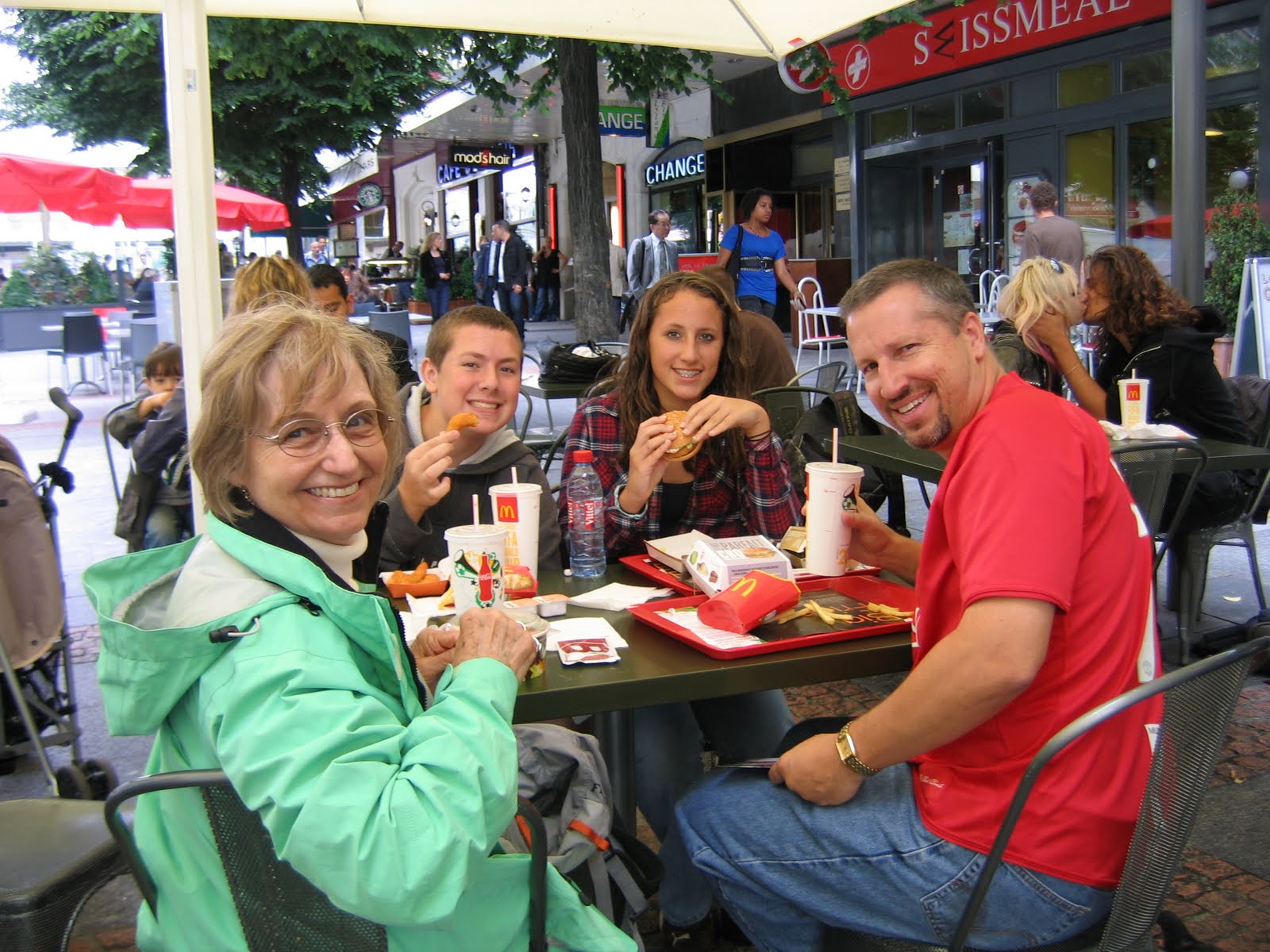
Eagle-eyed Prince C and Princess C had spotted a sign for McDonald's and so we had to have lunch at one of the Geneva franchises. Having received several coupons from McDo's (as it is referred to here) in the mail, I had tucked a few in my purse - just in case - and some came in handy indeed. I love the small idyll that I inadvertently caught at the right in this photo!
After lunch, we checked out the inside where the decor was decidedly more upscale.
So upscale, in fact, that we needed codes to use the facilities!
Intimations of internationalism
Following our visits to Lausanne and the "Swiss Riviera," our group arose early enough to go into Geneva in order to take the morning United Nations tour. The United Nations Office in Geneva (UNOG) is the largest presence of the United Nations in Europe. It is second in size only to United Nations headquarters in New York City, where most of the political bombast takes place and where all of the peace-keeping operations are managed. The Geneva office is generally where the day-to-day work of the UN and its specialized agencies is administered and monitored.
The United Nations compound comprises the Palais des Nations, where the League of Nations, the ill-fated predecessor agency of today's United Nations, was headquartered, more recently-built additions and several outbuildings. With the additions, the complex is 600 metres long, with 34 conference rooms and 2,800 offices.
After the events of 9-11 and subsequent global destabilizing actions, the UN park, which was at one time open to the public at large, is no longer open to visitors except on very rare occasions. One of these occurred on 5 June 2010 to celebrate World Environment Day. Access to the compound itself is allowed only upon presentation of an identification document. If one is there for a tour, access to most building areas is also quite restricted and visitors are required to remain with the tour leader. Various objets d'art are scattered throughout the buildings, all gifts from member state governments.
Tours can also vary depending on which conferences are using which building facilities. As it happened, the General Assembly hall was being used for an International Labour Organization (ILO) conference during our visit, so we were not allowed to view it. Still, we were able to see other parts of the old Palais des Nations building.
One room that we were allowed to visit was the Council Chamber, where we were treated to murals on the ceiling and walls. The murals were painted by the Catalan artist José María Sert and were a gift from the Government of Spain in 1936.
The murals depict human progress through health, technology, freedom and peace – all united by five colossal Dantesque figures (representing the world’s five continents) grasping each other’s hands in apocalyptical triumph at the dome of the ceiling.
Another room that we were able to view through glass from the upper gallery was the recently renovated Human Rights and Alliance of Civilizations Room. The main feature of the renovated room is a ceiling sculpture by the prominent contemporary Spanish artist Miquel Barceló, a gift from the Government of Spain again (!) in 2008. The ceiling sculpture consists of many layers of paint of different colors, composed of pigments from across the globe and sprayed onto the ceiling to generate stalactites.
The sculpture is groundbreaking both artistically and technically. So we added our own personal touches here. I don't believe that the artist will mind.
Although we did not have an up-close view, we were also able to catch a glimpse of one of the famous peacocks that live on the grounds and were "treated" to its harsh and raucous cry as we accompanied our tour guide.
Subscribe to:
Posts (Atom)