According to a recent study from "Language Rich Europe (LRE)," Switzerland remains ahead of other European countries when it comes to multilingualism. LRE promotes multilingualism for more prosperous and stable societies. LRE is a project headed by Martin Hope, who is Director of the British Council and also the current President of the European Union National Institutes for Culture (EUNIC), headquartered in Brussels, Belgium.
Switzerland may be a tiny country in the grand scheme of things. It is also landlocked, with no direct access to seaports. But its central location on the European continent, where its borders touch France, Germany, Italy and Austria along with a couple tiny principalities, has assured its reputation as a major logistical, cultural, commercial, technological and linguistic axis. Of course, for a very long time, it was also the location of choice for those who wished to keep their foreign assets secure - or secret - for whatever reason and was thus a major financial center. That status has been shaken somewhat in recent years and its infamous bank secrecy has been put through the wringer by countries, like my own, whose tax authorities are very interested in any assets that have not been declared by their owners. [Disclosure: as a Swiss resident, I must have a Swiss bank account in order to function here. As required, I have routinely declared my financial holdings here to the IRS. So far as I know, I am in compliance with the IRS as well as the Swiss authorities. Believe me, the two authorities do exchange such information.]
Although Switzerland has yet to become a member of the European Union and has its own currency, the Swiss franc (CHF), it has concluded bilateral agreements with all neighboring countries. Under the Schengen Agreement, since 2006, citizens of the EU may also pass through here freely. Interestingly, what I have noticed in my own recent returns from the US is that immigration authorities at the airport want to see my Swiss permit and don't give my US passport, which I always have as well, other than a cursory glance. They don't even open it.
There are already four official languages that are spoken in this country, listed in order of numbers of speakers: German, French, Italian and Romansh. German is spoken most widely while French is the principal language spoken in Western Switzerland, where I live. While the majority of Swiss are at least bilingual and many are trilingual in the official languages, very few speak all four. Thus, English is a "bridging" language for most, often chosen by students as a second or third language at the expense of the official languages.
Language Rich Europe aims to promote the harmonious coexistence of local, national and international languages in order to create a more socially stable Europe based on mutual respect and intercultural dialogue. This is an environment that I personally find to be wonderful. I feel very privileged to be living here.
24 May 2012

23 May 2012
Greater Geneva
When people ask me where I live, my answer is usually that I live in "the Geneva area of Switzerland," mainly because Geneva is much better known and thus more easily visualized than the tiny village (commune) where I actually reside. In fact, I can now begin using the term, "Greater Geneva, (le Grand Geneve) accurately. Within the last month, this conurbation (and yes, I learned a new word!) of three French departments (Ain, Haute-Savoie and Rhone-Alpes) and two Swiss cantons (Geneva and Vaud) has officially been dubbed Greater Geneva.
While the name itself is new, this agglomeration project has been on the drawing boards since the 1970s because of the large numbers of people employed in Geneva - generally for the international organizations that are based there - but who live outside Geneva canton, either in France or in Vaud. It wasn't until the late 1990s, however, that it took concrete form with the publication of the "Charte d'aménagement de l'agglomération transfrontalière franco-valdo-genevoise" (France-Vaud-Geneva Conurbation Development Charter). While there were many starts and stops along the way, the Charter was signed by the partners in 2007 and the project was officially launched. It allows for the creation of a coordination and administrative level and defines the grand organization principles for the region that are to be achieved by 2030, as shown below.
 To be precise, not all parts of each French department or Swiss canton named are actually included within this conurbation. It is only those regions that are in close proximity to Geneva. My village, being located in the western district of Vaud, with its regional administrative center located in nearby Nyon, is indeed included within Greater Geneva.
The area is home to approximately 730,000 inhabitants, 500,000 of whom live in Switzerland. Contrast this with the population of my birth state of Montana, which is approximately the size of the country of France. The population of that whole state is just shy of one million. Despite what might be seen as congestion by my fellow Montanans, this area is a shining example of how humans can co-exist harmoniously not only with their fellow humans from all over the world, but with the native flora and fauna.
I never feel crowded here.
While the name itself is new, this agglomeration project has been on the drawing boards since the 1970s because of the large numbers of people employed in Geneva - generally for the international organizations that are based there - but who live outside Geneva canton, either in France or in Vaud. It wasn't until the late 1990s, however, that it took concrete form with the publication of the "Charte d'aménagement de l'agglomération transfrontalière franco-valdo-genevoise" (France-Vaud-Geneva Conurbation Development Charter). While there were many starts and stops along the way, the Charter was signed by the partners in 2007 and the project was officially launched. It allows for the creation of a coordination and administrative level and defines the grand organization principles for the region that are to be achieved by 2030, as shown below.

The area is home to approximately 730,000 inhabitants, 500,000 of whom live in Switzerland. Contrast this with the population of my birth state of Montana, which is approximately the size of the country of France. The population of that whole state is just shy of one million. Despite what might be seen as congestion by my fellow Montanans, this area is a shining example of how humans can co-exist harmoniously not only with their fellow humans from all over the world, but with the native flora and fauna.
I never feel crowded here.
17 May 2012
Colorful, but brrr ...
I actually took the photos in this post while riding my bike about a week ago. But I noticed this morning that the colza that shows up vividly in these photos has already turned green. So I guess that it's time for me to get cracking. Despite the clouds piled up ominously here, the narrow part of Lake Geneva where I live looks as placid as a backyard swimming pool.
 The golden colza fields brightened what would otherwise have been a very gloomy morning. The color yellow, especially after gray days that seem to stretch on forever, always cheers me up. I'm sorry to see that these fields have already gone green, even though the green is also beautiful.
 Last evening, some areas of Switzerland reported below-zero (Celsius) temperatures and there was snow as low as 600 meters. I noticed a dusting of snow on the slopes of the Jura this morning and patches are still there. This is as cold a May as I remember during my eighteen years here. But the vines haven't been daunted by the weather and have begun to open their leaves.
 Looking ahead to the finished product, this morning I also noticed banners advertising the annual Caves Ouvertes (open wine cellars) scheduled to be held on 26-27 May.
Despite the cool - even cold - weather, Spring is marching inexorably towards Summer.


Despite the cool - even cold - weather, Spring is marching inexorably towards Summer.
14 May 2012
More May Flowers
Once I had passed through the gates to the jardins and entered the main display area, this was the sight that met my eyes.
 I wonder how Mme de Staël would have appreciated how we make use of her fountain and gardens for such events. We may not have the intellects or celebrity of the visitors she was used to hosting here in the 19th century, but these events do help to keep the grounds well-cared for.
 Tucked into little corners were colorful displays of plants for sale,

 examples of garden layouts that incorporated art,
 and floral-themed linens.
 Other examples of garden art were scattered about the entrance.
 Flowers and ideas for presenting them were everywhere.
 But the display that I believe would most have enchanted my grandchildren was this one, with its constant supply of multi-colored bubbles.
 Or perhaps even this stand of bonsai.
 There were roses everywhere
 and with the château as a backdrop, it was a feast for the eyes.


13 May 2012
May Flowers
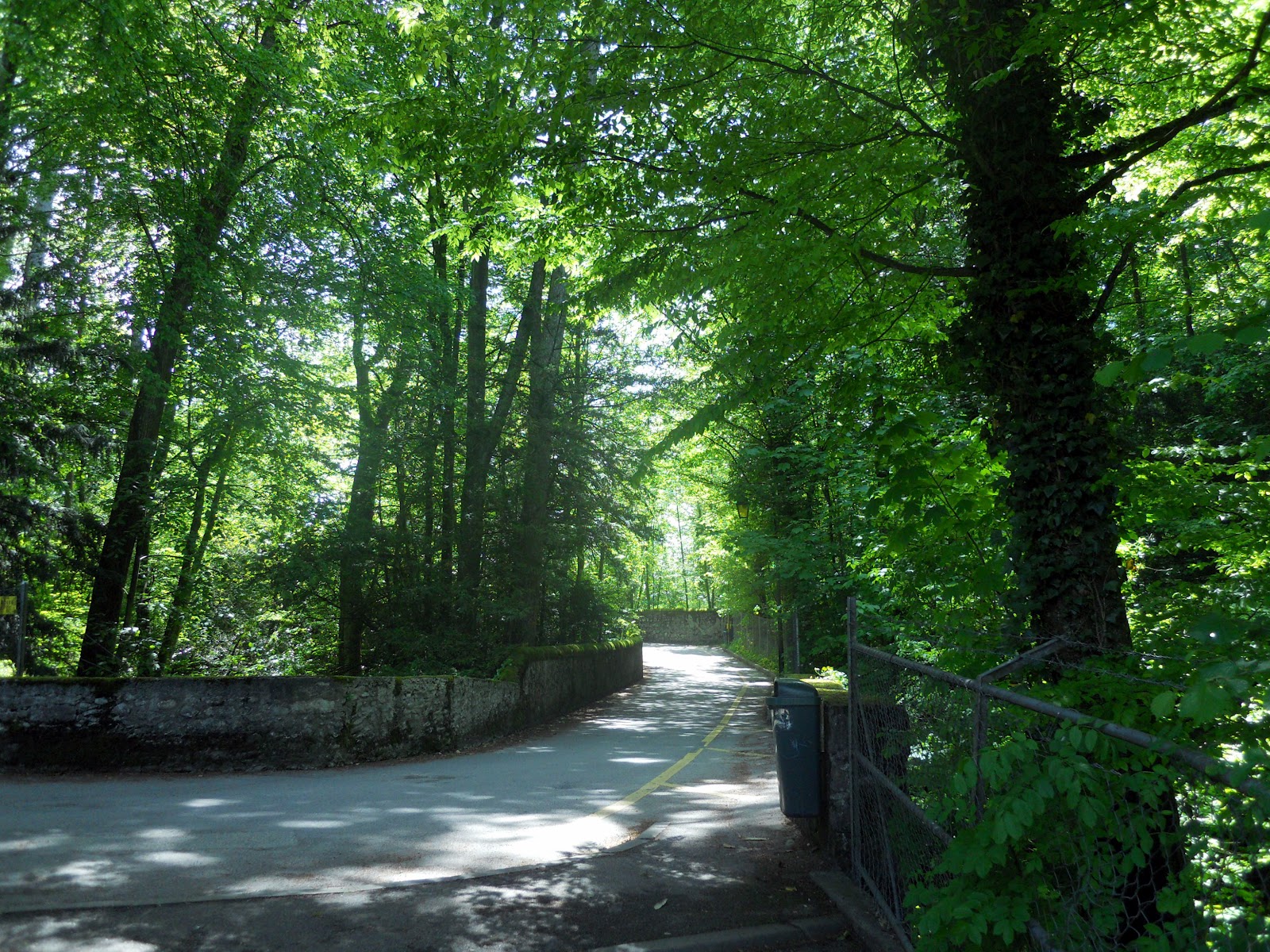
Friday and this weekend marked the annual three-day Flower Market in my village, which is always a colorful way to spend some time, especially if the sun is shining. And shine it did, on Friday, with the day's temperatures reaching record levels for this time of year! So I made my way into town via the shady trail rather than along the very sunny lake road.


As usual, our local château was the site of the expositions

with a detailed plan of which exhibits and exhibitors could be found where.

Even château outbuildings, such as the former stables to the rear of this photo, were utilized

with an eclectic grouping of objets to tempt entry.

The former caves (wine cellars) displayed various floral displays and bouquets,

as well as table settings, displaying caterer's wares.

But the main attractions were to be found in the jardins, which were the formal entry point.

More in the next post ...
12 May 2012
Continuing Rites of Spring
A couple posts back, I mentioned the Prom as one rite of Spring that occurs in many US secondary schools in May. Another rite of Spring that officially begins in March is baseball. The 2012 Major League Baseball Season kicked off on 28 March and will run until 3 October. So, once it begins, the baseball season lasts - and lasts - and lasts.
The Major League teams are merely one aspect of this perennial All-American sport. Most small villages and towns have minor league - and even smaller - teams. Additionally, most public schools of any size also have their varsity or principal teams, while there are junior varsity teams to train the younger players and keep them motivated. Such is the case with our grandson, Prince J, who is only a sophomore. As such, he is part of his school's junior varsity baseball team.
 Prince J's team has been playing well this season, as has Prince J himself. Both HWMBO and Proud Dad Big J have been enjoying his games so far. As is the custom, team pictures are taken by a professional photographer and Prince J - who used to be just a little peanut like Princes Tyger and Lightning - is growing into a fine young man.
 Here is the school's scoreboard, although this one is basically set up for football rather than baseball scores.
 We hope that the rest of the season continues to go as well for Prince J as it has begun.
The Major League teams are merely one aspect of this perennial All-American sport. Most small villages and towns have minor league - and even smaller - teams. Additionally, most public schools of any size also have their varsity or principal teams, while there are junior varsity teams to train the younger players and keep them motivated. Such is the case with our grandson, Prince J, who is only a sophomore. As such, he is part of his school's junior varsity baseball team.


11 May 2012
Unbecoming Swiss
LOL, Michele Bachmann is requesting that her Swiss citizenship be withdrawn - less than two months after she acquired it! Here is a compilation of reactions to what the compiler calls "a bizarre move by a bizarro politician."
In relinquishing her Swiss citizenship, Michele, of course, inevitably skews the facts. This is a tendency that others in her political party do on a regular basis and she is definitely no exception to the rule. In her announcement relinquishing Swiss nationality, she said, "Today I sent a letter to the Swiss consulate requesting withdrawal of my dual Swiss citizenship which was conferred upon me by operation of Swiss law when I married my husband in 1978." Also according to Michele, the recent news was merely because she and her husband had updated their documents.
"... which was conferred upon me by operation of Swiss law when I married my husband in 1978 ...?"
Uh ... no. And Michele, purportedly a lawyer, should know better.
First of all, while her husband Marcus may automatically have been considered Swiss at birth because he was the child of married Swiss parents, there is nothing so far to show that he ever formally applied for recognition of that status earlier than this year. He certainly never informed the Swiss consulate of his marriage in 1978. Even if his Swiss nationality had been recognized at the time of their marriage, marriage to a Swiss citizen does not automatically confer Swiss nationality. The non-Swiss spouse must formally apply for it, although the naturalization process is fast-tracked. It was easier for spouses in 1978; now there is a requirement for non-resident spouses to show that the marriage has lasted at least six years. Today, one must also make a showing of "close ties" to Switzerland.
There is intrinsically nothing wrong with dual national status. The US government recognizes it, albeit reluctantly, but dual nationality is generally considered a disadvantage for those who wish to work in sensitive positions in government and industry where perceptions of dual loyalty may arise.
Still, I was flabbergasted by Ms Bachmann's formal application in the first place, considering that she is so associated with those who love to hate Europe. While I understand that Swiss naturalization authorities were merely following the law in granting her citizenship, I wonder whether they really understood what a polarizing - and yes, bizarro - figure she is.
Subscribe to:
Posts (Atom)