Where on earth has November gone?
Hurricane Sandy hit the US East Coast, leaving lots of devastation behind, especially for residents of the states of New York and New Jersey. The storm was considered by many to be a climate change wake-up call, which had all too easily been "forgotten" in the heated campaign rhetoric of the US Presidential election. This week, as the US national holiday of Thanksgiving approaches, there are still people who, because of Sanday's destructive aftermath, cannot return to their homes or who are still without power.
In part exacerbated by a bad cold, I found myself in a quite dreadful state of stasis in the first part of November. I became unable to focus on anything beyond US Election Day, that is, 6 November, because I believed then - and believe now, for that matter - that the stakes in this most recent, and for me all-consuming, Presidential election were extremely high! I had given up on the radio and television coverage - even here - because all that was being reported was the "horse race" situation between President Obama and his challenger, Mitt Romney. The race was "too close to call," according to all the pundits and self-styled "experts."
As a fan of statistical probability guru, Nate Silver, I couldn't believe that this was quite the case. But having seen two elections in the past 12 years that should have been won [nb: some of us continue to believe that they actually were won] by Democratic candidates literally be snatched from the jaws of victory at the last minute, I was very worried. I could not bear the thought of this happening again.
Thankfully, Nate - who got nearly everything right in 2008 - did even better this year, predicting the correct results in 50 out of 50 states, even though it doesn't appear that he has updated his website to show the final Electoral Vote count. As we all know with the benefit of hindsight, President Obama won re-election quite handily, with 332 electoral votes to 206 for Romney. Only 270 were needed to win. So, in spite of all the news frenzy about "closeness" and even with some close results in "decider" states, the race really was not close. Even better, the Democrats not only retained control of the Senate but actually gained two seats. Together with two Independents who will caucus with the Democrats, this makes for a grand total of 55 out of 100 seats. And Democrats did much better than anyone had expected in the House of Representatives! While they remain in the minority (201 to 234), they regained eight seats that had been lost in 2010. Best of all, they defeated some of the most radical RW Republican candidates.
So much for the so-called "enthusiasm gap" bruited about by the "Mainstream Media (MSM)" since 2010! Despite these Democratic gains, however, the GOP continues to act as if their policies had not been heartily rejected by the majority of Americans. In doing so, they make themselves even more irrelevant and out-of-touch and me, for one, extremely thankful that these entitled jerks were not able pull the wool over everyone's eyes. Whew!
These results helped to jump-start me out of my stasis, at least to the point where I could finally complete research enough to draft syllabuses (syllabi?) for the courses that I will be teaching in January 2013. I still have to whittle tons of material into palatable bites of knowledge and complete class preparations, but at least I am feeling semi-functional once again. So, I'll try to get a posting routine going once again.
Showing posts with label Education. Show all posts
Showing posts with label Education. Show all posts
19 November 2012

21 June 2012
Rite of Passage
This past weekend, the small university where I have been teaching - in order to support my retirement "jet-set" lifestyle (LOL!) - held its annual commencement ceremony. The exercise was held at the Grand Hotel Kempinski in Geneva, formerly known as the Hilton or Noga-Hilton. There have been lots of changes over the past 18 years, which is as long as I have lived here.
There were 56 students in all: 24 undergraduates and another 22 graduates. Did I mention that the university is literally tiny? But what we lacked in quantity, we made up for in variety and internationalism. The students were from 30 different countries around the world. Some hailed from the Middle East; some from South and Central America; many came from Asia, even the South Pacific. Some came from Europe, particularly Central Europe and former SSRs that spanned both Europe and Asia. There were even a couple students from the United States among the graduate students.
 We faculty members were dressed in red robes while the students wore black.
 Former Swiss President, Micheline Calmy-Rey, and current Secretary General of the Club of Rome, Ian Johnson, were the featured guest speakers. I was not adept at getting a frontal view of Ms Calmy-Rey, just catching her as she was departing.
 But I managed to catch Mr. Johnson amid the photographic flurry of parents and friends, after the ceremony
 when both students
 and professors posed in the frame of Geneva's famed jet d'eau.
 Our young female graduates appeared to outdo one another in footwear, although at times we feared for their safety as they teetered about, extremely glamorous, but very precarious.
 Following the graduation ceremony and the photo ops, there was a reception at the hotel
 where relieved students and their families could relax and enjoy the beautiful scenery.
 That evening, we all returned to the hotel for a gala dinner and ball. Hurrah! The Class of 2012 has now officially been launched into the world - hopefully to find professional satisfaction and meaning in their young and hopeful lives.
There were 56 students in all: 24 undergraduates and another 22 graduates. Did I mention that the university is literally tiny? But what we lacked in quantity, we made up for in variety and internationalism. The students were from 30 different countries around the world. Some hailed from the Middle East; some from South and Central America; many came from Asia, even the South Pacific. Some came from Europe, particularly Central Europe and former SSRs that spanned both Europe and Asia. There were even a couple students from the United States among the graduate students.


24 May 2012
Language Rich Switzerland
According to a recent study from "Language Rich Europe (LRE)," Switzerland remains ahead of other European countries when it comes to multilingualism. LRE promotes multilingualism for more prosperous and stable societies. LRE is a project headed by Martin Hope, who is Director of the British Council and also the current President of the European Union National Institutes for Culture (EUNIC), headquartered in Brussels, Belgium.
Switzerland may be a tiny country in the grand scheme of things. It is also landlocked, with no direct access to seaports. But its central location on the European continent, where its borders touch France, Germany, Italy and Austria along with a couple tiny principalities, has assured its reputation as a major logistical, cultural, commercial, technological and linguistic axis. Of course, for a very long time, it was also the location of choice for those who wished to keep their foreign assets secure - or secret - for whatever reason and was thus a major financial center. That status has been shaken somewhat in recent years and its infamous bank secrecy has been put through the wringer by countries, like my own, whose tax authorities are very interested in any assets that have not been declared by their owners. [Disclosure: as a Swiss resident, I must have a Swiss bank account in order to function here. As required, I have routinely declared my financial holdings here to the IRS. So far as I know, I am in compliance with the IRS as well as the Swiss authorities. Believe me, the two authorities do exchange such information.]
Although Switzerland has yet to become a member of the European Union and has its own currency, the Swiss franc (CHF), it has concluded bilateral agreements with all neighboring countries. Under the Schengen Agreement, since 2006, citizens of the EU may also pass through here freely. Interestingly, what I have noticed in my own recent returns from the US is that immigration authorities at the airport want to see my Swiss permit and don't give my US passport, which I always have as well, other than a cursory glance. They don't even open it.
There are already four official languages that are spoken in this country, listed in order of numbers of speakers: German, French, Italian and Romansh. German is spoken most widely while French is the principal language spoken in Western Switzerland, where I live. While the majority of Swiss are at least bilingual and many are trilingual in the official languages, very few speak all four. Thus, English is a "bridging" language for most, often chosen by students as a second or third language at the expense of the official languages.
Language Rich Europe aims to promote the harmonious coexistence of local, national and international languages in order to create a more socially stable Europe based on mutual respect and intercultural dialogue. This is an environment that I personally find to be wonderful. I feel very privileged to be living here.
20 April 2012
Visiting in the Rain
April showers have certainly come this year, almost with a vengeance in their frequency. As I mentioned before, this is generally a good thing around because the winter months here in the lakeside plain area were much too dry. Still, what is rain on the plain becomes snow in the mountains. I've noticed, with some trepidation for the mountain-based communities, that the high mountain snow that was beginning to melt now appears to have been replenished. So there will be even more of it to melt. Still, life goes on.
Thus yesterday, along with Sweet Momma I, I set off for Lausanne to visit a mutual friend, Sweet Momma B, who is currently living there with her son, little Prince M and his father Proud Dad Big J. There were some moments, as here, when the sun broke through the clouds to shine in the Lausanne streets.
 The young family are now living in Lausanne while Big J completes his MBA course at IMD, a top-ranked business school, self-described as "a world pioneer in executive education." IMD certainly attracts some high-powered visitors. Former US President Bill Clinton is scheduled to deliver the keynote speech on "Embracing Common Humanity" for the IMD Excellence Forum on 20 May.
Sweet Momma B is expecting another little one in May and, although looking very well, is getting quite fatigued in these latter stages. While she will relinquish one reason for this fatigue - her part-time position - today, the principal reason for it is lively little Prince M. Prince M will remain a constant, albeit very sweet, burden.
 As with all little boys I have known, Prince M loves a challenge, this one in the form of a light pole that he wants to push out of the way.
 Seeing that his strength is not quite up to the task, he abandons the challenge with a sweet, if mischievous, smile, intended to charm and save face.
 After a nice visit with the growing family, I returned home by train, leaving Sweet Momma I clear sailing to pick up her daughters at their respective schools in Geneva. Traipsing towards my apartment from the train station, I noticed a lovely, if quickly fading, rainbow.
 Eternal reminder that the current April showers will one day cease and that the May flowers will arrive in abundance, this rainbow was much appreciated. Unfortunately, the rainbow's promise does not hold true for the coming weekend.
Thus yesterday, along with Sweet Momma I, I set off for Lausanne to visit a mutual friend, Sweet Momma B, who is currently living there with her son, little Prince M and his father Proud Dad Big J. There were some moments, as here, when the sun broke through the clouds to shine in the Lausanne streets.

Sweet Momma B is expecting another little one in May and, although looking very well, is getting quite fatigued in these latter stages. While she will relinquish one reason for this fatigue - her part-time position - today, the principal reason for it is lively little Prince M. Prince M will remain a constant, albeit very sweet, burden.


03 April 2012
Robotics - Towards the Future?
HWMBO, an electrical engineer by training, has been extremely excited during the past couple years because two of our grandchildren, the "Double Cs" who came with their father to visit Switzerland in the summer of 2010, have expressed significant interests in things technical. These interests have been evidenced by participation in their secondary school robotics club. In fact, this year, Son B, their father, has also been the team coach and principal advisor. Just as in athletics, there are competitions among robots, built by these prospective engineers.
 The main competition in Maryland is sponsored by Maryland First Robotics. The 2012 Chesapeake Regional Robotics Competition was held in the early part of March at the Baltimore Convention Center.
 Our grandchildren's team, the Robo-Lions with team-built Robot 2199, was part of the competition.
 Their alliance was seeded eighth after the qualifications rounds. The team will now move on to the Queen City Regional Competition in Cincinnati, OH. For a YouTube video of highlights of Robot 2199's performance, please click here.
Proud Granddad HWMBO was there to witness the events, take photos and root wholeheartedly for all the budding technicians. While I wasn't able to be there first-hand, I've participated vicariously. I too have been very proud!


Proud Granddad HWMBO was there to witness the events, take photos and root wholeheartedly for all the budding technicians. While I wasn't able to be there first-hand, I've participated vicariously. I too have been very proud!
23 October 2011
Where have all the resolutions gone?
Long time passing ...
October, which began so promisingly for keeping SD on schedule, has certainly disappointed. More disappointingly, there is no one to blame - if blame should be assigned - but myself. It has been slightly busier on the non-home workfront because I have been teaching a second course on a regular basis. I also served as a replacement for an absent professor in another class and was asked to prepare a "Waiver Exam" for the course that I was hired to teach.
It was my first experience with preparing a Waiver Exam and the idea had to be explained to me, although it makes sense. Evidently, the small university where I teach has a policy of allowing transfer students who have taken courses similar to those offered the option of taking a "Waiver Exam" designed to cover the entire course syllabus. The exam is graded on a Pass-Fail basis and, if the student passes, he/she is granted full credit for the course. I still haven't quite understood whether or how the P-F is included in the student's overall grade point average (GPA), but that is someone else's problem.
So drafting a final exam for someone who had not been and would not be participating in the class proved to be interesting. The challenge was to design it so that it was reasonably fair yet as comprehensive with the concepts as a final exam that I would design for the class. So it took quite a lot of time and effort to prepare. I was, fortunately, compensated for it by an additional lump sum. But, as with the preparation time involved for the regular class, when I actually divide that lump sum by the time spent already - and still to be spent, because I must also grade that exam - the lump sum shrinks almost to insignificance.
We just finished half-term last week, which meant that my regular classes had to take mid-term exams as well. That also took thought and preparation in addition to regular class preparation. Fortunately, I have now completed grading the exams and was somewhat surprised to discover that, for once in my teaching career, the results actually form an almost perfect bell curve. There are some As and Bs - about in the numbers that I had expected - with a multitude of Cs sliding into Ds. Unfortunately, there were also some Fs. One of the Fs is an aberration, I am sure. One individual, whose class participation until the week before the exam had been excellent, fell ill and thus missed the in-class review. I don't believe that the student had fully recovered by exam time; certainly the grade would not have been an F otherwise. Another student with a F had not even attempted to respond to a 30-point question and I don't really understand why. The student had responded to a similar 30-point question and done credibly well. Had that student even begun to answer the second, the grade would likely not have been F.
So, it is reassuring to realize that the exam was likely a fair one. Some students' study skills seem to be lacking, especially since there were no surprises or tricks on the exam. They all must realize that they need to do the work. Even the two 30-point questions provided all the factual information that the students needed. What they needed to demonstrate for those was that they understood that information and how it related to the course so far. Most did quite well with them; a couple did superbly well. So that is also heartening.
Whatever the results, there is still time enough to turn things around in a positive sense grade-wise before the end of term. I hope that the students are enjoying their half-term break. I know that I am enjoying mine so far - even more so once I will have completed grading the Waiver Exam!
Perhaps SD will also come to life again - at least for a time - and October won't be yet another month of "lost" resolutions.
29 September 2011
Busy Week
It's been active here this week. Along with my regularly-scheduled course - for which I have calculated that I am probably earning about CHF 3 per hour, if I count all the hours that I spend in preparation for it - I will also be giving a reading course in English as a Second Language (ESL) beginning in October. The schedule and course work are already planned out for me in that one and I can coordinate with the regular instructor. So even though the stated hourly pay for language courses is less than for "content" courses, the hourly work rate may actually work out to be much higher simply because I'll spend less time of my own in preparation. I have 18 students in the first class and only three in the ESL class. What fun!
In addition to my regular course, thanks to the good-will of the regular ESL instructor, I also spent some time this week sitting in on the ESL class, in order to avoid a too-abrupt transition from what the students are used to. We also had our first faculty meeting of the term this week, which gave all of us a better idea of the university's plans for the upcoming year - and even into the future, assuming that the global financial crisis does not disrupt those prognostications. It was a good meeting on the whole and my colleagues seem very open and friendly so far. I simply feel a bit overwhelmed by trying to learn all the new names.
In this third week, I am finally getting confident enough to recognize my students well enough to call them by their names, instead of simply getting by with a smile and a wave. We have a three-hour session once a week. If I saw them more often, I believe that I would have learned their names much faster. But I do enjoy only having to teach once per week although I do wonder how well they are learning. They may have the same trouble with taking in a whole lot of information at once, only to have it gestate for a week before learning a whole lot of new information. The good thing is that I have covered much of the overall conceptual framework already. Now, it's time to start demonstrating the concepts with real examples and driving the concepts home through case studies. If today's class was any indication, they seem to enjoy that approach and it will get the course away from being totally instructor-centric, even though I'll still have to channel discussions carefully and keep them on track.
Unsurprisingly, it is the female students who seem the more serious from the get-go. In my experience, it usually takes males of this age some time to settle. They like to "test" a bit more. Once they've made a few half-hearted challenges, realize that there will be little encouragement for such and that there is every incentive to buckle down and get to work especially if they have become even slightly motivated by the subject matter in the meantime, some will perform at least as well as their female counterparts. The others will find their own rhythms eventually. But each class has a different dynamic and this one is still in development mode, an appropos term in the circumstances.
Friday seems to have arrived in record time and I am thoroughly looking forward to my "off" day, before I have to get busy for next week's classes. I will also need to find time before next Friday to prepare the equivalent of a final examination for a student who has received official permission to receive credit for the course that I teach, provided that he/she passes the exam that I prepare.
So, it looks as if there is still a busy weekend ahead.
25 September 2011
Autumn Equinox
No, there has been no emergency - and no real excuse - for not posting for almost the entire month of September. In part, it was due to the time change. The blog time is set for one time zone and I spent the early part of the month in another time zone six hours away. This generally meant that by the time I was ready to sit down and write something, I was already into the next day blog time. So I would rationalize by saying that I would write first thing in the morning. Of course, that never happened.
So, here we are, with the Autumn Equinox occurring during the past week. If I don't get myself in gear, the whole month will have passed SD by and we'll be in October. When did Time begin to pass so quickly? I can remember summers before I was teen-ager that seemed to last forever and a day, so that we were almost happy to begin a new school year just to have a routine again.
Ironically, I have begun an academic School Year this September, as has HWMBO. Each of us, however, is seeing things from a different perspective. I, on the one hand, have returned - somewhat - to my first career incarnation, i.e., teaching. But there is a small, welcome difference. I am teaching university-level students this time, rather than my most recent formal teaching experience of secondary students. Of course, I did also training sessions with adults before HWMBO and I met and married, but the training sessions were not strictly in an academic framework and were very much project-oriented. HWMBO, on the other hand, has returned to student life. He is auditing two courses at the local community college. He is, by far, the most senior member in his classes. Still he seems to be greatly enjoying the co-ed life. Both of us are enjoying the stimulation of young minds once again. But we still find ourselves on separate continents.
I returned to Switzerland earlier in September, so the time zone excuse - if it ever qualified as an excuse - no longer qualifies. But most of my time has been spent in research, preparation of lessons and in learning the mysteries of Powerpoint in order to transfer concepts to PPT slides to teach and repost on the university's intranet site. I can even insert hyperlinks into the slides so that the students can follow the links to the source sites. Meanwhile, HWMBO has been learning how to use his college's intranet, where the professor actually posts lectures and follow-up thoughts in addition to the regular class materials.
This new generation takes such marvels for granted. Both HWMBO and I can remember all too well the pre-xerox days of smeary "ditto" machines (carbons even!), when slide and overhead projectors were considered daringly avant-garde and a good supply of white-out was absolutely necessary. In those days, out-of-date films from the state film library - usually spliced and re-spliced ad nauseam so that they broke off in the film projector; no showing ever involved fewer than two stops and restarts - and recorded tapes were audio visual mainstays. We didn't even have video cassettes when I last formally taught, long ago in those "Dark" Ages. Now we have access to information even as it is being updated.
Sometimes I wonder, however, whether all this access to information leads more to information overload than to knowledge. I would like to believe that greater knowledge is indeed the end result, but I am not so sure.
In any event, my students and I have now all survived the first couple weeks. I've even been offered an additional class to teach, beginning in October. The wonderful thing is that this new "career" offers me the opportunity to continue living in my beloved little Swiss haven, just when I had thought that I really would have to face economic reality and leave.
I hope to enjoy The Dream as long as it can last. And SD will share that enjoyment with me, even when I am slow - even very slow - to post.
29 July 2011
Brief Respite
The summer has so far been a very active one. With all the energy generated by two 20-somethings who are determined to have a well-rounded European experience which seems to entail studying hard during the mornings and early afternoons, working out, spending time at the beach - a real challenge given that the weather has not been beach-inspiring - attending concerts (the Montreux Jazz Festival and the recent Paléo Festival), sightseeing, and travelling (Marseille and Paris), it has been a whirlwind.
This past week, in particular, has seen more events than usual. First, a well-travelled cousin and one of her work colleagues stopped by for a night on their way from Zermatt, after having spent time in Munich and Salzburg. And late last evening, my sister, mother to my niece, and a friend, mother to my niece's chum, arrived after a long journey from Billings, MT. Before the moms could barely even catch their respective breaths, they were whisked off to Paris for a long weekend with their daughters. As they are currently in full jet lag mode, this represents true maternal sacrifice. Monday, 1 August, is the Swiss National Holiday, so the girls are taking advantage of the long weekend to see the bright lights, sights and sounds of la Ville-Lumière (the City of Light). They have only four days of classes remaining before their course will be finished.
In the meantime, nearly three weeks ago, one of my last remaining "irons in the fire" actually burst into flame so that I received a job offer to teach a course at a local university. Of course, I am delighted at this prospect. Otherwise, it was fairly obvious that my economic situation would be precarious to such an extent that I would have to return to the US, at least for a time, and rent out the apartment. The situation has occurred not least because the USD is at such incredible - previously unforeseeable - lows. The shenanigans of the totally irresponsible Republican Representatives in the US Congress have done nothing but exacerbate the situation. Those people are literally insane. I have never been so thoroughly ashamed of so many of my countrypersons in my life. (I have certainly been ashamed before by the actions of some, but right now the numbers of full-blown certifiable idiots are unprecedented.) They do not deserve to be called adults. Their silly actions and rabid pronouncements demonstrate that they are barely out of diapers emotionally and in full-blown Terrible Two stage. They also represent racism rampant and that may be the crux of the matter.
In any event, the job offer is contingent on my presenting a sample lesson satisfactorily next week, so the time left after - finally - completing my write-ups on the wonderful trip to Italy from the spring has been spent in research, writing and basically outlining the parameters of the course. Now that all my visitors have left for the weekend, I will be devoting my time specifically to preparing the sample lesson, complete with Powerpoint presentation. This will be a challenge. I have given Powerpoint presentations before, but always with the assistance of very able staff who have prepared the slides for me. Now I'm on my own.
I've worked my way through the Windows tutorial and will try my hand at producing some slides this weekend. Fortunately, HWMBO is used to guiding my long-distance learning even though he is hardly enthusiastic about the prolongation of my stay - at least until December. It's also been too long since I've seen the grandbabies, who are growing up much too fast. Even Baby Prince Attani shows signs of wanting to walk even before his nine month marker that will occur in August. So, I've scheduled a brief return to the US in August, but must be back in September to begin teaching my course.
I'll take some time to post some recent photos of the grandbabies over the weekend, but will likely not post much else until my lesson has been presented and, hopefully, I have a signed contract in hand! Besides, once my visitors return next week, the week's other activities will dominate my energy.
Please wish me luck!
23 July 2011
Checking In
This has been a Bad Blog Summer for me, despite the best of intentions. Ironically, it has been one when I have had lots of photos to share; it's just that I've been so busy taking those photos and dealing with other things that blogging has been relegated to last place. I've missed blogging and, if anyone has been paying attention, I have also consistently missed my self-imposed deadlines. But I still haven't given up entirely and hope at some point to get back on a more-or-less regular basis.
The summer has passed quite quickly. My young guests have only two weeks of their summer courses in French remaining. Yesterday afternoon, after their morning classes, they boarded the train for Marseille. Why Marseille of all possible places in the south of France? Well, it appears that a family friend of one of them had offered them a stay at a very nice hotel there - free of charge! Quite naturally, they accepted the offer. I am very happy for them. Our weather here has been rainy and wet and the weather there will have sunny days during their visit. We all would like to see some more sun. On the other hand, I am missing the heat wave (la canicule is the French term) that is currently afflicting the US East Coast. HWMBO is receiving the full effect - another reason why he should have stayed here longer.
Their mothers will arrive next week, only to be whisked off to Paris for a long weekend with their offspring before they have even realized that they have jet lag. They had kindly invited me to go along - and I do love visiting the "City of Light" - but believe that the moms and their "babes" need some catch-up time. We'll all get some visiting time together once they return. I will also host a visiting cousin and her travelling companion for a night before the moms arrive, so next week will pass quickly in a whirl of activity.
In the meantime, my own life has taken an unexpected turn.
With no small reluctance, I had been preparing to let out my beloved apartment here beginning this fall in order to relocate to the US for a time. This had been based both on financial and personal considerations. Like the embattled US Government, currently being held hostage by a minority of fanatical right-wing zealots who refuse to raise taxes on the top one percent of the population or even to reinstate the tax rates in effect prior to the last administration's infamous give-away to the very wealthy - by this stand officially rendering corporatism into latter-day feudalism - my finances needed a shot in the arm that would be consistently reliable. Since the 2008 global financial crisis, the short-term jobs that I have needed to make up the difference between my basic resources and my costs here have sputtered until they have dried up altogether. Meanwhile, none of my other "irons in the fire" had caught fire, even though there had been some promising moments from time to time. Suddenly, like a deus ex machina in a plot where the hero/heroine looked all but lost, I was offered a chance to teach at a small local university. For this autumn trimester, it's just one course unless something happens so that a second course is offered. But if that course works out - and there is no reason to believe that it won't - I will be able to teach as much, or as little, as I want from then on. And my finances, although still precarious for the fall trimester, would certainly receive a needed shot in the arm.
Yes, the opportunity could still fall through or I could decide that for many reasons (HWMBO and grandbabies principally among them) it is not what I want to do. But, for the moment, I have had a small respite from the looming rental decision that could still become inevitable, even if just for a time. So the grand relocation has been averted for a while longer. In the meantime, I am spending my free moments researching, studying, redesigning the course syllabus that I received, reviewing course materials and plotting out lectures and class activities for a 12-week period between early September and early December. I have even tutored myself in the intricacies/mysteries of Powerpoint over these past days. I have certainly used Powerpoint before, but that was when I had talented and knowledgeable staff to turn my rough materials and drafts into masterly professional slides so that all I had to do was to present them. Now I must learn to do such things myself. Ha!
Please keep your fingers crossed that all will go well! In the meantime, I WILL finish posting about the wonderful trip to Italy and in general try to get "caught up" (in the infamous words of my late mother) with this, of late, woefully neglected blog.
31 May 2011
Visiting Italy's Lake District: Part IIb - Sights in Stresa
Stresa's first appearance in historical documents occurred just before the end of the first millennium, when it existed as a small community of fishermen and peasants. Despite the natural beauty of the area, survival was fairly difficult for the people living there. During the Middle Ages, the town was a fiefdom of the lords of Castello and Visconti. But it was when the Borromeo family - part of the Milanese aristocracy - became its rulers, that the magnificent buildings that have since made Stresa famous were added. The Borromeos obtained part of the territory in 1441. By 1653 the entire district was reunited under their rule. Throughout the 16th and 17th centuries, the Borromeos commissioned palaces to be built on the islands of Bella and Madre. Here is a glimpse of lovely Isola Bella from the Stresa lake promenade.
 Stresa passed into Austrian hands in 1719, before coming under the rule of the House of Savoy in 1748. The town began to achieve its reknown as a tourist destination at the beginning of the 19th century, when glamorous villas such as the Villa Pallavicino and Villa Vignolo were built. In 1906, the opening of the Simplon Tunnel facilitated widespread international travel from northern and western Europe. Trains on the London-Paris-Milan line began to call at Stresa station, and travellers and writers from all over Europe came to sing the praises of Stresa and Lake Maggiore, spreading their fame far and wide and enticing an ever larger number of people to visit. Every year, Stresa now welcomes hundreds of thousands of tourists from across the globe.
Now we were in this beautiful spot, visiting one of the lake areas that has inspired so many, especially poets, writers, artists and landscape architects from other parts of Europe. Guide P led us along the lake promenade, pointing out sights of interest, including fine hotels,
 where tourists - like us, although lodged much more expensively - lounged in the Italian sun.
 Some used the lake as a backdrop for keepsake wedding photos.
 One of our stops was to the Villa Ducale, built in 1770 by Giacomo Filippo Bolongaro after returning to Stresa once having made his fortune in tobacco. At that time the villa's gardens reached as far as the lake shore. When Bolongaro died in 1780, his property was passed on to his granddaughter who was a close friend of the Abbott Antonio Rosmini. She convinced him to make the villa his official residence. When she died, the villa was inherited by the Rosmini family and became a prestigious cultural center. Over the years the villa changed hands many times and became known as the Villa Ducale when it was in the hands of the Duchess of Genoa (part of the Italian Royal Family). After the Rosmini family reacquired the villa in 1942, it was restored and inaugurated as the International Center for Rosminian Studies in 1966. The villa houses a vast library containing over 100,000 volumes. It was undergoing reconstruction when we visited and we could not visit the library or even enter the building.
 The Duchess of Genoa’s daughter, Margherita, who later became the first Queen of Italy, also used to stay at the Villa. In 1889, the Margherita pizza, where red tomatoes, green basil, and white cheese represent the colors of the Italian flag, was named after her.
The Villa's once vaunted gardens, now somewhat overgrown, needed some tending
 although there were ongoing efforts at watering during our visit.
 Not wanting to be overlooked by their neighbors, the residents of the Villa Ducale constructed a wall, apparently believing, as Robert Frost's neighbors did, that "Good fences make good neighbors," even as Frost ruminated that, "Something there is that does not like a wall ... ."
 But we did enjoy our introduction to this beautiful area.


Now we were in this beautiful spot, visiting one of the lake areas that has inspired so many, especially poets, writers, artists and landscape architects from other parts of Europe. Guide P led us along the lake promenade, pointing out sights of interest, including fine hotels,


The Villa's once vaunted gardens, now somewhat overgrown, needed some tending


30 May 2011
Visiting Italy's Lake District: Part IIa - More Stresa
And yes, the jet-lagged group had arrived, after having been shuttled from Milan by bus. Because Stresa's back streets, including the one where the Hotel Fiorentino is located, are so narrow, large tour buses cannot come into town. So the bus had parked in the lakeside parking lot where I had recently been walking and the weary travellers had to make their way to the hotel on foot. Fortunately, their luggage was ferried to the hotel in a tiny pick-up.
 At the hotel, I met HWMBO, who had arrived safe and sound with the group from Milan, despite a harrowing series of connecting flights from the US. It was the first time that we had seen each other in person, other than virtually via Skype, since February, so the welcome was warm!
 HWMBO then introduced me to the other group members. Including me, there were 20 of us. There I also met our guides. Guide K was a young German woman married to an Italian and who lives in Umbria. She had accompanied the group from Milan. Guide P was Swiss, originally from Zug in Switzerland, but who now resides in Minnesota in the USA. He was to assist K, who was an experienced group guide, in order to learn the ropes because this was his first season with the company, European Walking Tours, contracted by Road Scholar for the visit to the Lake District. Both guides would accompany us everywhere we went. However, we would also have local guides who knew the regions well. They were scheduled to give field lectures during our walks to acquaint us with the sights that we were visiting.
The Bolongaros deftly assigned room numbers and there was a lot of bustle and hustle as the travellers checked in, collected their baggage and left to explore their rooms and freshen up. We reconvened at 12:30 pm for an alfresco lunch on the hotel's terrace and some tentative and exploratory conversations, as people do when they are getting to know one another. After lunch, Guide K made the welcome announcement that everyone could rest for a while, if they wanted. We would meet our local guide at 4:30 pm for a walk through Stresa. And thus it was that we met Guide P, an effervescent Italian woman who was very knowledgeable about and proud of the Lake Maggiore region.
 At first, we retaced my steps from the morning, stopping in front of the Stresa city hall
 where the flags of Italy, the European Union, Piedmont (Stresa's region in Italy), and Stresa were displayed.
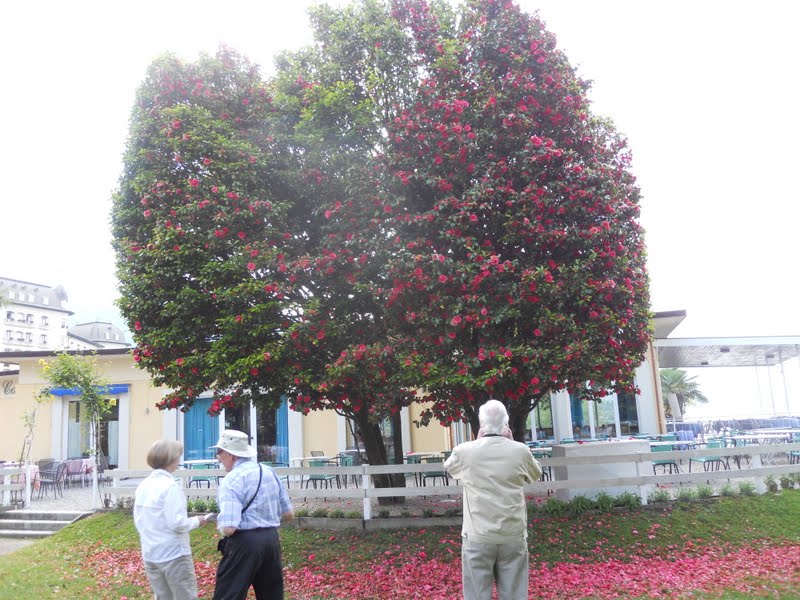
 Then we strolled along the lakeside, stopping for photos of some of the trees that were still in bloom,
 with occasional close-ups.


The Bolongaros deftly assigned room numbers and there was a lot of bustle and hustle as the travellers checked in, collected their baggage and left to explore their rooms and freshen up. We reconvened at 12:30 pm for an alfresco lunch on the hotel's terrace and some tentative and exploratory conversations, as people do when they are getting to know one another. After lunch, Guide K made the welcome announcement that everyone could rest for a while, if they wanted. We would meet our local guide at 4:30 pm for a walk through Stresa. And thus it was that we met Guide P, an effervescent Italian woman who was very knowledgeable about and proud of the Lake Maggiore region.



11 April 2011
Switzerland and Languages
Switzerland is a unique country in many ways. One of its most unique characteristics deals with its internal linguistics. Three distinct languages - German, French and Italian - are spoken here. Where these languages are spoken depends largely on the shared history of Switzerland with Germany, France and Italy respectively. Thus, German is the principal language spoken in northeastern and eastern Switzerland, where Germany and Austria are bordering countries. French is spoken where Switzerland shares a border with France, that is, northwestern and western Switzerland. And Italian is spoken where Switzerland shares the Alps with or otherwise adjoins Italy.

In addition to these languages, a small subset of the population in southeastern Switzerland speaks the fourth national language: Rumantsch. Rumantsch, like French and Italian, is also derived from Latin and is thus a "Romance" language. But to complicate things further, there are five regions where Rumantsch is spoken; each region has a different dialect; and each Rumantsch-speaking region is separated from the others, generally by German-speaking regions.
So, how do people communicate when there are more than three national languages? The answer is simple. Very well. The Swiss broadcast media, for example, air programs in French, German and Italian, with dual options, including English, when a program is broadcast in its original language. And not only do Swiss nationals communicate well with each other, they also do extremely well when a fifth language - English - is thrown into the mix. In fact, quite a few Swiss nationals love languages generally and deliberately strive to learn others as well.
I personally find this a lovely trait. I think that it is a real shame that so many people in my own huge, culturally, linguistically and ethnically diverse homeland seem to feel threatened by non-English speakers to the extent that some states are attempting to pass English-only laws. Teaching foreign languages has always been an uphill battle in the United States - for many reasons - which I will not even begin to discuss here. Again, that is a real shame.
When I was much younger, I had the impression that every single person in Switzerland spoke German, French and Italian. In fact, that is not quite the situation. Most Swiss do speak more than one language. But they principally study French in French-speaking Switzerland and choose English as a second language. In German-speaking Switzerland, English is also favored over French as an elective. In Italian-speaking Switzerland, German or English are often selected instead of French.
There is some concern in French-speaking Switzerland that German is not selected by enough students and that this will ultimately limit their workplace opportunities. Beginning in 2012, there will be a major push to interest students in the Geneva area to study German or even "Schwyzerdütsch" (Swiss German), which is not quite the same thing. Swiss authorities will try to redress what they see as this lack of interest with a three-pronged approach.
First, they will evaluate and improve, where improvement is needed, the abilities of the German-teaching personnel. Speaking German - or any other language - does not necessarily mean that one is able to teach it. They will also introduce a new method of teaching German, both at the primary and middle school levels, that will be based more on oral and written expression. Finally, they will incorporate more hours of German into the primary school schedule, as well as reinforcing the hours already required at the middle school level. While French will retain its absolute priority status in the Geneva area, more hours of English will also be incorporated into the schedule, with Italian as yet another elective.
Language, culture, traditions, practices, folksongs and mentalities are all interwoven. The more we recognize this fact, as well as accept, understand, appreciate and interact with it, the more our own lives can be enriched.
08 March 2011
Centennial - well, almost - but still a LONG way to go!
Today, March 8, marks the observance of International Women's Day (IWD). It was originally known as International Working Women's Day, begun as a socialist celebration in 1911, influenced by rapid world industrialialization that included women in the work force in growing numbers. The resulting economic expansion led women to join men in protesting against inhumane working conditions.
The first IWD was observed on 19 March 1911 in Germany, so technically, we have not quite arrived at the Centennial date. But 8 March is now the date of observance. For some countries, it is a national holiday. The site that describes activities being held all around the world is International Women's Day 2011. For whatever reason (malicious hacker attacks are suspected), the site has been down intermittently throughout the day.
The background and timeline of events leading to IWD as it is celebrated today can be found here. Thousands of events have been and are being held throughout the world today to inspire women and celebrate achievements. A global web of rich and diverse local activity connects women from all around the world ranging from political rallies, business conferences, government activities and networking events through to local women's craft markets, theatric performances, fashion parades and more. For the United Nations, this year's theme is "Equal access to education, training and science and technology: Pathway to decent work for women." The IWD site clarifies that, whatever the umbrella "global" theme may be, each participating country and group may choose a theme appropriate to its perceived requirements; it lists selected themes here.
In the United States, for example, President Obama proclaimed the whole month of March 2011 to be "Women's History Month," calling Americans to mark IWD by reflecting on "the extraordinary accomplishments of women" in shaping the country's history.
When HWMBO lived in Switzerland full-time, he volunteered services as an extremely versatile network engineer to non-governmental organizations (NGOs) located in Geneva, among them the World YWCA. As part of his volunteer activities, he was able to assist on the spot with technical matters for international women's conferences in Cairo (Egypt), Nairobi (Kenya), Brisbane (Australia), Dakar (Senegal), and Georgetown (Guyana), to name some. He was able to see much more of the world than I! His consciousness was thoroughly raised when he was able to see firsthand what conditions, prejudices and circumstance, often socially, politically and economically debilitating, that women - still - face around the world.
It's a real shame that so many others have not had the same kind of enlightening experiences. In my own country even today, right-wing politicians are practically conducting all-out war on women's reproductive choices. Canadian author Margaret Atwood's The Handmaid's Tale is all too eerily prescient, I'm afraid.
01 February 2011
Winds of Change
World-changing events during December 2010 and January 2011 began in Tunisia. Their effects are now being felt across much of North Africa and the Middle East. Can we hope that the time of the autocratic ruler in the Arab World, or throughout most of it, is finished? Let us fervently hope so.
The little country of Tunisia, the "roaring mouse" of recent events, received its independence in 1957 as part of the break-up of the former extensive French colonial empire. The French were only its most recent conquerors, however. Its indigenous people were an agricultural people who utilized farming methods that had originated in the Fertile Crescent regions and arrived in northwest Africa (the Maghreb) via the Nile Valley. They were ancestors of Berber tribes whose descendants today live in Morocco, Algeria, Tunisia, Libya, Mauritania, Mali and Niger.
Tunisia's first identifiable foreign occupiers were Phoenicians who settled its coastal areas around the 10th century BC. They founded the city of Carthage, which became the predominant civilization in the Western Mediterranean, until it was conquered by Rome in 149 BC. The Romans controlled most of what is modern Tunisia from then until the area was conquered by the Vandals in the 5th century AD. It was reconquered by Rome in the 6th century AD. But, around the end of the 7th century and the beginning of the 8th century AD, the region was conquered by Arab Muslims, who continued their sweep westward to encompass current-day Algeria and Morocco and definitively established Islam as the dominant religion. In the late 16th century, Tunisia's coast was among the pirate strongholds known as the Barbary States. Around the same time, Tunisia, like the rest of North Africa, fell under the domination of the Turkish Ottoman Empire. From that time until the 19th-century French invasion, even under its Turkish governors, the Beys, Tunisia was virtually independent. But France invaded Tunisia in 1881, using the pretext of a Tunisian incursion into Algeria, which the French had already invaded and conquered in 1830, using as pretext a slight to the French consul in Algiers. Post-Napoleonic 19th-century France was certainly not averse to using specious pretexts to expand its influence and control, just as in the 21st century, powerful nations continue to "justify" their invasions of others on equally specious pretexts.
Tunisia's struggle for independence was led by Habib Bourguiba, who then became its first first President. After being virtually unchallenged in that role for 30 years, Bourguiba was ousted in a bloodless coup in November 1987 by being declared unfit to rule by his doctors. His Prime Minister Zine El Abedine Ben Ali assumed the Presidency and ruled until what the West is calling the Jasmine Revolution, a continuing series of street revolutions that constitute the most dramatic wave of social and political unrest in Tunisia in three decades. As result, Ben Ali stepped down and left the country. A caretaker government has been created, with elections scheduled to take place within 60 days. The situation will remain unresolved until then, at least.
Tunisia's seemingly successful protests against corruption in government, autocracy and looting of public assets have sparked similar protests in other Arab countries. They have been compared to the Velvet Revolution in the former Czechoslovakia because they have created a domino effect in the Arab bloc, much as the Velvet Revolution did in the Communist bloc. Most prominently in the press these days are the demonstrations in Egypt, which are being covered most comprehensively by non-US networks and print media. Here, for example, is a link to Al Jazeera English, which provides live on-line streaming of events as they occur.
Unlike the actions in the Communist bloc, which were universally cheered on and hailed with great glee by the leadership of Western nations, these actions that so far have shown basically peaceful demonstrations in support of political rights and against corruption by too-long entrenched powers are, at best, being very cautiously welcomed by the Western powers. Those of us who are unhappy with leaders who profess to believe in democratic rights only when the voting results ensure the comfortable status quo for the ruling classes that has been carefully maintained over the years are equally unhappy with these cautious pronouncements. It's understandable that our Western leaders - not just those here in the US - are nervous. After all, it is our combined policies - too often short-sighted, unfair and imbalanced generally - and funding that have helped to prop up and keep the corrupt ones in power. And everyone knows it. At least, everyone outside the United States knows it. We here have been so dumbed-down in our knowledge and understanding of international events that too many here haven't even the slightest idea of how our actions resonate badly and are perceived abroad.
Fortunately, there are sources that do attempt to let the people involved speak for themselves instead of being interpreted by essentially no-nothing US pundits or those with a particular political agenda. Al Jazeera's coverage is one. There are admirable others. One such is the Guardian (UK). Here, for example, is an interactive link from the Guardian that shows the very thoughtful responses and unanimous support of the peaceful demonstrations and movements for change by several writers, both male and female, throughout the Arab world. If that link is somewhat challenging (arguably some of the click-on balloons make it difficult to read the actual words of the writer in question), here is another. These responses are well worth reading. They provide unfiltered views of those who have all too often been poorly - and unfairly - portrayed in US media, in particular.
These winds of change should not be considered frightening. They should be welcomed wholeheartedly. Let us all take heart from the courage that is being shown by the millions who are in the streets. If their actions do ultimately result in the kinds of beneficial changes that will make these societies more open and more equitable for all their citizens, then we will all be winners. How could we not? This is not naivety. It is common sense.
28 October 2010
Geneva - Literary and Cultural Crossroads
Shortly after HWMBO arrived here earlier this month, but before the frenzy of later events, commitments, projects and illnesses, the two of us joined members of our local writing group for a literary tour of Old Town (la Vieille Ville) Geneva. We timed our 8:45 departure for Geneva to coincide with the last vestiges of the "Rush Hour" but discovered that it still took us a good hour to make it into town, through the international organizations section, across the Mont Blanc bridge and into the eponymous underground parking area there. This left us a scant 15 minutes to make our way on foot from the parking up to the fountain in the Place du Bourg de Four in the center of the Vieille Ville so as not to be late for the 10:00 meeting time.

We were the first to arrive. Other members of the group - we were about 12 in all - ambled in more or less on time and we all introduced ourselves. As we later learned, some had driven from as far afield as Fribourg, making our own little junket seem minimal in comparison. We all agreed, however, that the morning's traffic had been nothing less than cauchemaresque (nightmarish). The weather was also quite brisk so we were very glad to have bundled ourselves up warmly. Our guide, a British expatriate who has worked for Geneva Tourism for years and who now considers Geneva her home, has made a speciality of researching writers throughout the ages who have come to Geneva, who have either been inspired by or had experiences here that have resonated so that they committed them to paper for all of us to share. To begin with, she led with a major Heavy Hitter. The first written mention of Geneva that she had found was from the notable historical character, Julius Caesar, who already had quite an illustrious military career behind him before his destiny led him to Geneva.

The reference to Geneva dated from 58 B.C., when Caesar had arrived at the western tip of the lake, believing that it was the source of the mighty Rhône river. He didn't have the benefit of our later knowledge that the river originates in the Alps southeast of Lake Geneva. Even if he had had that knowledge, it probably would not have made a major difference in how events ultimately played out. Caesar came to the Geneva area specifically to confront the Helvetii, a Celtic tribe living in what is now central Switzerland. The Helvetii planned to move to southwestern Gaul (now France) - by force if necessary - to settle on what the tribe believed were more fertile lands there. The Helvetti feature prominently in Caesar's Commentarii de Bello Gallico (Commentaries on the Gallic Wars). Thus, Caesar provides the first known literary reference to Geneva in those commentaries. A spirited recap of Caesar's Geneva campaign and its aftermath can be found here.
Geneva continued to attract notable travellers, poets and writers throughout the centuries, in part due to its geography. It is, after all, a central crossing point between northern and southern Europe, as well as between western and eastern Europe. Other personalities, events and influences contributed to its international attractions. When Romans were converted to Christianity, for example, they brought Roman Catholicism to the area. But during the Reformation, French-speaking Geneva invited Jean Calvin to come from Basel where he had initially sought asylum. Thus, the formerly Catholic St. Peter's Cathedral became a Protestant Cathedral - and remains so today.

A group of touring students felt comfortable enough to rest on the Cathedral's steps.

As a result of Calvin's influence, Geneva became a center of religious reform, as well as a center of religious freedom and, especially later with Jean-Jacques Rousseau in the 18th century, free thought. In the 19th century particularly, Geneva came into its literary own. Members of the British aristocracy often travelled through the area, especially on their way to the sunny climate of Italy.
Many of these were writers who were literally enchanted by the breathtaking scenery and some stayed on a bit, notably the poets Lord Byron and Percy Shelley and Mary Wollstonecraft Godwin, who became Shelley's second wife. She wrote her Gothic masterpiece, Frankenstein, while spending a cold rainy summer on the banks of Lake Geneva.

Russian writers seeking refuge from debt-collectors or penurious Russian aristocrats also spent time in Geneva. That is especially ironic, considering how expensive the cost of living in this area is now.
While doing research for this post, I happened upon an article from the New York Times, dating from 1919, noting that it was hardly by chance that Geneva was selected to be the site of the League of Nations. Writer Julian Grande states rather grandiosely, "By selecting Geneva as the site of the League of Nations, the city of Calvin and Rousseau, of the Reformation and the Red Cross, and of refugees in all times, has now become the capital of the world." Unfortunately, things did not turn out too well for the League of Nations. But its successor entity, the United Nations, while headquartered politically in New York City in the United States, has left most operational functions to its major European office, the United Nations Office at Geneva (UNOG), which is actually headquartered in the Palais des Nations where delegates to the former League of Nations met. Geneva is referred to by UNOG as the "Heart of Europe."
Is it any wonder that so many of us latter-day travellers also love this area?
20 August 2010
Robots at the "Battle O' Baltimore"
A couple weekends ago, HWMBO and I happily were able to be present at the Battle O' Baltimore. This recently constituted event has absolutely nothing to do with the better-known Battle of Baltimore that took place during the War of 1812, when US forces successfully defended the city of Baltimore from an invasion by the British fleet who had sailed to the port of Baltimore via the Chesapeake Bay. The defense of Baltimore at nearby Fort McHenry inspired Francis Scott Key to compose the lines to what we now know as "The Star-Spangled Banner," aka the US national anthem.
The Battle O' Baltimore that we attended was not nearly as violent as the 1812 original, thank heavens! It was also great fun to watch. As described in the url link provided above, this was the fourth annual "battle" of "robots" that are specifically designed by secondary school robotics clubs to play soccer (aka "football" to the world outside the United States) or, more properly, a variation of that game. After returning from his visit to Switzerland and France, Grandson Prince C joined his school's robotics club where he has learned quite a lot. At first, he was part of the design team. By the time of the "Battle," he was one of those operating his team's robot. The teams that participated in this year's event came from Pennsylvania and Virginia as well as Maryland and are listed here. Here are those who were judging the event.
 The "Battle" took place in the gymnasium of the Boys' Latin School of Maryland, which is in a beautiful part of Baltimore. In the gym, each team had a cheering section.
 Some cheering sections formed conga lines that serpentined around the gym between matches.
 As it turned out, we arrived a bit later than we should have although the news that greeted us was good. Prince C's robot had competed so well in its previous matches that it would participate in the semi-final bouts. Fortunately, we were in time for those. Robot 2199 is the one that we cheered for.
 Prince C's blue t-shirted team huddles, planning their strategy.
 Then they check their robot over carefully to ensure that everything is working the way that it should.
 And here is mightly little Robot 2199 in action!
While Prince C's team won its first semi-final bout, it lost the next two, so it was the other team that went on to the final match. We were very proud of him and his team's accomplishments. And Prince C still had a big smile for his Grands!
 It will be a "Battle" to look forward to next summer!
The Battle O' Baltimore that we attended was not nearly as violent as the 1812 original, thank heavens! It was also great fun to watch. As described in the url link provided above, this was the fourth annual "battle" of "robots" that are specifically designed by secondary school robotics clubs to play soccer (aka "football" to the world outside the United States) or, more properly, a variation of that game. After returning from his visit to Switzerland and France, Grandson Prince C joined his school's robotics club where he has learned quite a lot. At first, he was part of the design team. By the time of the "Battle," he was one of those operating his team's robot. The teams that participated in this year's event came from Pennsylvania and Virginia as well as Maryland and are listed here. Here are those who were judging the event.


While Prince C's team won its first semi-final bout, it lost the next two, so it was the other team that went on to the final match. We were very proud of him and his team's accomplishments. And Prince C still had a big smile for his Grands!

Subscribe to:
Posts (Atom)