Showing posts with label Nostalgia. Show all posts

13 October 2012

"Dresser" and "Chiffonier" - Together Again

Last Sunday, my late mother's elder sister, our beloved Aunt H, passed away of natural causes at the age of 95.  Fortunately, I was able to visit her this past summer in Montana on the week before her 95th birthday, taking with me Swiss chocolates (of course!) and a dozen red roses.  She proudly posed for a picture with her roses, looking much younger than her years.
During our visit, I found her as sharp and funny as ever, as keenly interested in the world as she had always been, but very much missing five of her younger sisters who had preceded her to the Great Beyond.  Only one of the original "Seven Sisters," Aunt E, remains with us now.  I was also able to visit her, together with her husband of 64 years, my Uncle P, and they also posed for me, although poor Uncle P was not quite sure exactly who I was.
Among our old family photos, I finally found one of all seven sisters together.  It was taken sometime in the 1930s in the yard of their family home in rural Montana, most likely before Aunt H first left to attend college in one of the "cities."  They literally look as if they are poised on the threshold of their lives, ready to embrace their separate destinies in due course.  Aunt H is at the upper left, next to my mother.  Aunt E is the impish-looking one on the left side of the front row.
Now, of course, we know how their stories played out: how all of them married and bore children, my cousins, and even how my cousins in their turn married - or didn't - and had children - or didn't - and how their children have since had children themselves - or not - and so it goes.  Aunt H especially LOVED the children!  Here she is, just this summer, surrounded by "greats," all of whom adored her and who had made the cake for her themselves.
Aunt H was a local celebrity, always a hit at gatherings, not simply those of our own family but also of her friends and their families because she could write the most clever poems to celebrate whatever occasion it happened to be.  She would recite them, as here, on the occasion of Aunt E and Uncle P's 60th wedding anniversary in 2008.
And here she is with two of her children, her eldest daughter and her youngest child, her only son.  Two daughters were unable to attend that gathering; another daughter had predeceased her.

Tiny, but with a sense of humanity and humor larger than life, she could light up the world around her.  I don't believe that I ever heard her utter a cross word.  Not only did she share full partnership at all the farm-related chores with her late husband, my Uncle J, including milking their cows manually, but she bore and raised five children.  After milking the cows, she would separate the milk from the cream in a separator.  As I recall, she even churned her own butter.  I only re-experienced something like her home-separated cream after I moved to Switzerland and tasted the wonderful double Gruyere.  All her bread was home-baked and her cinnamon rolls were legendary. With her Singer sewing machine, so ancient that it was operated by a treadle rather than electricity, she would generously "whip up" clothing for her daughters and her nieces.  Indeed, during my early years, the only non-hand-me-down clothing that I wore was courtesy of Aunt H's sewing skill.    

When she spoke at my late mother's Celebration of Life in 2002, she described how she and my mother, when they were very young, would pretend that they were in fact princesses.  They called themselves "Dresser" and "Chiffonier" after the two most elegant pieces of furniture in their small and very crowded home simply because they liked the names.  Equipped with whatever bits of finery they could concoct together, they would embark upon endless series of adventures - fitted in among their chores.

Now Dresser and Chiffonier are together again, rejoicing I am sure with all their loved ones who preceded them.  May this newest adventure be the most wonderful one of all!

But we who are left behind miss them all.  Very much.

02 May 2012

And Now There Are Two

Once upon a time there were seven little girls, sisters who were separated in age by 15 years from oldest to youngest. There were also two little brothers, but they were older and did not have the same father as the little girls did. The little girls' father had hoped in vain for sons of his own, but finally understood - after seven daughters in a row - that it was not to be. So he adopted the little boys and gave them his name. Apart from the three oldest sisters who were old enough to remember, the little girls didn't know their brothers as well as they knew each other.

In their earliest years, the burgeoning family lived in a tiny house near the coal mine owned and operated by their father and his brothers at some distance outside the nearest small town. Here are six of the seven (minus the youngest daughter, who hadn't been born yet) near the creek at the mine, where they all loved to play. My mother, described as "a little dark-haired beauty" by her older sister, was the second oldest. Here she most resembles her own daughter, Artist Sis.
Their father and his younger brothers had come to Montana via Canada from Buckinghamshire in England. Some versions of the story maintained that the brothers had originally intended to work their way across Canada and ultimately set sail for Australia. But by the time they reached Alberta, they had heard about the land giveaways by the Great Northern Railway in the high plains of northern Montana. In those days, it was easy to enter the US, so they simply walked across the Canadian border. Having spent time in coal mines in England, they knew what was necessary to manage one. They spent the rest of their lives in Montana, first mining, then farming.

The little girls flourished. The family eventually moved into town so that the girls could attend school there, but summers were generally spent at the mine. Little did the girls imagine that someday - many years hence - some would have their ashes scattered in that beautiful place where they remembered their happiest days. But many years would pass before that would happen.

By the time the oldest of the little girls became young women, WWII was raging in Europe. Ultimately the US entered the fray after the bombing of Pearl Harbor. The war's reverberations were felt by all. The oldest, Aunt H, had married a farmer, an immigrant from Norway, in the years before the US entered the war. My mother and her sisters, Aunts L & J, headed west to Seattle where they were able to find jobs that were then opening up to women while the men were conscripted to fight. My mother and Aunt L married their husbands, both servicemen for the US in WWII, in the early part of the war before the men were sent abroad. When mother discovered that she was "expecting," she returned to her parents' home, as did Aunt L with her own newborn daughter. Most of the sisters were thus reunited for the duration of the war. The younger sisters finished their schooling. All met and married husbands and had children in due course. Here the family, less Aunt J, is assembled for the wedding of the "baby" Aunt Ja (aka "Butter," so nicknamed because she was "as precious as butter," which was rationed during the Great Depression when she was born). My mother, standing next to her parents, is the only sister who is not dressed as part of the wedding party. She was "expecting" Healer Sis at the time.
I do not seem to have any of the family photos that feature all seven in the same photo, if any such exist at all. It seems that there was always at least one who was absent - not always from this world - simply from the photo. Here, for example, is a photo of five (Aunt J is once again absent but Aunt Butter had passed) posing with their oldest brother, Uncle J.
Ironically, it was the youngest, Aunt Butter, who was the first to leave this world, even before her parents or her older brothers, stricken by a cerebral hemorrhage in her 40s. Later it was Aunt MJ's turn in her 70s, followed by my mother in her 80s and Aunt J, just having turned 80, all victims of manifestations of that most deadly disease: cancer. This photo of the five sisters remaining after Aunt MJ's death seems to presage that their calling home was nearing for all, haloed as they are in the sun.
Last month, it was Aunt L's turn, also due to cancer. And now there are two.
Our family "matriarch," Aunt H, and her second-youngest sister, Aunt E, are still here. We love them both, just as we will always love their sisters. We can only imagine how happy they all must be to be reunited with so many they loved. But we will always miss them - and remember.

28 April 2012

Morocco - Honored Guest

In yesterday's post, I mentioned that Morocco is the Guest of Honor at the 2012 International Book Fair in Geneva.
As a result, in addition to several books, as well as other displays and exhibitions featured throughout the Palexpo center, the book fair program includes sessions about the place of books in Morocco, seminars on current political and cultural developments there and tributes to various deceased Moroccan writers. Special attention is being given to women and children in writings. There is also a workshop on Arabic calligraphy.

At the entrance to the Moroccan bookstore section, I was delighted to find a book that is a modern reprint of French Romantic painter Eugene Delacroix's sketchbook and diaries from his travels in North Africa in 1832, when he accompanied a diplomatic mission to Morocco and Algeria shortly after the French had conquered Algeria. The mission set sail from Toulon, France, landed at Tangier, Morocco and then traveled across Morocco into Algeria, returning to France via Oran and Algiers. Delacroix's artwork was profoundly affected by these travels and the colorful sketches from his journals served as inspiration for some of his most famous paintings. Delacroix would have been inspired by some of the exhibits, such as this display of a saddle, musket and riding boots, probably very like those he observed firsthand and painted.
Two young Moroccan women, dressed in kaftans, greeted visitors to the bookshop,
and two other kaftan-clad hostesses were ready to treat visitors to a tea ceremony with the tiny multi-colored glasses that are used to hold the very hot, very sweet mint tea that is served everywhere in Morocco,
while another display case featured sumptuous - and likely heavy - ceremonial kaftans and headdresses.
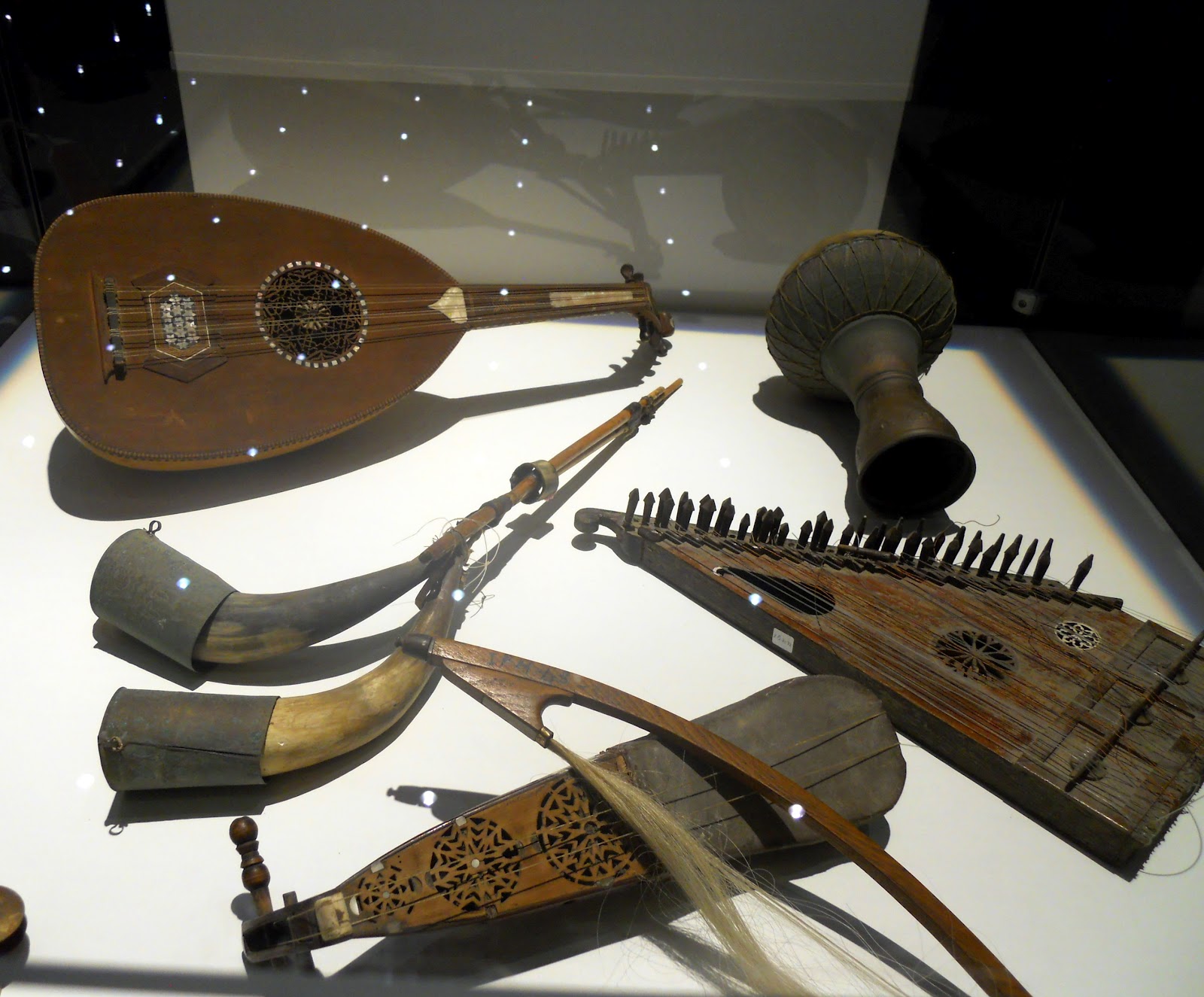
One display featured a selection of traditional musical instruments
while in another area, a musician enchanted several children by playing the oud.
There were examples of mosaics, crafts that North Africans carried with them to the Iberian peninsula,
copper worked receptacles,
and Berber jewelry,
as well as displays featuring the bounty of Moroccan agriculture, such as grains,
spices and scents.
All in all, my visit to the exhibits at the book far provided a lovely reminder of the beautiful and exotic country where I spent eight years of my adult life among lovely people and had many life-enriching and life-changing experiences, including the birth of my second son in Tangier some 135 years after Delacroix had first landed there. As it had with Delacroix and has with so many others before and since, Morocco also worked its magic on me.
   

02 April 2012

Caravans, Cranes and War Without End, Part 3

As with so many situations today, thinking about the country of Afghanistan - and how it has changed from my initial romantically sweeping impressions and not for the better as a result of the military invasion spearheaded by the US in late 2001 - is, at the very least, depressing. Thus, before getting too far into this post, I would like first to post these words from someone I greatly admire, the late noted historian and author, Howard Zinn. His words serve as a touchstone to remind us that even during some of our darkest hours, the best qualities of our shared humanity have - so far - managed to transcend the worst of situations.
"To be hopeful in bad times is not just foolishly romantic; it is based on the fact that human history is a history not only of cruelty, but also of compassion, sacrifice, courage, kindness.
What we choose to emphasize in this complex history will determine our lives. If we see only the worst, it destroys our ability to do something. If we remember those times and places - and there are so many - where people have behaved magnificently, this gives us the energy to act, and at least the possibility of sending this spinning top of a world in a different direction. And if we do act, in however small a way, we don't have to wait for a grand utopian future.
The future is an infinite succession of presents, and to live now as we think human beings should live, in defiance of all that is bad around us, is itself a marvelous victory." [Emphasis mine.]
In October 2001, ostensibly due to the refusal of the then-Government in power in Afghanistan, the Taliban, to hand over Osama Bin Laden to US authorities and to disband Al Qaeda bases in Afghanistan following the catastrophic 9-11 bombings, the US launched "Operation Enduring Freedom (OEF)." As pathetically and hopelessly misnamed as other US military ventures occurring during the 2001-2008 period, the only thing enduring about OEF is its length. So far at least, "freedom" in any meaningful sense for the Afghani people has been an impossible dream. OEF's US and NATO fatalities appear comparatively minimal in relation to military operations on a similar scale. But the human toll - both physical and mental - on the Afghani people and all combattants and the continuing deterioration and destabilization of the entire region, to say nothing of the extravagant sums of money literally poured into a bottomless Black Hole that have enriched unscrupulous people of all nationalities with little benefit to the ordinary Afghan together with the area's strongly resurgent trade in opium poppies, make this ill-advised, ill-conceived and ill-implemented measure one of the greatest military stalemates, if not in history, certainly in recent times.

It didn't have to be this way. Yes, my country was greatly traumatized - and remains so today - by the events of 9-11. I myself am still traumatized by them. But I remain even more traumatized by their aftermath. Unscrupulous, indolent and short-term opportunistic politicians and their Machiavellian puppeteers - in the name of a "War on Terror" - seized upon the occasion to curtail US civil rights and liberties to an unprecedented extent (see the so-called "Patriot Act"). They also implemented agendas that had very little to do with "freeing" anyone, but very much to do with gaining complete access to strategic geopolitical locales  and to the enormous reserves of natural resources located therein, as well as personal enrichment.

The US had itself laid the groundwork for Al Qaeda in the 1980s by arming and training the most rabid opposition groups to fight against the Soviets. As Edward Girardet states from his first-hand observations, "Despite endless opportunities to support moderate factions during the Soviet-Afghan war, the CIA - prompted by Pakistan - insisted on working closely with the most fanatical Islamic factions." Girardet notes further that, even before the infamous August briefing (that then-President Bush apparently never read that warned that attacks were being planned in the US), that the US was warned in 2001 by credible, less fanatic, Afghan leaders that there would be an attack in the US and that there should be no intervention - particularly a military intervention - in Afghanistan, but rather that pressure should be put on Pakistan. This was because Pakistan, particularly through its military intelligence, was supporting the Taliban. As we have seen since, Pakistan still supports Taliban factions today. In fact, Girardet asserts that, had the US not rushed into Afghanistan in 2001, the Taliban, who were already on the point of implosion, would have defeated themselves. There were simply too many different voices and factions - an endemic Afghan situation. What a lot of anguish the entire world might have been spared, had cooler heads and more informed, less selfish and less short-sighted individuals been in power in the US in 2001! If only.

There is universal consensus - save for armchair military "experts" - that a military solution in Afghanistan imposed by outside powers is improbable, if not impossible. Centuries of military history in the region would seem to bear out that consensus. "Justice" cannot be imposed by military means. Any viable solution must involve Afghans in their own destiny. They must include not simply those Afghans selected by or acceptable to Western power-brokers, but every group of Afghans that has a stake in their own nation. Afghans - not simply those at the highest levels -  must be consulted and involved in their own destiny. Plenty of people are needed with full measure of our best human qualities: compassion, sacrifice, courage, kindness - much of which has been demonstrated by selfless countless aid workers on the ground before, during and continuing even now under extremely difficult circumstances.

The current plans for US "drawdown" rely too much on our continuing military presence in Afghanistan. This is perceived as an occupation - with some few soldiers inevitably either deliberately insulting Afghans or committing atrocities - even though the majority of military personnel are simply trying to do their best in extremely difficult circumstances, with an undefined and nebulous "mission" to boot.

As one veteran of the US war in Iraq puts it, "War doesn't just rob the occupied of their humanity; it robs the occupier of theirs too. And this is why humankind cannot continue to wage senseless wars that accomplish nothing but death and destruction." Well said, IMO, from one who has "been there, done that."

Humankind is incredibly resilient. It survived the world's arguably worst Holocaust ever in the 20th century, after all. While there is much harm from the past decade that can never be undone, if we can all learn lessons from it and do as much as we can to mitigate its lasting effects to assist in building new foundations and new bridges among cultures, there is reason to be optimistic. While some of us may never be able to travel with the caravans as did the characters in Michener's novel nor will we ever behold unscathed relics of former civilizations in Afghanistan such as the Buddhas of Bamiyan that HWMBO visited in the late 1970s, perhaps we will one day see the cranes return to fly over Kabul in the spring. Or, better yet, Afghans themselves who are living in harmony among their fellows and with their environment will see these lovely emissaries of spring and wonder at their passage.    

30 March 2012

Caravans, Cranes and War Without End, Part 1

When I was much younger, among the books I loved to read were those by novelist James Michener. Michener's works were generally characterized by their scope and treatment of epic sagas.  He often began literally at the geological or at least the pre-historical origins of the regions that he wished to encapsulate for his readers and described ensuing generations in detail. One literally needed a map of the territory or territories covered, along with family trees to keep the characters sorted, as the stories wound their way through the generations, with actual historical events often forming the backdrop. Michener's research was meticulous. But what also characterized his novels for me, especially in hindsight and upon reading some at my now more advanced age, was Michener's prescience. So many of the issues he treated, whether they concerned ethnic identities, religious zealotry, tolerance or the lack of it, individuals and their rights or identities being subsumed into a larger geopolitical military context or simply appreciation of the richness, beauty or vast expanses of the regions his novels dealt with, have emerged time and again as events in those regions have made headlines.

Some of his novels have resonated with me at different times in my life. More eerily, they have even paralleled my own life trajectory, although occasionally in their film as well as written forms. Thus, I first saw "South Pacific," the film made from the blockbuster Broadway musical of the same name based on his Pulitzer Prize-winning novel "Tales of the South Pacific," in the early 1950s when my family made its first-ever major family trip together. We had boarded the then-orange-and-black Empire Builder in our tiny rural home town in Montana - that was when the train made stops in other than major cities so that people could actually get from one place to another - and traveled westward for many, many hours through the Rocky Mountains to Spokane, Washington to visit my father's parents as well as other family members there.  As if the Spokane visit were not already an adventure sufficient unto itself, while we were there, we attended a showing of the movie. The wonderful tunes, beautiful film footage and story line grabbed my soul and imbued it - once and forever - with the wanderlust that has been with me since.

Continuing Michener's fascination with Polynesia was his 1959 novel, "Hawaii," which I loved - even the seemingly-endless description of the birth of the islands themselves. While awaiting the birth of my older son in the mid-60s, I read "Caravans" and "The Source." After living in Tangier, Morocco in the late 60s and meeting descendants of those whose ancestors had fled to Morocco from Spain after the Spanish had reconquered Andalusia in the 15th century, I read "The Drifters." I read several other titles in the 1970s, courtesy of the Missoula County Public Library.

"Caravans" re-entered my life in film form late in 1980, when my sons and I were once again in Morocco, this time in Rabat. As an aid worker, I was entitled to attend English-language films at the Embassy and generally took my then-teen-aged sons with me - homesick as they were for anything American at the time. Somehow we had missed seeing the film in the States, so it was a new experience for us. A few months later when I had been introduced to the man who would later figure in my life as "HWMBO," I was delighted to learn that much of the film had been shot on location in Iran, near where HWMBO and several other US expatriates lived during the time when relations between our two governments were friendly. Some of these new friends had actually been "extras" on the set! Now we were together with them in Morocco. They were as affected with wanderlust as I!

Later, after marrying and returning with my newly increased family to Maryland, I read Michener's "Chesapeake." It was a lovely introduction to that home. That novel is here with me now. In Switzerland.

But all those life experiences were pre-9-11, that catastrophically tragic day when the world literally changed forever.

Michener was fortunate. He left us all in 1997, before the horror arrived, before the decade-plus thereafter when the US - if it ever truly had a claim as a "White Knight" had most certainly lost it, perhaps forever.  And now for the Cranes ....

13 March 2012

Solar Flares and Aurora Borealis

The past several days, various news sources have discussed the solar flares that our Sun has been responsible for lately. Yes, our gallant life-giving star occasionally has its moments. Perhaps the Sun is frustrated with the antics of us humans here on Earth - and methinks we may give a lot of cause for that. But even in spite of our antics, the Sun continues with these phenomena. The flares are apparently caused by large energy releases. They eject clouds of electrons, ions and atoms through the Sun's corona into space, ultimately bombarding those in their path with x-rays and UV rays.

It appears that we here on Earth are fortunate, for the most part. These charged particles may occasionally disrupt long-range communications, although so far there has not been much disruption reported. It also appears that Earth has a strong enough magnetic field to repel harmful rays so as to protect our atmosphere from being stripped of its oxygen atoms. I find that to be a good thing.  After all, none of us could exist without oxygen. However, our neighboring planet, Mars, has a magnetic field that is not as strong as our own.  This article describes how Mars loses oxygen atoms in its atmosphere ten times faster than Earth's atmosphere does.

But in recent days, I have also noticed more people on Facebook and elsewhere posting photos of the wonderful Northern Lights displays in their areas this year.  One wonders whether the Sun's recent activity may have something to do with some of the more spectacular displays.  Or perhaps I am just noticing these displays more this year.  Here, for example, is a wonderful video from Norway, taken in January 2012.  And here is a series of photos as posted in today's Washington Post online, taken by Alaskan photographer, Dennis Anderson.  Sorry, but you'll first have to sit through 15 seconds of a commercial before being able to view the WaPo series.          

Around here, the night skies have been much more subdued.  We cannot see the Northern Lights from here, although the last few evenings, we have had some nice sunsets. Here was last evening's:
I LOVE the wonders of the internet!  The Northern Lights were winter phenomena of my youth that helped to compensate for the long, cold, dark, bleak and harsh winters on the high plains of north-central Montana.  In my youth, I didn't realize how fortunate that I was. After all, not everyone could see these wonders first-hand, as we were used to doing, but I didn't know that then. Even then, however, I appreciated their almost supernatural beauty.  With the internet, I can now relive some of that pleasure without having to endure the occasionally painful existence.

That is pretty close to a definition of Paradise, IMO.

31 August 2011

County Fair

August has literally raced by.  At the beginning of the month, I had visitors and days were busy with rushing about visiting tourist areas and other destinations.  I also had to surmount my last hurdle before officially being offered a position that will allow me to continue living in my apartment in Switzerland.  Then, once my visitors had departed and with the original schedule having been disrupted by my last-minute change to plans, I caught a plane for MD and have been spending time with family and friends here.  "Little things" like an earthquake that happens once every century and what could have been the most disastrous US hurricane ever, given the scope and population that could have been affected, have also occurred this month.  Thank heavens that neither of those last events was as bad as it could have been!

Earlier in the month, however, HWMBO and I decided to take advantage of a break in the usual hot and humid August weather to attend the local county fair.  We arrived early and thus were able to browse about without being much affected by crowds, our favorite time.  Here, HWMBO enjoys looking at an ancient Ford.  He remembers his father driving one like it.

Obviously, agriculture - still an important part of Maryland's economy - was featured at the fair.

We visited halls full of steers, some prize-winning, others not.  All were beautifully cared for.  Unfortunately for them, all were also destined to become features on beef menus throughout the county.

Even this handsome guy ....

Fate was kinder to dairy cattle ... so long as they were heifers.

We also enjoyed watching the sheep judging

while other sheep await their turns in pens.


This one looks like a Shar-pei!  It has more wrinkles than I do - well, perhaps not.

The pigmy goats were cute.

Prince Tyger would have LOVED to visit this exhibit.  HWMBO is convinced that he'll be an engineer with his love of anything mechanical.

We also went over to watch the quarter horse competition, bemused somewhat by the fence-borne water hoses that are used to wet down the dusty surface of the ring.

This rider was waiting casually outside the ring.  She and her horse were eventually among the prizewinners.

Once the riders were allowed inside the ring, they trotted their horses around as requested

and then lined up for the decisions of the judges.

From the horse show ring, we browsed through more exhibit halls, seeing veggies galore

as well as exhibits from the various 4-H Clubs in the area.

There were eating options available and

 none were crowded this early on a weekday.   The amusement park hadn't even opened yet.

When I was growing up in Montana, county and state fairs were always the highlights of my summer.  The sights, noises and smells bring back a wealth of memories.  For a couple years, Artist Sis and I actually belonged to a 4-H Club ourselves, although being "townies," our projects had to involve sewing or cooking instead of raising an animal as our country cousins did.

In some ways that was better, because we never had to say goodbye to our aprons and scarves (our usual sewing projects) or to think of them as someone else's dinner!

16 May 2011

Very Belated Mothers' Day Greetings!

I must apologize.  But I was so excited about our visit to Italy that I forgot that while I was gone, Mothers' Day would occur.  May is the month when mothers in the US and some other countries are traditionally honored.  Spank me with a wet noodle, please, because my very special sisters, aunts, daughters-in-law, other in-laws and friends who are mothers did not receive ANY special greetings from me on The Day!  For shame!

At the very least, I could have programmed in some trusty - and enjoyable - Jacquie Lawson e-cards for my loved ones.  I first discovered Jacquie Lawson some years back after reading an on-line article describing how her e-cards were giving the more established greeting card companies fits.  Curious about this, I stopped by for a look at her website and have since become a faithful subscriber and an enormous fan.   In my opinion, she is far and away the best there is in the e-card business.  She is worth an entire blog post herself.  Another time, perhaps.

In this post, which comes not just a week but nine years late, I would specifically like to remember my own mother, who was born, raised, and educated in Montana, raised five children there, and, with the help of my father, provided college educations for all.  Yes, we all helped by earning scholarships and working part-time while we were students, but it was the expectations that she and my father had of us, in addition to their financial support, that assisted us in accomplishing our personal and professional goals.

The earliest photos that I have of her date from the early 1920s.  She was born in 1920, right after the Great War but before the Great Depression.  Unusually for the time, she was born in a hospital, my grandfather having been quite solicitous of his wife's health.  She was my grandmother's fourth child, but only the second for my grandfather.  Grandma was a widow with two sons when she met and married my grandfather; he adopted both and gave them his name.  Here is Mom with her older sister, my Aunt H.

Grandma gave birth to nine children who lived: two sons and seven daughters in all.  Grampa tried mightily for sons of his own but it was not to be.   While the children were young, the family lived outside their little Montana town near the foothills of the Rocky Mountains in a minimally outfitted homestead where Grandpa and his brother, Great-Uncle F, had a coal mine.  "The Mine" became the setting for many a tale of my mother's childhood with the mine ponies, Dixie and Brownie, and Birch Creek - the stream flowing through the property - featuring prominently.   Here she and five of her sisters - the youngest not even born yet - pose on the rocks near Birch Creek.

After graduating from high school, Mom attended a two year teacher's college and became an elementary school teacher.  Here she poses in her college dorm with a favorite stuffed animal.

She met my father in her home town while he was filling in at the local newspaper there during the illness of the regular publisher.  His own home town was about 60 miles east of hers and the newspaper publisher there had literally taken him under his wing and taught him the printing trade.  Mom and Dad dated for a time and then my father travelled to Alaska to work for a newspaper there.  That might have been the end of the story for them except that on 7 December 1941, the Japanese bombed Pearl Harbor, and my father returned to Seattle, WA in the Lower 48.  He was lonely there, knew that it was only a question of time before he enlisted and received orders, and asked Mom to join him in Seattle where he would help her find a job.  So, after her teaching obligations for the year had been fulfilled, she and two of her younger sisters, my Aunts L and J, went to Seattle where they were rapidly hired to work in industries gearing up for a wartime economy.  Dad enlisted in the Navy and he and Mom were married in Seattle.

After that, Dad was ordered to report to San Diego for training.  Mom joined him there later on and was once again quickly hired to work in a wartime-related industry.  From most accounts, that period of their lives was quite a happy one.

When Dad was shipped out to join the fighting in the South Pacific, Mom, having discovered that she was expecting yours truly, decided to return to her parents in Montana.  In due course, I was born and accepted quite easily that my father must be a picture because that was all that I ever saw of him in those early years.

Mom returned to teaching in her home town while Dad was in the South Pacific.  Here she is with her first grade class.

Fortunately, Dad made it through the war safely.  After he returned, we moved back to his home town where he was co-publisher of the local newspaper and my second sister was born.  Here is my mother with my grandmother and my great-grandfather, together with me and my younger sister, Artist Sis.

Ultimately, our family grew to include four girls and one boy, planted firmly in the middle with two sisters on each side.  The poor guy never stood a chance!  Mom proudly pinned his Lieutenant's bars on him after he completed his OCS training to become a US Marine.

My brother survived the conflict in Southeast Asia, but was brought down at a much too-young age by a stealthier enemy: colon cancer.  Neither Mom nor Dad ever quite recovered.  Most parents are never the same after the death of a child, no matter how old the child.  But they still managed to take great joy in ALL their grandchildren, including my brother's daughter, Princess E.  This is one of my favorite photos of my mother, with her youngest grandchild, Princess B.

Mom's fondest desire was that we all take a family cruise together - and so we did, in December 2000.  It was not the happiest time for our family because we were all terribly upset by the stolen election that year.  Mom, my sisters and I, and Princess B, grown older, may all seem a bit dazed in this photo.

We are still very happy that we did have that time together, however.  It was only a scant year later that Mom was diagnosed with multiple myeloma.  After that, it was only a question of time even though she believed, right up to the last, that she would somehow win out by sheer indomitable force of will.  We lost her in August 2002, a few short months after she posed (on the left) with two of her remaining sisters, my Aunts H and L.

I feel certain that she was just as happy not to be here for the illegal invasion of Iraq and its aftermath and especially not for the 2004 Presidential election results!  But I am sure that she would be very proud of the results of the 2008 election!  For all the Mothers' Days when we had you, for those since we have lost you and for all those to come, please know how much you are loved.  And how greatly you are missed.