In yesterday's post, I mentioned that Morocco is the Guest of Honor at the 2012 International Book Fair in Geneva.
As a result, in addition to several books, as well as other displays and exhibitions featured throughout the Palexpo center, the book fair program includes sessions about the place of books in Morocco, seminars on current political and cultural developments there and tributes to various deceased Moroccan writers. Special attention is being given to women and children in writings. There is also a workshop on Arabic calligraphy.
At the entrance to the Moroccan bookstore section, I was delighted to find a book that is a modern reprint of French Romantic painter Eugene Delacroix's sketchbook and diaries from his travels in North Africa in 1832, when he accompanied a diplomatic mission to Morocco and Algeria shortly after the French had conquered Algeria. The mission set sail from Toulon, France, landed at Tangier, Morocco and then traveled across Morocco into Algeria, returning to France via Oran and Algiers. Delacroix's artwork was profoundly affected by these travels and the colorful sketches from his journals served as inspiration for some of his most famous paintings. Delacroix would have been inspired by some of the exhibits, such as this display of a saddle, musket and riding boots, probably very like those he observed firsthand and painted.
Two young Moroccan women, dressed in kaftans, greeted visitors to the bookshop,
and two other kaftan-clad hostesses were ready to treat visitors to a tea ceremony with the tiny multi-colored glasses that are used to hold the very hot, very sweet mint tea that is served everywhere in Morocco,
while another display case featured sumptuous - and likely heavy - ceremonial kaftans and headdresses.
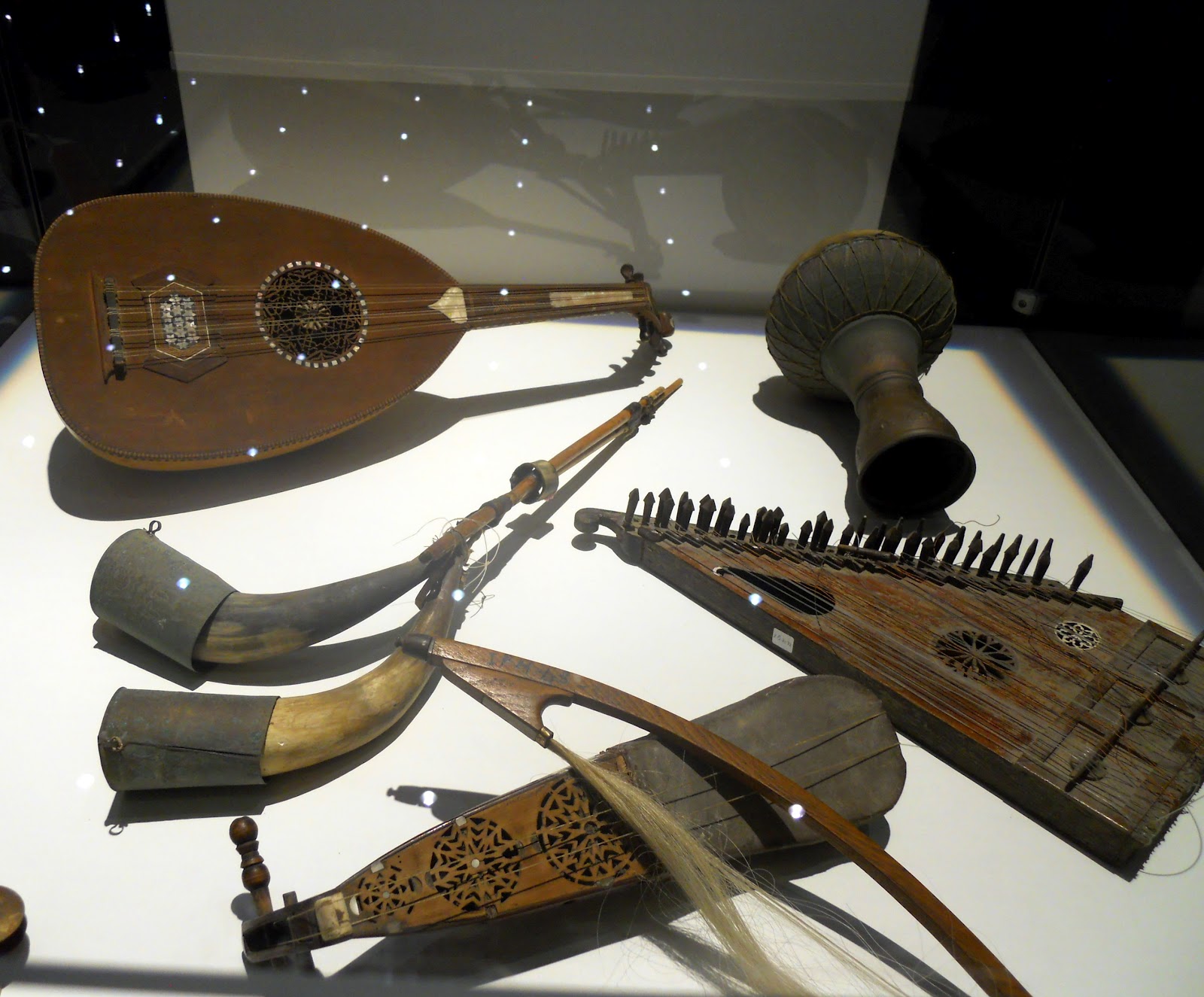
One display featured a selection of traditional musical instruments
while in another area, a musician enchanted several children by playing the oud.
There were examples of mosaics, crafts that North Africans carried with them to the Iberian peninsula,
copper worked receptacles,
and Berber jewelry,
as well as displays featuring the bounty of Moroccan agriculture, such as grains,
spices and scents.
All in all, my visit to the exhibits at the book far provided a lovely reminder of the beautiful and exotic country where I spent eight years of my adult life among lovely people and had many life-enriching and life-changing experiences, including the birth of my second son in Tangier some 135 years after Delacroix had first landed there. As it had with Delacroix and has with so many others before and since, Morocco also worked its magic on me.
Sagittarius (22 November - 21 December) is a fire sign ruled by the planet Jupiter and represented by a Centaur wielding a bow and arrow. Sagittarians tend to have dreams that are very dear to their hearts and are the bases for their motivations. Their freedom to dream is essential to their well-being. Among many other things, they love children, animals and travel.
Showing posts with label Morocco. Show all posts
28 April 2012
13 November 2010
Interpreting the world: to speak or not to speak
When I was much, much younger, I dreamed of being an interpreter.
That dream occurred sometime after I had relinquished my first dream of being a cowgirl. After all, it was the cowboys who had all the "fun" and I much preferred the idea of pants to skirts, although I really wanted to find some way of having horses in my life - and still would. Sigh. It was also after I had progressed from potential career dreams as follows: veterinarian, from which I was actively discouraged (no "girl" should be a vet and "girls" don't need to study science) and for which I had no role model; interior decorator (VERY short-lived!); archaeologist (the study of ancient languages that figured large in that career actually helped feed into the idea of becoming an interpreter and I adore studying ancient civilizations); and diplomat (linguistic skills are very much in demand there).
Although I did study foreign languages and now speak languages other than English, what I actually did become was a member of one of the two professions (teaching and nursing) that were considered "acceptable" for women. Of course, that was "back in the days." One of the ironies with the teaching profession today, IMO, is that there are not enough dedicated women - or men, for that matter - like those whom I had as teachers and with whom I worked as a colleague, in part because of increased professional opportunities in other fields. Another is that today's public schools have become dumping grounds for every sort of social problem. Basic common-sense ideas such as smaller class sizes, allowing teachers actually to teach, and allowing teachers to receive decent salaries and benefits seem always to be trampled before the latest fad (e.g., charter schools, etc.). Moreover, today's classroom teachers are held to standards by so-called business leaders that those selfsame business leaders do not even hold themselves to. But all that is a whole other topic.
On the whole, I enjoyed my various and varied teaching experiences and found that those experiences gave me invaluable skills for motivating and managing people from different cultures and walks of life, and also for solving problems, all of which were very useful in my later career transitions. And while I never became an "official" interpreter, there have been times when I have served as an "unofficial" interpreter, including one heady period when I ended up assisting my birth state of Montana to obtain international trade contracts as a result. I thoroughly enjoyed those experiences and they inspired me into returning to the international sphere in careers other than teaching.
That may explain in part why this recent article in the Guardian newspaper caught my eye. It discusses the newly released memoirs of a longtime British Arabic-speaking interpreter. From an "unlikely" background - read "not from the so-called upper class elite" - growing up between Lancashire and Liverpool in the UK, Leslie McLoughlin became the UK's Arabic interpreter of choice for British ministers and Arab VIPs. He has now written what the Guardian refers to as an "engaging autobiography." Also according to the Guardian, he is "good on the frustratingly wide gap between literary and spoken Arabic in its regional variations from Kuwait to Morocco."
This comment rings true to me and it is refreshing to see it acknowledged by a respected and pragmatic academic. I lived and worked in Morocco for a total of eight years and became quite fluent in the Moroccan Arabic dialect. When I actually studied the language, however, I was taught "Modern Standard Arabic," which is a dialect more commonly spoken in the Middle East. I remember when I was studying the language and mentioned to an Arab student colleague from Saudi Arabia that I had lived in Morocco, I was surprised when he told me that he had never understood what any of the Moroccan Arabic speakers he had met were saying! It is true that words and expressions, as well as pronunciation, were different in the various local dialects, as compared to the more commonly spoken Middle Eastern idiom.
The article related a few anecdotes from the autobiography, one of which reminded me of a couple of experiences that HWMBO and I had in Morocco in the early 1980s. The pertinent McLoughlin anecdote related to when the family was fleeing from chaos in Lebanon in 1976. "The trick was to pretend, for their own safety, that they were monoglots who didn't speak a word of Arabic. They were relieved to hear a gunman shout: 'Let them go, they're English and don't know what's going on.' They crossed the border unscathed into Syria."
Our experiences were different in that we were not fleeing from Morocco but trying to return to it after having been to nearby Ceuta, a Spanish-speaking enclave within Morocco, where we had purchased electronic items, including a stereo record player - all of which were technically subject to customs duty. The customs officer asked my anglophone (aka monoglot) husband what the items were. HWMBO responded in English. The customs officer simply nodded and waved us through. No duty. Nothing. It was as simple as that.
A few months later, I made the trip by myself and on this trip purchased a cassette player as a Christmas gift for No 2 Son, Big S. On returning via the same border, I was asked what the boxed item was. Unfortunately, I responded in Arabic that it was a cassette player. That was a mistake. I was stopped for few harrowing moments. They were not simply requesting payment of duty but planning to confiscate the player entirely.
Fortunately for me and my son's Christmas present, the customs chief had a heart. Of course, a few well-placed tears on my part didn't hurt. The chief even carried the player back out to my vehicle for me before waving me through. It was one time where my feigning incomprehension would have been the wiser course - by far.
29 October 2010
Geneva - Crossroads of Intrigue
During our literary tour of Geneva a couple weeks back, we learned about many writers known to and influential in history who lived and wrote here, or who were inspired by events or scenery here. The attraction has not yet worn off. People still come here for a variety of reasons. Many often write about their experiences here as memoirs. Some of the more contemporaneous writers, however, especially those who came during the early third and mid-20th century, also found Geneva to be a wonderful setting or inspiration for novels featuring diplomatic intrigue, aka spying. In fact, there are often glimpses of Geneva and/or Switzerland in some of the great spy flicks featuring James Bond or, more recently, Jason Bourne. Part of this is due to Geneva's role in international diplomacy and as a neutral ground where East and West have traditionally been able to meet, both officially and unofficially.
Among others, our guide mentioned two authors well-known for their novels of intrigue who had spent time in Geneva, specifically, Graham Greene and Eric Ambler. One of the latter's titles mentioned by our guide was "The Light of Day" which features - as is often typical of Ambler's novels - a protagonist who is a bumbling sort of anti-hero who manages to surprise himself - and the professional spies - by his decisive actions in a given situation.
Interestingly, soon after our tour, the 1964 film "Topkapi" - which was based on "The Light of Day" - was featured on the Turner Classic Movie (TCM) cable channel here. For some reason, although I had read the novel in the 60s, I had never seen the film. So I was thoroughly enchanted to see Peter Ustinov cast as Ambler's bumbling anti-hero, together with luminaries such as Melina Mercouri and Maximilian Schell.
But our guide also whetted our curiosity by speaking about a real-life intrigue that took place in Geneva in the waning days of the Cold War: the so-called "suicide" of a West German politician named Uwe Barschel in a Geneva hotel in 1987. The incident has resonated with her especially because her husband was at that time employed as a journalist (he is now retired) and had received word in the middle of the night that he should get to the hotel before the room could be "cleaned up." Reports state that Barschel was found, fully clothed and lying in a bathtub in his hotel room. His family has always insisted that his death was not a suicide. Interestingly, this case (l'Affaire Barschel) was also featured as part of a documentary report on Zone d'Ombre ("Murky Area"), as recently as 27 October 2010 on the French-speaking Swiss channel TSR. The truth of what happened is still not known but there is reason to believe that his death was linked to his refusal to allow Israeli arms for Iran to be shipped from ports in Schleswig-Holstein. During the Iran-Iraq war, Israel and the United States secretly armed both sides. When will we ever learn?
The guide's personal link to this true mystery reminded me of another, also related to Geneva, that also has had many strange links to my own life throughout the years. This mystery, which has always been a personal quest of mine, relates to the mysterious disappearance - and presumed death - of Moroccan left-wing politician Mehdi Ben Barka. Ben Barka "disappeared" 45 years ago today in Paris, having travelled there from Geneva. Why I have cause to remember that date is because on or about 29 October 1965, I myself was passing through Paris - my first visit to the "City of Light" - from Rabat, Morocco on my way home to give birth to No 1 Son some months later. I was horrified by Ben Barka's disappearance at about the same time - ships passing and all that.
Ben Barka was someone whom many young Moroccans who came of age in the 1950s and 1960s admired. When he was forced into exile in 1963, shortly after the accession to power of King Hassan II, after the unexpected death of his father, King Mohammed V who was considered more friendly to liberal causes, many of these young Moroccans felt that their vision of an independent country based on a parliamentary monarchy had been betrayed. Hassan II was indeed more repressive than his father had ever dreamed of being.
As an exile, Ben Barka met with and knew several of the great revolutionary rebels of the period. After meeting Che Guevara, Malcom X and others in Algiers, he travelled to Cairo, Rome, Geneva and Havana, trying to unite revolutionary movements of the Third World. He was lured to Paris for a meeting, and there was abducted. Although there is still no one clear theory of what happened to him, most have concluded that he died at the hands of General Mohamed Oufkir, who was the Moroccan Interior Minister at the time. There have been recurring but so far unverified reports of both US and Israeli complicity in this death as well.
This story has always fascinated me. Its aftermath has had a tangential influence on my own life. In 1972, just after I left Moroccan airspace after a brief visit there, the same General Oufkir led an assassination attempt on King Hassan II, unsuccessfully attempting to shoot down the King's private jet. The King, known for his incredible luck at escaping such attempts, managed to escape yet again. Oufkir "committed suicide" although the wound was in the back of his head. Oufkir's family was held prisoner for some 17 years afterwards - a gross travesty of human rights. The pilot who flew the King's plane and saved his life was thereafter named the Head of the Moroccan Air Forces. Many years later, I would return to Morocco yet again to meet HWMBO there, at the time working on a commercial US contract under the direction of the Head of the Moroccan Air Forces.
And now we have come full circle.
12 July 2010
Changes
In case there are devoted - or other - readers of SD out there in the blogosphere, you may have noticed some recent changes in the blog format. These are experiments, carried out courtesy of Google Blogger's new Template Designer feature.
This particular blog will continue to be a work in progress so please don't be surprised if you see additional modifications in a future visit. For right now, however, I have modified the basic template to Blogger's "Simple" Designer template and added a background photo from among those furnished. I'm still not quite satisfied with widths, fonts, etc., but petit à petit l'oiseau fait son nid. Hopefully, my nid, like my life, will continue to grow.
The background photo that I selected shows a selection of colorful tagine pots. I found this photo especially appropos, not only because it is beautiful but also because of the eight-year period of my life that I spent in Morocco, where delicious tagines feature prominently at mealtimes.
The pots shown may not necessarily be made in Morocco, but they are clearly tagine pots and their style is North African. So as someone who loves North-African culture, I thank the photographer, listed in the credits below, and invite everyone to share a little bit of North Africa with me.
21 February 2010
Of Minarets and men ... and women
My thoughts were abruptly moved from the east side of North Africa to the far west, from Egypt to Morocco, by news of the collapse of the minaret of the Bab Berdieyinne Mosque in Meknes on Friday, 19 February 2010.
A minaret is to a mosque somewhat as a bell tower is to a church. It is where the muezzin calls Muslims to prayer. A mosque is where many Muslims go to pray on Fridays, although some advantages of Islam are that no building is necessary for prayer and no priest is necessary to lead prayer. The faithful can pray anywhere. Usually, however, they prostrate themselves on a prayer rug facing in the direction of Mecca. This particular minaret, apparently a casualty of the very heavy rains that have been causing similar disasters and loss of life in other regions as well, was about 400 years old. The death toll appears to be climbing still. The last figures that I've seen indicate that so far 41 people have lost their lives in the collapse. Here is a photo of the minaret that was taken in December 2009.
The media have generally attributed the minaret's construction to Sultan Moulay Ismaïl Ibn Sharif, who reigned in Morocco from 1672-1727. In many ways, he was considered to be the Moroccan equivalent of Louis XIV. He was also the second ruler of the Alaouite dynasty, which is the ruling dynasty in Morocco today. He made Meknes his capital city, building some of it from stones plundered from the ancient Roman ruins at Volubilis nearby. In addition to being a prolific builder and a warrior king, the Sultan was also a prolific progenitor. He is said to have fathered almost 900 children through his harem of some 500 women.
Because the minaret is believed to have been some 400 years old, I am not sure that its construction can be attributed to Moulay Ismaïl. By my reckoning, if it is 400 years old, it would have been built in 1610 and the Sultan wasn't even a gleam in his father's eye at the time. The mosque, however, was apparently built on the orders of Khnata bent Bakkar, who as Dowager Sultana following the death of the Sultan, was the de facto ruler of Morocco from 1727 to about 1754. During her husband's lifetime, she also acted as his First Minister and Secretary. After his death, she was the reigning constant throughout the reigns of ten of her husband's sons by various wives, much as Catherine de' Medici was the de facto ruler of France from the time of Henri II's death until the accession of Henri IV, the first of the Bourbon dynasty to hold the French throne.
Meknes is one of the four Imperial Cities of Morocco, the others being Fès, Rabat and Marrakech. It is also a UNESCO World Heritage city and is situated some 62 miles east of the current capital city of Rabat. One of its nicknames is "City of the Hundred Minarets," though strictly speaking the count is now down to 99. That omission will not last long. Morocco's present King Mohammed VI has ordered reconstruction of the damaged buildings.
Morocco is a country that I once called home. I was first married and lived there from October 1964 to August 1970, with a brief stay in Montana for the birth of my first son. My second son was born in Tangier. My sons and I returned to live in Rabat from August 1980 to August 1982, while I worked with a community development project. I met HWMBO there during our second stay. Those are all stories for another time. I love the country and its people. Like Egypt, Morocco certainly has its socio-economic-political problems. But its natural beauty is stunning. And I sincerely hate when bad things happen to good people, especially when so many are already among the most vulnerable.
I first visited Meknes, as opposed to merely passing through it on the train, in the spring of 1965. That also is a story for another time. One of the most notable landmarks of Meknes is the Bab el-Mansour. It was named after its architect, El-Mansour, a Christian who converted to Islam, and was completed in 1732.
Here is an example of the architecture that can be found in the Old City.
Here is a street in the narrow medina, awaiting tourists.
And here one can choose sweets to one's heart's content.
May the rains stop pouring long enough to give everyone a chance to dry out, to mourn their loved ones, and to put their damaged lives back together again!
Subscribe to:
Posts (Atom)