04 April 2010

Easters past and present

A year ago, I had family visitors here for Easter.  Healer Sis and her long-time friend, Sweet L, were here for almost all of the month of April.  It was a lot of fun.  We went to dinner in Geneva and the weather was so mild that we were able to have our meal outside on the terrace of the restaurant.
We had a lovely view of the lake and the ferries passing by.  In the distance, we could just about make out the United Nations complex on the other side.

We then drove to Evian on the French side of Lake Geneva.  We got drinks at the fountain where one can help oneself to the famous mineral water for free.
We also took a quick tour of Nyon and the decorated fountains there.


This year, I had no family visitors for the holiday.  Via the wonders of Skype, however, I did get to see and speak to Princess Butterfly who proudly showed me the chocolate bunny that the Easter Bunny had left her.  Last year, she took part in the Easter Egg Hunt on the Capitol lawn in Montana with Momma M and Papa Big S.
Prince Tyger and his parents also visited with me via Skype.  Prince Tyger, who has grown so much since I last saw him in the flesh, hasn't quite gotten into the Easter egg spirit yet, being a year and a half younger than Princess Butterfly and without older siblings to "educate" him about its wonders.  Still, he's got a great experience in store for tomorrow - one that I can only envy.  He'll be heading off to the Easter Egg Roll on the White House lawn in Washington.

Who knows what might happen there?  Whatever does, I have a feeling that Prince Tyger just might remember that experience!

03 April 2010

Easter, fountains, water and Spring

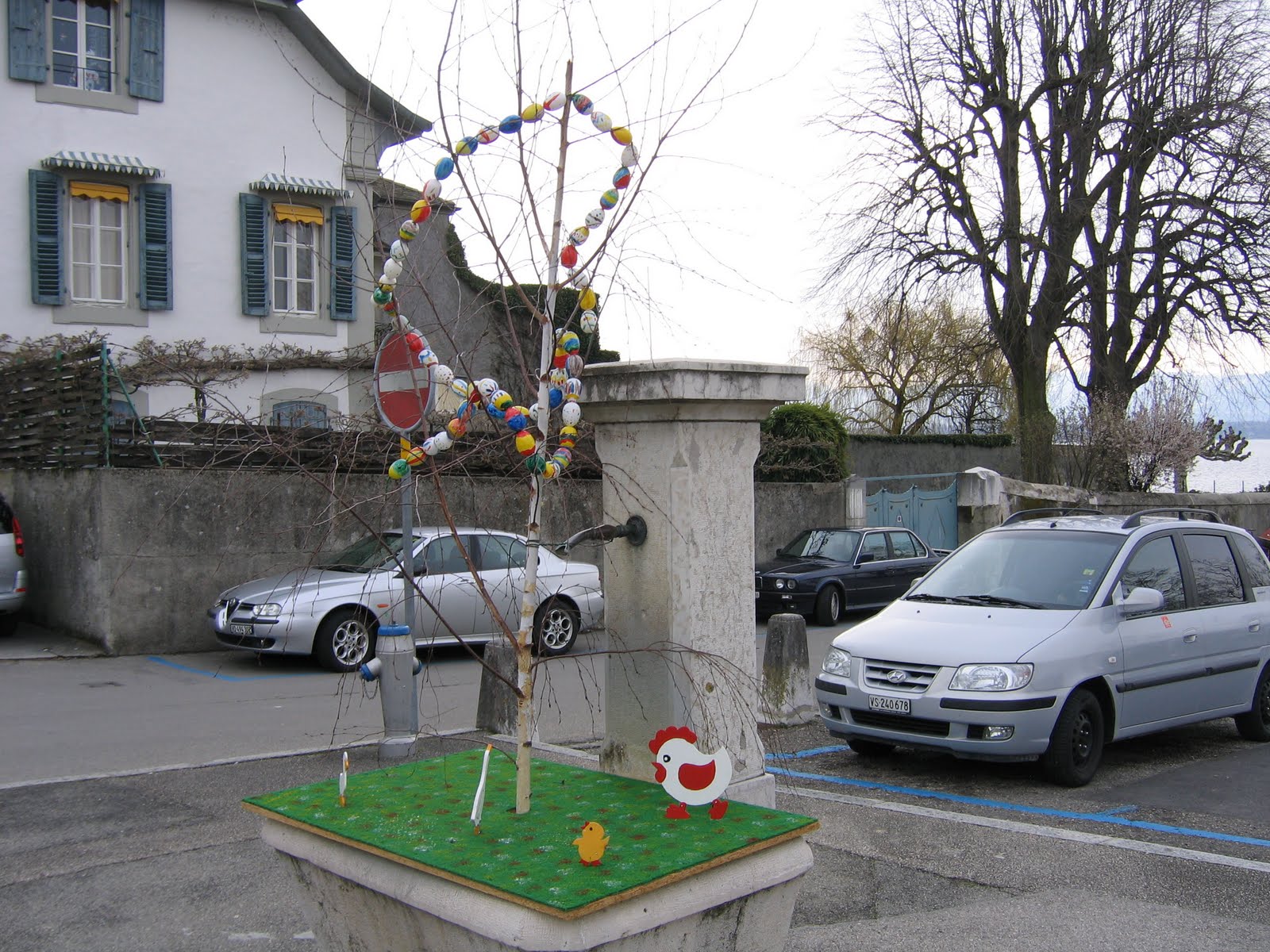
The charming small city of Nyon, about a ten-minute drive from here along Lake Geneva (Lac Léman), is the center of our administrative district.  In fact, many traditions that originate there are also celebrated in nearby communes, especially those in the western area of the district, where I live.  One especially fun seasonal practice of this region is decorating every fountain in each commune with Easter decorations, generally flowers, ribbons or other streamers, and eggs.  Sometimes cutouts of bunnies are added.
According to one source, this practice may owe its origin to an old German tradition of celebrating the melting of the snow in the mountains and the return of water to the fountains.  Around here, the decoration is done either by groups of school children or different community associations.  Often, there is a sign by each fountain that tells who was responsible for each.

I don't recall ever seeing fountains decorated for Easter when I lived in Geneva canton.  But it may simply have been that I never really had time to notice.  It is also true that we generally used the Easter break as an occasion to travel and visit other regions so we may have missed seeing decorations because of that.   But now that I am retired and more content to stay in one place while everyone else braves the traffic jams or other travel disruptions, predictable and not, of a peak vacation period, I have a lot more time to pay attention.

I first noticed the decorated fountains in my little commune two years ago.  Here is the one in front of the Maison de Ville (City Hall) from 2008.
And here it is this year.
Here is the largest fountain in the bourg as it was decorated two years ago.

And here is this year's version of the same fountain.

Here is a photo from 2008 of the small fountain that stands at the entrance to the boat landing, where we wait to catch the lake ferries.

I fully intended to get a photo of this year's version, but I got distracted.  That happens all too often and much too easily these days, I'm afraid.  I got distracted because I noticed that the snack bar beside the boat landing was already open.  The opening of the snack bar is an even more definite sign of Spring than the flowers, the leaves turning green and the Easter decorations!

02 April 2010

Clip-clopping into a Green era

Our favorite morning walking route takes us past an area that was formerly known as a "Parc Avicole" because some years ago it was the site of a poultry farm.  Up until late fall of 2009, there were still some few chickens there, together with several donkeys.   One day last fall, however, we realized that the chickens were gone and the donkeys, previously numbering around five, had become three.  We also noticed that thorough cleaning and airing out of the buildings was ongoing, as was a lot of renovation work.

The renovation is continuing.  It is now clear that the former poultry farm is to be transformed into a nice stable.  So far, the new inhabitants are seven draft horses.  Six are chestnuts with flaxen manes and tails.  One, by far the largest, is dark bay with a black mane and tail.  They appear to be quite gentle and tame.  Hand-lettered signs have been posted to request that passers-by please not feed them.

I was downtown in our little bourg on Wednesday morning and there two of them were, pulling a long cart with high sides.   Everyone was stopping to pet them and chat with the drivers.  I had heard rumors that they might be available for various functions.  By this, I assumed functions where they would be festooned to pull people around in carts during various celebrations or festivals, much as they do in central Switzerland for weddings and family celebrations, or even as happened while I was on an excursion to the Emmental in the summer of 2008.
But I was wrong ... or at least I was wrong about their main functions.  As reported in yesterday's Tribune de Genève, our horse neighbors will perform dual duties.  Not only will they make weekly rounds throughout our tiny commune with their carts to pick up bulky or cumbersome furniture, trash or garden clippings, they will also be cared for by alienated adolescents from Geneva canton.  Studies and other programs have shown that working with and training animals such as horses or dogs can help problem adolescents to empathize and feel empowered.  Here is a picture of some, who, while like most adolescents who hate to get out of bed early, are still very excited about getting up, grooming, feeding and working with these lovely animals.

The horses themselves are a special and ancient breed, le Comtois, which is thought to have existed in France as far back as the fourth century.  Today, they are primarily bred in the Jura regions of both France and Switzerland.  They are versatile horses.  While most often used in rural regions for farm work even today, before the days of modern warfare, they were also favored by the French military for both cavalry and artillery.  Some even accompanied Napoleon's army to Russia.

In my mailbox yesterday, I received a notice from the commune, announcing that the removal service will begin this month, that the commune had been divided into four zones (I fall into Zone 1), and that the service dates would vary depending on the zone assignments.  Our little village is apparently one of the first, if not the first, in Switzerland to have such a program.  It appears that similar removal programs in France and Germany, using horses instead of motorized vehicles, have become widespread.  This one, however, may be among the first anywhere to combine the removal service with rehabilitation of troubled adolescents.  What a great idea to combine a "green" initiative with a program that aims to improve young lives!

I stopped by to see my now "famous" neighbors this afternoon.  They were enjoying their Good Friday break and were not nearly as pretty as they were for their village debut Wednesday.  They had clearly been rolling in the mud.  But I have seen them often enough after they've just been brushed to know that they are well cared-for generally.  And what fun to have them close by!

01 April 2010

Le Poisson d'avril

Happy First of April!  It is once again April Fools' Day.  I hope that any practical jokes that were played on you today were actually clever or witty, not juvenile or nasty.  But the day is not over yet.  It's too early to relax.  If you were here with me, however, you would be celebrating le Poisson d'avril (April Fish Day), together with the rest of the francophone world.

On this day, a favorite school prank hereabouts is to attach a paper fish to the back of an unsuspecting victim.  When the unfortunate person discovers the fish, he is promptly dubbed a "poisson d'avril."
Although there are earlier references to hoaxes and jokes being played on others on April 1st, many believe that the tradition arose because of a calendar reform in France that occurred in the sixteenth century.   As the theory goes, the French King Charles IX changed New Year's Day to 1 January in 1564.  Up to then, it had been celebrated on or about 25 March, corresponding more or less to the Spring solstice.  It is likely that the change was less Charles's idea than that of his mother, Catherine de Médicis, because Charles would only have been about 14 at the time and he was very much a "mama's boy."

Given that there were terrible religious wars between Catholics and Huguenots (French Protestants) occurring at the time and that communications were neither as immediate nor as reliable as they are today, a lot of people either didn't get the word about the date change or possibly didn't accept the change if they did.  It was a pretty chaotic and unruly situation all round.   Human nature being what it is, those who didn't know about the change or who stubbornly clung to the old calendar system and continued to celebrate the New Year during the week that fell between the old date and 1 April were easy targets for "jokes."  Given the ongoing religious tension and the historical evidence that religious fanaticism tragically incites the worst excesses of human behavior, I have no doubt that at least some of these jokes were not in fun.  They were likely quite vicious or worse.  A paper fish is nothing in comparison and thank heavens for that.
Many believe that the "fish" tradition stems from the fact that most gifts that were given at the New Year were things to eat.  Because fish was the most common meal during Lent, most often occurring around this time, it was the most likely food symbol to use.  Some rather grotesque models to cut out can be found here and sea creatures for younger ones to color can be found here.

One of the most famous April Fools' jokes of the past century deals with the infamous Swiss spaghetti harvest.  This was a three-minute BBC broadcast in 1957 that reported about a family in southern Switzerland that was harvesting spaghetti from a spaghetti tree, after a mild winter, and that the dreaded "spaghetti weevil" had virtually been eradicated.  At the time, spaghetti was not widely eaten in the UK and was considered an exotic delicacy.  At least some there were unaware that spaghetti is a pasta made from wheat flour and water.  Hundreds of listeners phoned in to ask how they could get spaghetti trees to grow in their own gardens. 

Now such a story may seem too far fetched to be believable.  But considering the Beeb's reputation, along with the fact that many non-Italians had only experienced eating spaghetti from cans at the time, when I remember my own days growing up in the "back of beyond," I see how it could have been somewhat credible.   Even now, with the internet and all the facts that can be verified almost immediately on-line, many people still choose to believe the strangest things.  And that's the truth.

31 March 2010

The "Big Bang" is happening ... and we're still here

One cannot change the past, so there is little use in regretting it.  But one can learn from it and try to move on in a positive manner.  Still, while I cannot change the era in which I was raised and the mentality that generally decreed ... which I accepted all too easily ... that females have no gift or need for math or science, one thing that I truly do regret is that I did not study either in a much more dedicated and thorough manner.  In the final analysis, that I did not is due more to my own decisions than to anything or anyone else.  Had I really wanted to, I probably could have.  Suffice it to say, however, that girls in Montana in the '50s and early '60s were not encouraged to pursue such studies; those who did were more the exceptions who proved the rule.

I like to think that I attempted to remedy that deficit somewhat by having the good sense to marry HWMBO, who is an engineer.  As such, he has a deep respect for and knowledge of both math and science, physical science in particular.  More importantly, however, he has the instincts of a teacher, keeps learning himself and has pushed me, albeit often figuratively kicking and screaming, into the computer age.  Thank heavens for that!

Had I not had this positive and enlightened influence, I would not be nearly so excited by the truly worldshaking events that transpired yesterday, 30 March 2010, in Geneva.  The LHC (Large Hadron Collider), a particle accelerator used by scientists to study particles (the smallest known fundamental building blocks of all things), began sending two beams of subatomic particles in opposite directions at speeds accelerating nearly to that of light so that they would collide head-on in an effort to recreate the conditions occurring just after the "Big Bang."

The LHC is located at Cern, officially the European Organization for Nuclear Research, even though it has retained the original acronym of its long-ago predecessor.  The history, development and timeline of CERN are well described at the CERN website.  Other general information can be found here.  What is immediately pertinent to me, however, is that the LHC is quite literally beneath my feet.  It occupies a 27 km circular tunnel 100 metres beneath the French-Swiss border near Geneva.  Just thinking about all these frenetically accelerating particles makes my own head spin.

Knowledgeable scientists everywhere, particularly particle physicists, are tremendously excited that this is finally happening.  They expect to glean all sorts of knowledge, not only from the happening but also from the process.  Here is a photo showing the dedicated concentration at CERN itself.  Some reports of the event can be found here and here.  Videos can be found here.

This is one reason why I truly wish that I had been intelligent enough to get past the obstacles of my days as a student and learn enough to understand even the smallest bit of what is now happening.   I am very happy to see that several in my family's younger generations have not been deterred, or distracted, as I was.  This milestone is literally fascinating.  To the extent that the knowledge obtained can make the world a better place, it is desperately needed.

Unfortunately, science or knowledge of any sort that doesn't fit with preconceived notions is too often seen as the "enemy" by those who either do not understand or who simply refuse even to try.  They prefer that individuals be ruled by fear and superstition.  Just as Christopher Columbus was plagued by "flat-earthers" and Galileo, the greatest scientist of his age, was tried by the Inquisition for his beliefs - among them, that the Earth circled around the Sun, which we all know to be true today - we have our present-day doubters and Doomsday cults.   That has been the case for CERN's experiments.  Fortunately, the experiments were not halted.

Most of us, fortunately, only know about Doomsday cults from the newspapers.  But I actually had a tangential personal experience with one back in October 1979, while I was living in Montana.  I was aiming to broaden my professional horizons and had prepared a cv for printing, which in those pre-personal computer days meant having to go to a print shop.  Unbeknownst to me, the clerk at the counter was a member of a Doomsday cult that fervently believed that the world would end in March 1980.  As I attempted to discuss formatting with him, he asked me why I was even trying to look for a new job, which took me aback, then amazed me as he explained why.  I responded that I would take my chances, that I wanted my cv printed and, if he didn't want my business, I would go elsewhere.

He printed the cv for me, showing that he either needed to eat or had a modicum of common sense after all.  And here I am today.  Even after yesterday.  Still.

30 March 2010

Passe, passe le temps ...

Around three weeks or so ago, the weather around here looked like this:

The Spring solstice arrived almost two weeks ago.  Since then, it's seemed as if the planet has shaken itself into a semblance of more usual climate order.  What had begun as the coldest month of March in the past three years - March here truly having begun like a lion - has since turned into fairly temperate weather, at least so far as air temperature has been concerned.

But March, which will end tomorrow, has still not approached anything like lamb status, with wind rattling the shutters by night and with rain pelting down by day.  In spite of the wind and rain, however, Spring is letting us know that its coming is inevitable.  My forsythia is blossoming, even though I noticed that it is not quite as far along as are the bushes at the Geneva airport.  I have had occasion to make several runs there in recent days.  One more is scheduled for tomorrow morning.  The next rounds of visitors, at least those that I know about right now, will occur in June.  By then, the forsythia should have lost its blossoms and leafed out ... as should the trees, once again hiding most of my lake view with their summer foliage.

Last week, I set out some pansies ... the little ones that some call "Johnny-Jump-Ups."  To my delight, one pansy plant from last year survived both summer drought and winter frost to greet me as well.  Pansies (les pensées = thoughts) are such cheerful flowers.

Even my rosemary plant has been inspired to blossom.

This morning, I walked down to the little park just across the lake road.  One can feel it slumbering, just waiting for the families and children who will populate it this summer ... who will barbecue and have picnics, who will swim at the little rocky beach, who will play volleyball and boules, who will swing on the swings and play on other playground equipment.  Right now, everything is dark and overcast.

But the flowering plants tell me, as they tell us all, that the summer sun will come again.  The graceful swan that swam to the shore to greet me, hoping for a handout, will not be as disappointed as it was this morning.
And once again, the seasons will follow, one upon the next, in this comforting manner. 

29 March 2010

Teaching and learning

Many years ago, in an earlier professional incarnation, I was a teacher.  In all, I spent about 15 years as a classroom teacher.  I was primarily a teacher of French, but I also taught English as a Foreign Language (TEFL), English in a US secondary school - where it sometimes seemed as if I were teaching a foreign language - and history.  For one interesting, if unexpected, two-year period in Tangier, Morocco, I even taught third grade.  I loved teaching.  My experience comprised both public and private systems, elementary to university and even non-university adult education.  In my opinion, fully buttressed by historical example, a society that does not encourage and value good teachers and public education is a society that will fail sooner rather than later.

One of many good things that Napoleon Bonaparte established for France was to revolutionize its education system.  However laudworthy, Napoleon's motives came with an agenda.  He believed, for example, that the breakdown in public social order and the resulting chaos and instability during France's revolutionary days was, at least in part, caused by insufficient education.  As he explained, "Of all social engines, the school is probably the most efficacious, for it exercises three kinds of influence on the young lives it enfolds and directs: one through the master, another through con-discipleship, and the last through rules and regulations."  He also believed public schools should form intelligent yet obedient citizens and assist the middle class, in particular, to become successful, making members of the class less likely to revolt in the future.  Acting on these pragmatic and common sense beliefs, he established the bases for France's commendable system of contemporary public education.

I am also a firm believer in public education.  While I recognize that some private schools are also excellent, or at least prestigious, so long as the public schools are well-maintained, well-staffed and allowed to do their most basic job of imparting and nurturing knowledge about the world, the society in which they exist can remain healthy.  If that is not the situation, then a society will ultimately fail, no matter how many elite private institutions may seem to flourish there.  It's as simple and as profound as that.

I could write volumes about the public education system in my own country today, which I believe is ailing for many reasons.  I will perhaps do so in future posts.  But today, my topic instead is a French actor, Gérard Klein, whose long-time role as l'instituteur Victor Novak has personified for many the role of a dedicated teacher, all the while focusing on contemporary problems in French society.  Klein's series, "l'Instit," debuted in February 1993 and ran until June 2004.  Episodes are frequently shown as re-runs on French and Swiss TV channels, as recently as yesterday.

His character, Victor Novak, became an elementary school educator later in life, after first being trained and acting as a magistrate for children's matters.  He does not have his own class in a single school, but rather is assigned to replace elementary educators throughout France, and even in some former colonial French possessions where France still provides staff for schools, who are temporarily absent for whatever reason.  And yes, he does travel to those locations on a motorcycle, to the delight of his young charges.  Each episode is therefore filmed in a different geographical region, is approximately the length of a feature film, and has at least one contemporary social issue or problem that is fully discussed in that context.  That the issue or problem may not always be resolved is more a reflection of reality than a failing of the series.  In brief, the series itself is a wonderful teaching vehicle, both for the French language and for French culture with a small "c."   Most of all, the episodes demonstrate the basic similarities and common concerns among all human beings, French or not.

Novak has his own personal tragedy in that, in his travels from school to school, he is always hoping to have news of his wife, who fled from him years ago, taking their only daughter with her.  While one understands this to be merely a story device, one wonders what on earth could have precipitated his wife's departure, since Novak is, to all appearances, a pretty darn decent guy!

Klein himself is also a pretty darn decent guy.  After announcing his departure from "l'Instit," Klein narrated another educational series called "Va savoir" (Go learn).   Children travelled with him in a yellow bus to learn about various trades and crafts in rural France.  Since then, he has narrated another series called "Gérard Klein autour du monde" (Gerard Klein Around the World), where he shows viewers unusual or little-known places of the world, together with individuals who are working in social or environmental projects there.

In addition to these, he and his wife, Francoise Vallon, have a website known as "Humain sans frontières" (Human Without Borders) on which their 52 minute features of different places in the world ... and the humans who live there ... can be seen. 

If I were still teaching French, I would literally beg, borrow or steal to have these resources for my French classes.