The weather has been gloomy for the past few days, with intermittent showers. I realize that April showers are good and that, according to the old saw, May flowers will follow. Some day, that is. Still, it is much prettier and definitely more cheerful around here when there are a few glimmers of sunshine. So to cheer myself up today, I am posting some photos of local scenes from times when the sun was actually shining. Some, like this one from the east entrance to the bourg, were actually taken in late spring, when the trees had fully leafed out. But one takes one's sun where one can find it.
Strolling along, one finds the little flower shop, which always has colorful plants outside to draw purchasers inside.
A bit further along, one finds the pâtisserie/confiserie/chocolaterie de la Fontaine. The goodies one finds there are, unfortunately, addictive.
One shop that has recently opened sells savons de Marseille (soap from Marseille) and lots of baskets.
We also have a mom-and-pop type grocery store. There is a major shopping center about ten minutes away. But it's nice to be able to find fresh vegetables and fruits within walking distance.
Like most of the small villages along Lake Geneva, ours has a château. And the château has a very interesting history that I'll describe another day.
A favorite pastime on sunny days is to take a cruise on one of the lake ferryboats. The weather is still a bit brisk for that right now. But the summer will eventually come ... and I'll probably remember these cool days with a certain nostalgia.
Sagittarius (22 November - 21 December) is a fire sign ruled by the planet Jupiter and represented by a Centaur wielding a bow and arrow. Sagittarians tend to have dreams that are very dear to their hearts and are the bases for their motivations. Their freedom to dream is essential to their well-being. Among many other things, they love children, animals and travel.
08 April 2010
07 April 2010
Marathon Men
Yesterday, I received a message from a long-time friend, Richard Harteis, who announced that the film, "Marathon," based on his memoir "Marathon: A Story of Endurance and Friendship," will be featured at the Palm Beach International Film Festival, running from 22-26 April 2010 at locations around Palm Beach County, Florida.
Thinking of Richard inevitably brings to mind a flood of memories dating back nearly 30 years. Foremost among them are memories of his long-time companion and all-round lovely human being, Pulitzer-Prize-winning poet William Meredith, who was Richard's great love and soul mate and who died in 2007. "Marathon" is in part a story of how, after William suffered a stroke at age 64, leaving him partly incapacitated for the last 24 years of his life, Richard served as his companion and caregiver. In a recent newspaper interview, Richard explains that the film and the book comprise a "broad story," touching upon several key issues: the challenges of aging, of taking care of an older loved one and "of being gay in America." The film has been well-received at other festivals and I wish Richard well with this one.
I first met Richard and William both in August 1980 in Rabat, Morocco, of all places. At the time, William was there to visit Richard, who was working in Morocco as a physician assistant with a large US corporation there. The local English-speaking community group had asked William to read some of his poetry at a poetry evening.
At the time, I was a single mom who had recently relocated to Morocco to work with a bilateral development project. Healer Sis had accompanied my two teen-age sons - who were not at all happy about being relocated just then - to Morocco and was staying on for a while to experience the culture and help all of us to adjust. Thank heavens for that! Relocating adolescents in the best of circumstances is no simple task; relocating them to a whole new and very different culture where they do not speak the language(s) ratchets up the challenge enormously. But that is a different story altogether.
Both Healer Sis and I attended the poetry evening. We found ourselves seated near the front, perhaps even in the front row, if memory serves me well. We enjoyed the readings very much. William's poetry is wonderful and William was an outstanding reader. Before he finished, however, William told us all that he wanted to read one of Richard's poems and then proceeded to do so. He read "The Hermit," a moving poem about a holy man living on a barren hilltop that was a place sacred for barren women to make a pilgrimage in the hopes that by doing so they would bear children. Unfortunately, the site was also favored for technological development (radar placement) and the hermit and the barren women lost out. The combination of this bleak but lovely poem-story together with various recent upheavals in my and Healer Sis's lives caused us both literally to burst into tears. We both finally managed to dry our tears and compose ourselves, but that experience really marked the moment for us.
After Healer Sis and William both returned to the US, I got to know Richard through a mutual friend. As Richard remembers it, he later introduced me to HWMBO. I remember being introduced to HWMBO differently, by another mutual friend. But it is true that Richard helped to advance and encourage our budding romance and can thus take part of the credit ... or the blame.
Several years later, in the 90s, Richard and William both visited us in Switzerland. They were then a couple. Richard set aside his careers (as physician assistant and poet) to act as William's caregiver after William's 1988 stroke. In large part due to Richard's care and management, William had recovered significantly, could speak and move about, primarily with the help of his collapsible wheelchair as he tired easily. With Richard's help and encouragement, William was even travelling to literary events to read poetry throughout Europe. These tours were generally sponsored by the US cultural services. Richard and William had, in fact, just been in Avignon for a festival there before coming here. While they were here, a close friend invited us to a party and Richard and William kindly read for all present. Later the same friend accompanied us on a tour of Nyon via le petit train. The short stay finished up with a hearty Swiss fondue and then they left for Paris.
My fondest memories of that visit are of my one-on-one moments with William. At the time, the Sturm und Drang of my workplace was taking a very heavy toll. Speaking with this quick-witted but delightful, gentle and caring individual was like having warm, sweet and soothing spiritual balm poured over all my mental aches and pains. The visit refreshed me so much that I was able to continue with my own marathon.
06 April 2010
Gallimaufry 2
They should be singing "Cherry Pink and Apple Blossom White" in Washington, DC right now. The 2010 Cherry Blossom Festival is continuing through 11 April, although the National Park Service doesn't believe that the blossoms themselves will last that long. The peak blossom date was supposed to have been 31 March. For those who can't make a personal tour to the Tidal Basin, there are lots of photos available at the Washington Post website.
Swiss biker, Fabian Cancellara, came in first at the Tour des Flandres (Tour of Flanders) in Belgium on Sunday. He is the first Swiss biker to win that race since 1923. The press are calling him "Spartacus" because of the power he showed in defeating the Belgian champion biker, Tom Boonen. I was able to watch the final moments of the race. Cancellara made it look easy, coming in front by more than a very comfortable minute and carrying a Swiss flag handed to him by one of the spectators for the final few meters.
Around here it is clear that the bike racing season has begun. One group of serious bikers swooshed right by me as I was walking along the Lake Road last week.
Another great Swiss athlete, Roger Federer, is not having a good spring in the US, having been ignominiously retired early during his last two tournaments there. Andy Roddick has been the latest beneficiary of Roger's missteps, having won at the Sony Ericsson Open in Miami on Sunday. Andy also came in second at Indian Wells two weeks ago. If we have anything like the wonderful 2009 Wimbledon final between Federer and Roddick in store for us fans this year, the 2010 tennis year should be outstanding.
Tuesday evening, the SNCF (French railway system) was hit by a workers' strike that has affected about a quarter of the Paris train à grande vitesse (TGV = High Speed Train) traffic. This has caused major disruption to those holidaymakers who are trying to return home after the Easter holidays. I am so happy that I went absolutely nowhere. I thoroughly enjoyed going nowhere.
There has been a lot of outrage on this side of The Pond about the recent video released on Wikileaks that shows a massacre of Iraqi civilians and Reuters journalists by US forces who launched an air strike in Baghdad in July 2007. The Pentagon is also outraged, although its rationale for outrage is not about the massacre but instead because the Wikileaks website is a "danger to national security." Over here, the outrage is more appropriately about possible war crimes.
My personal belief is that Wikileaks performs a public service that the US mainstream media (MSM) either cannot or will not perform. IMO, the US MSM has generally served us all very badly, but most especially during the period from November 2000 to November 2008. That there has been a slight improvement since is principally because the US Administration itself has changed for the better, not because the US MSM does its job any more thoroughly. In fact, given its record of ignoring major improvements all-round since January 2009 and hyping the literally insane "Teahadists" and their self-appointed standard-bearer, Sarah Palin (clearly what Gertrude Stein had in mind when she famously said "there is no there there"), the US MSM either must start reporting facts responsibly or be superseded entirely by sources such as Wikileaks. Had the US MSM been reporting the facts as they should have, instead of acting merely as stenographers and mouthpieces for lying warmongers who themselves had never been to war, it is quite likely that Iraq would not be in the disastrous state that it is today.
And so it goes ... .
04 April 2010
Easters past and present
A year ago, I had family visitors here for Easter. Healer Sis and her long-time friend, Sweet L, were here for almost all of the month of April. It was a lot of fun. We went to dinner in Geneva and the weather was so mild that we were able to have our meal outside on the terrace of the restaurant.
We had a lovely view of the lake and the ferries passing by. In the distance, we could just about make out the United Nations complex on the other side.
We then drove to Evian on the French side of Lake Geneva. We got drinks at the fountain where one can help oneself to the famous mineral water for free.
We also took a quick tour of Nyon and the decorated fountains there.
This year, I had no family visitors for the holiday. Via the wonders of Skype, however, I did get to see and speak to Princess Butterfly who proudly showed me the chocolate bunny that the Easter Bunny had left her. Last year, she took part in the Easter Egg Hunt on the Capitol lawn in Montana with Momma M and Papa Big S.
Prince Tyger and his parents also visited with me via Skype. Prince Tyger, who has grown so much since I last saw him in the flesh, hasn't quite gotten into the Easter egg spirit yet, being a year and a half younger than Princess Butterfly and without older siblings to "educate" him about its wonders. Still, he's got a great experience in store for tomorrow - one that I can only envy. He'll be heading off to the Easter Egg Roll on the White House lawn in Washington.
Who knows what might happen there? Whatever does, I have a feeling that Prince Tyger just might remember that experience!
03 April 2010
Easter, fountains, water and Spring
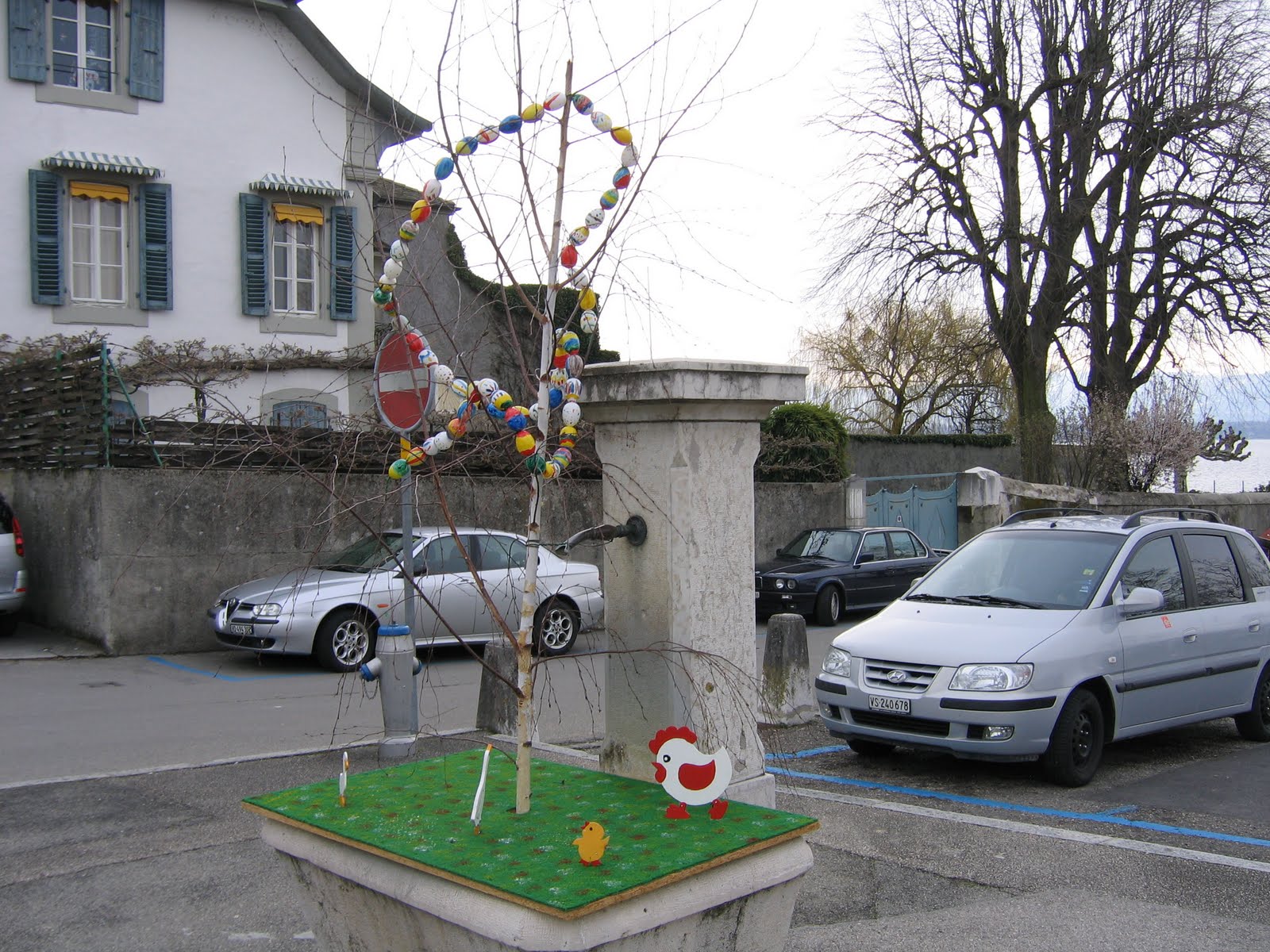
The charming small city of Nyon, about a ten-minute drive from here along Lake Geneva (Lac Léman), is the center of our administrative district. In fact, many traditions that originate there are also celebrated in nearby communes, especially those in the western area of the district, where I live. One especially fun seasonal practice of this region is decorating every fountain in each commune with Easter decorations, generally flowers, ribbons or other streamers, and eggs. Sometimes cutouts of bunnies are added.
According to one source, this practice may owe its origin to an old German tradition of celebrating the melting of the snow in the mountains and the return of water to the fountains. Around here, the decoration is done either by groups of school children or different community associations. Often, there is a sign by each fountain that tells who was responsible for each.
I don't recall ever seeing fountains decorated for Easter when I lived in Geneva canton. But it may simply have been that I never really had time to notice. It is also true that we generally used the Easter break as an occasion to travel and visit other regions so we may have missed seeing decorations because of that. But now that I am retired and more content to stay in one place while everyone else braves the traffic jams or other travel disruptions, predictable and not, of a peak vacation period, I have a lot more time to pay attention.
I first noticed the decorated fountains in my little commune two years ago. Here is the one in front of the Maison de Ville (City Hall) from 2008.
And here it is this year.
Here is the largest fountain in the bourg as it was decorated two years ago.
And here is this year's version of the same fountain.
Here is a photo from 2008 of the small fountain that stands at the entrance to the boat landing, where we wait to catch the lake ferries.
I fully intended to get a photo of this year's version, but I got distracted. That happens all too often and much too easily these days, I'm afraid. I got distracted because I noticed that the snack bar beside the boat landing was already open. The opening of the snack bar is an even more definite sign of Spring than the flowers, the leaves turning green and the Easter decorations!
02 April 2010
Clip-clopping into a Green era
Our favorite morning walking route takes us past an area that was formerly known as a "Parc Avicole" because some years ago it was the site of a poultry farm. Up until late fall of 2009, there were still some few chickens there, together with several donkeys. One day last fall, however, we realized that the chickens were gone and the donkeys, previously numbering around five, had become three. We also noticed that thorough cleaning and airing out of the buildings was ongoing, as was a lot of renovation work.
The renovation is continuing. It is now clear that the former poultry farm is to be transformed into a nice stable. So far, the new inhabitants are seven draft horses. Six are chestnuts with flaxen manes and tails. One, by far the largest, is dark bay with a black mane and tail. They appear to be quite gentle and tame. Hand-lettered signs have been posted to request that passers-by please not feed them.
I was downtown in our little bourg on Wednesday morning and there two of them were, pulling a long cart with high sides. Everyone was stopping to pet them and chat with the drivers. I had heard rumors that they might be available for various functions. By this, I assumed functions where they would be festooned to pull people around in carts during various celebrations or festivals, much as they do in central Switzerland for weddings and family celebrations, or even as happened while I was on an excursion to the Emmental in the summer of 2008.
But I was wrong ... or at least I was wrong about their main functions. As reported in yesterday's Tribune de Genève, our horse neighbors will perform dual duties. Not only will they make weekly rounds throughout our tiny commune with their carts to pick up bulky or cumbersome furniture, trash or garden clippings, they will also be cared for by alienated adolescents from Geneva canton. Studies and other programs have shown that working with and training animals such as horses or dogs can help problem adolescents to empathize and feel empowered. Here is a picture of some, who, while like most adolescents who hate to get out of bed early, are still very excited about getting up, grooming, feeding and working with these lovely animals.
The horses themselves are a special and ancient breed, le Comtois, which is thought to have existed in France as far back as the fourth century. Today, they are primarily bred in the Jura regions of both France and Switzerland. They are versatile horses. While most often used in rural regions for farm work even today, before the days of modern warfare, they were also favored by the French military for both cavalry and artillery. Some even accompanied Napoleon's army to Russia.
In my mailbox yesterday, I received a notice from the commune, announcing that the removal service will begin this month, that the commune had been divided into four zones (I fall into Zone 1), and that the service dates would vary depending on the zone assignments. Our little village is apparently one of the first, if not the first, in Switzerland to have such a program. It appears that similar removal programs in France and Germany, using horses instead of motorized vehicles, have become widespread. This one, however, may be among the first anywhere to combine the removal service with rehabilitation of troubled adolescents. What a great idea to combine a "green" initiative with a program that aims to improve young lives!
I stopped by to see my now "famous" neighbors this afternoon. They were enjoying their Good Friday break and were not nearly as pretty as they were for their village debut Wednesday. They had clearly been rolling in the mud. But I have seen them often enough after they've just been brushed to know that they are well cared-for generally. And what fun to have them close by!
01 April 2010
Le Poisson d'avril
Happy First of April! It is once again April Fools' Day. I hope that any practical jokes that were played on you today were actually clever or witty, not juvenile or nasty. But the day is not over yet. It's too early to relax. If you were here with me, however, you would be celebrating le Poisson d'avril (April Fish Day), together with the rest of the francophone world.
On this day, a favorite school prank hereabouts is to attach a paper fish to the back of an unsuspecting victim. When the unfortunate person discovers the fish, he is promptly dubbed a "poisson d'avril."
Although there are earlier references to hoaxes and jokes being played on others on April 1st, many believe that the tradition arose because of a calendar reform in France that occurred in the sixteenth century. As the theory goes, the French King Charles IX changed New Year's Day to 1 January in 1564. Up to then, it had been celebrated on or about 25 March, corresponding more or less to the Spring solstice. It is likely that the change was less Charles's idea than that of his mother, Catherine de Médicis, because Charles would only have been about 14 at the time and he was very much a "mama's boy."
Given that there were terrible religious wars between Catholics and Huguenots (French Protestants) occurring at the time and that communications were neither as immediate nor as reliable as they are today, a lot of people either didn't get the word about the date change or possibly didn't accept the change if they did. It was a pretty chaotic and unruly situation all round. Human nature being what it is, those who didn't know about the change or who stubbornly clung to the old calendar system and continued to celebrate the New Year during the week that fell between the old date and 1 April were easy targets for "jokes." Given the ongoing religious tension and the historical evidence that religious fanaticism tragically incites the worst excesses of human behavior, I have no doubt that at least some of these jokes were not in fun. They were likely quite vicious or worse. A paper fish is nothing in comparison and thank heavens for that.
Many believe that the "fish" tradition stems from the fact that most gifts that were given at the New Year were things to eat. Because fish was the most common meal during Lent, most often occurring around this time, it was the most likely food symbol to use. Some rather grotesque models to cut out can be found here and sea creatures for younger ones to color can be found here.
One of the most famous April Fools' jokes of the past century deals with the infamous Swiss spaghetti harvest. This was a three-minute BBC broadcast in 1957 that reported about a family in southern Switzerland that was harvesting spaghetti from a spaghetti tree, after a mild winter, and that the dreaded "spaghetti weevil" had virtually been eradicated. At the time, spaghetti was not widely eaten in the UK and was considered an exotic delicacy. At least some there were unaware that spaghetti is a pasta made from wheat flour and water. Hundreds of listeners phoned in to ask how they could get spaghetti trees to grow in their own gardens.
Now such a story may seem too far fetched to be believable. But considering the Beeb's reputation, along with the fact that many non-Italians had only experienced eating spaghetti from cans at the time, when I remember my own days growing up in the "back of beyond," I see how it could have been somewhat credible. Even now, with the internet and all the facts that can be verified almost immediately on-line, many people still choose to believe the strangest things. And that's the truth.
Subscribe to:
Posts (Atom)