In another brief break from China travels, I would like to pay homage to a best-selling mystery writer who actually lives not too far from where I do when I'm in Maryland.
Yesterday, while reading the Washington Post on-line, I noticed an article stating that Barbara Mertz, aka "Elizabeth Peters" and "Barbara Michaels," celebrated her 85th birthday in Frederick, MD on Saturday, 29 September. One of the best-known - certainly the longest - of her best-selling mystery series deals with the spunky British heroine, Amelia Peabody, who with her intrepid, if irascible, husband Radcliffe Emerson (they refer fondly to each other as "Peabody" and "Emerson"), practices Egyptology during its erstwhile "heyday" in the late Victorian through - to date - post WWI period. Thus, several among the more than 100 guests who gathered together in Frederick from various locations costumed themselves as Egyptian pharaohs. Mertz herself wore "a long black gown and jet-black wig" while sitting "in a rattan throne, sipping a drink and smoking from a silver hookah like a character in 'Alice in Wonderland.'"
Mertz's literary tastes are eclectic, to say the least. Apart from the "Alice" image mentioned in the article, activities took place in the "graciously landscaped yard of Mertz's Hobbit-inspired farmhouse. A grand pyramid (c. 2012) marked the entrance. Early in the day, a live camel and a python [?!] dropped by to add Egyptian ambiance. Belly dancers entertained the audience."
I remain somewhat mystified about the python's relationship to Egyptology - surely an asp would have been a more appropos, albeit substantially more lethal, choice. Perhaps there are liability issues with parading an asp around carousing guests. And writing as "Elizabeth Peters," Mertz's work is fiction after all so why not take a few liberties? But it sounds as if all enjoyed themselves thoroughly. Among the guests were several of my favorite mystery writers: Joan Hess, Margaret Maron and Aaron Elkins are among those mentioned.
Mertz actually has a PhD in Egyptology from the University of Chicago and began her writing career with a couple popular histories of Egypt. When she began her career writing fiction in the 1960s, her agent suggested that she use pseudonyms so that her readers would not confuse her fictional works with the previously published nonfiction. Mertz herself says that she finds the different names a "horrible nuisance" but that they do seem to help her readers distinguish among the types of books that she writes. Mertz writes nonfiction on archaeology; Michaels writes thrillers, many with a supernatural element; and Peters writes mystery suspense, with a substantial element of comedy.
I have read nearly all of her fictional offerings and plan to read the nonfiction as well. I read "Crocodile on the Sandbank," the first book in the Amelia Peabody series, when it was first published in 1975 and was delighted when many Peabody-Emerson sequels followed in the 1980s. Being quite busy professionally, I left Amelia, Emerson and their growing brood behind during much of the 1990s, but had my interest rekindled once I had actually visited Egypt for myself. So it was with great pleasure that I returned to their adventures after the millennium. Now, I am current through "A River in the Sky," published in 2010, that describes their adventures in pre-WWI Palestine, when it was a province of the Ottoman Empire, because they have been banned from their beloved Egypt.
Mertz has brought a world of joy - and imparted knowledge - to so many people through her writings that I wanted to send her my own very special birthday greetings. She is an inspiration in so many ways for so many women. Happy Birthday and thank you, MPM!
Showing posts with label Books. Show all posts
Showing posts with label Books. Show all posts
02 October 2012

05 July 2012
Randomly Miscellaneous Thoughts
After getting our respective exercise this morning (HWMBO to play tennis; me to take a brisk walk), which was no small thing considering that the temperature was already in the 90s and climbing, we decided to make a run to a new supermarket that has opened nearby: Wegmans.
As I discovered while surfing the net, Wegmans has been in business since 1916 and is still a family-owned business. This fact may at least partially account for its generally excellent business rating. It has appeared on Fortune magazine's list of "100 Best Companies to Work For" since the list's inception. In 2007, it received an award for "Best Grocery Store" in 2007 from the Food Network. In 2012, Consumer Reports ranked it as the top large US grocery chain.
In size and offerings, it was impressive, with an excellent selection of seafood, wonderful imported cheeses and organic products. There was a multi-faceted food court. One could either order from one of many counters and take one's purchases upstairs to eat or could be seated at a counter, as we decided, and order there. On the menus, we were specifically directed not to leave a tip for the server. This got me to hoping that this meant that the staff were actually receiving decent hourly wages and benefits. After learning that the company is considered an excellent place to work, it appears that may indeed be the case. I'm due to prepare dinner tonight and I'll be utilizing some of our purchases.
Today's online Washington Post has an interesting interactive here, showing the before and after images from last Friday night as viewed from space. Click on the link and drag the slider shown there to the right for the "before" image and left for the "after" image.
As I discovered while surfing the net, Wegmans has been in business since 1916 and is still a family-owned business. This fact may at least partially account for its generally excellent business rating. It has appeared on Fortune magazine's list of "100 Best Companies to Work For" since the list's inception. In 2007, it received an award for "Best Grocery Store" in 2007 from the Food Network. In 2012, Consumer Reports ranked it as the top large US grocery chain.
In size and offerings, it was impressive, with an excellent selection of seafood, wonderful imported cheeses and organic products. There was a multi-faceted food court. One could either order from one of many counters and take one's purchases upstairs to eat or could be seated at a counter, as we decided, and order there. On the menus, we were specifically directed not to leave a tip for the server. This got me to hoping that this meant that the staff were actually receiving decent hourly wages and benefits. After learning that the company is considered an excellent place to work, it appears that may indeed be the case. I'm due to prepare dinner tonight and I'll be utilizing some of our purchases.
*****
Most businesses and households in the area are now connected and functional, thank heavens, and most roads have also been cleared of debris. Crews have been working nonstop since Friday night's storm and high winds struck. Just before my return, our neighbor's teen-age daughter had been involved in a serious fender bender when the car in front of her braked suddenly to avoid a large fallen branch and her reaction time was just too slow to avoid a collision. Although the car was impressively damaged, it appears that no one was hurt - which is the most important concern. And during our visit to Wegmans, we ran into one of HWMBO's fellow voyagers from his trip to China who shared with us that her household had been without electricity for three days. She was very relieved to be re-connected.Today's online Washington Post has an interesting interactive here, showing the before and after images from last Friday night as viewed from space. Click on the link and drag the slider shown there to the right for the "before" image and left for the "after" image.
*****
This being a Presidential election year, there is a lot in the news about the doings of the two major candidates. President Obama, as the incumbent, has the "bully pulpit" advantage and is making excellent use of it. Mitt Romney, the GOP candidate, appears less and less knowledgeable about anything that would actually help move the country forward every time he opens his mouth. Perhaps someone should do him a favor and tell him just to zip it. Another real problem for him even though he has oodles of cash: his own party apparently finds him "boring." Here's hoping that things stay that way for him and that the President wins a second term. I personally believe that anything else would be devastating, not only for the US, but for the world that must live with us.
*****
Courtesy of one of the online groups I follow, I have found a very interesting website for anyone who, like me, loves to read and also loves to imagine the geographic locations of where the action in a novel takes place: Maps of the Classics. Take some armchair journeys and enjoy! After all, journeys of the mind can often be the most satisfying of all.
28 April 2012
Morocco - Honored Guest
In yesterday's post, I mentioned that Morocco is the Guest of Honor at the 2012 International Book Fair in Geneva.
 As a result, in addition to several books, as well as other displays and exhibitions featured throughout the Palexpo center, the book fair program includes sessions about the place of books in Morocco, seminars on current political and cultural developments there and tributes to various deceased Moroccan writers. Special attention is being given to women and children in writings. There is also a workshop on Arabic calligraphy.
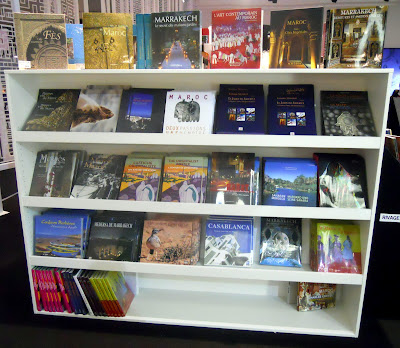
At the entrance to the Moroccan bookstore section, I was delighted to find a book that is a modern reprint of French Romantic painter Eugene Delacroix's sketchbook and diaries from his travels in North Africa in 1832, when he accompanied a diplomatic mission to Morocco and Algeria shortly after the French had conquered Algeria. The mission set sail from Toulon, France, landed at Tangier, Morocco and then traveled across Morocco into Algeria, returning to France via Oran and Algiers. Delacroix's artwork was profoundly affected by these travels and the colorful sketches from his journals served as inspiration for some of his most famous paintings. Delacroix would have been inspired by some of the exhibits, such as this display of a saddle, musket and riding boots, probably very like those he observed firsthand and painted.
 Two young Moroccan women, dressed in kaftans, greeted visitors to the bookshop,
 and two other kaftan-clad hostesses were ready to treat visitors to a tea ceremony with the tiny multi-colored glasses that are used to hold the very hot, very sweet mint tea that is served everywhere in Morocco,
 while another display case featured sumptuous - and likely heavy - ceremonial kaftans and headdresses.
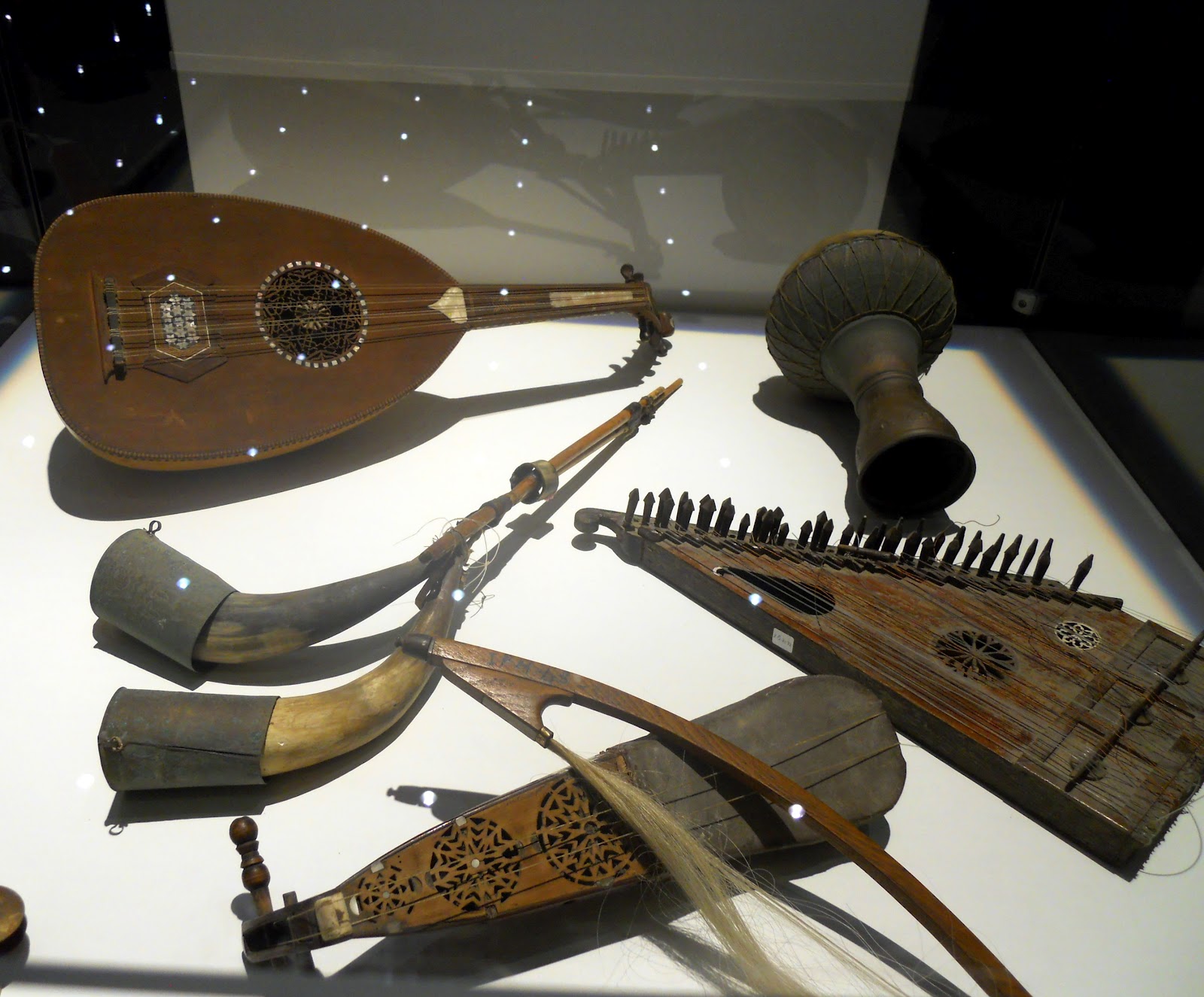
 One display featured a selection of traditional musical instruments
 while in another area, a musician enchanted several children by playing the oud.
 There were examples of mosaics, crafts that North Africans carried with them to the Iberian peninsula,
 copper worked receptacles,
 and Berber jewelry,
 as well as displays featuring the bounty of Moroccan agriculture, such as grains,
 spices and scents.
 All in all, my visit to the exhibits at the book far provided a lovely reminder of the beautiful and exotic country where I spent eight years of my adult life among lovely people and had many life-enriching and life-changing experiences, including the birth of my second son in Tangier some 135 years after Delacroix had first landed there. As it had with Delacroix and has with so many others before and since, Morocco also worked its magic on me.

At the entrance to the Moroccan bookstore section, I was delighted to find a book that is a modern reprint of French Romantic painter Eugene Delacroix's sketchbook and diaries from his travels in North Africa in 1832, when he accompanied a diplomatic mission to Morocco and Algeria shortly after the French had conquered Algeria. The mission set sail from Toulon, France, landed at Tangier, Morocco and then traveled across Morocco into Algeria, returning to France via Oran and Algiers. Delacroix's artwork was profoundly affected by these travels and the colorful sketches from his journals served as inspiration for some of his most famous paintings. Delacroix would have been inspired by some of the exhibits, such as this display of a saddle, musket and riding boots, probably very like those he observed firsthand and painted.




27 April 2012
Books, Books Everywhere!
It is very heartening for those of us who, much as we may appreciate the convenience of reading on Kindle or other electronic devices, still love the shape, feel, smell and texture of an authentic book to see that despite all, the Geneva International Book Fair is still going strong. I know, for example, that my young grandchildren will almost always choose to settle down to thumb through a well-loved book even when there are other noisier, glitzier and more colorful distractions around even though they are also able to manipulate iPads, Androids and their ilk much more competently than I.
Yesterday, I visited the Book Fair with Friend J. The Fair is the 26th one to date. It began Wednesday, 25 April and will run through Sunday at the Geneva Palexpo. Part of the exposition dealt with opportunities for students to have study experiences abroad
 in order to learn languages - not merely English - literally to open themselves to the world. And yes, the Police also had a stand!
 Books in French, including textbooks for the very young, dominated the displays.
 In addition, there were some books in English, including an impressive display of books stressing the learning of English as a Second Language. When I stopped to take a photo of this display, one of the attendants chuckled and exclaimed that I was the first person she had seen take a photo of the English ESL books. Ah well, it takes all kinds!
 There was a large area dedicated to books, mostly in French, from African authors and dealing with African topics, history and cultures.


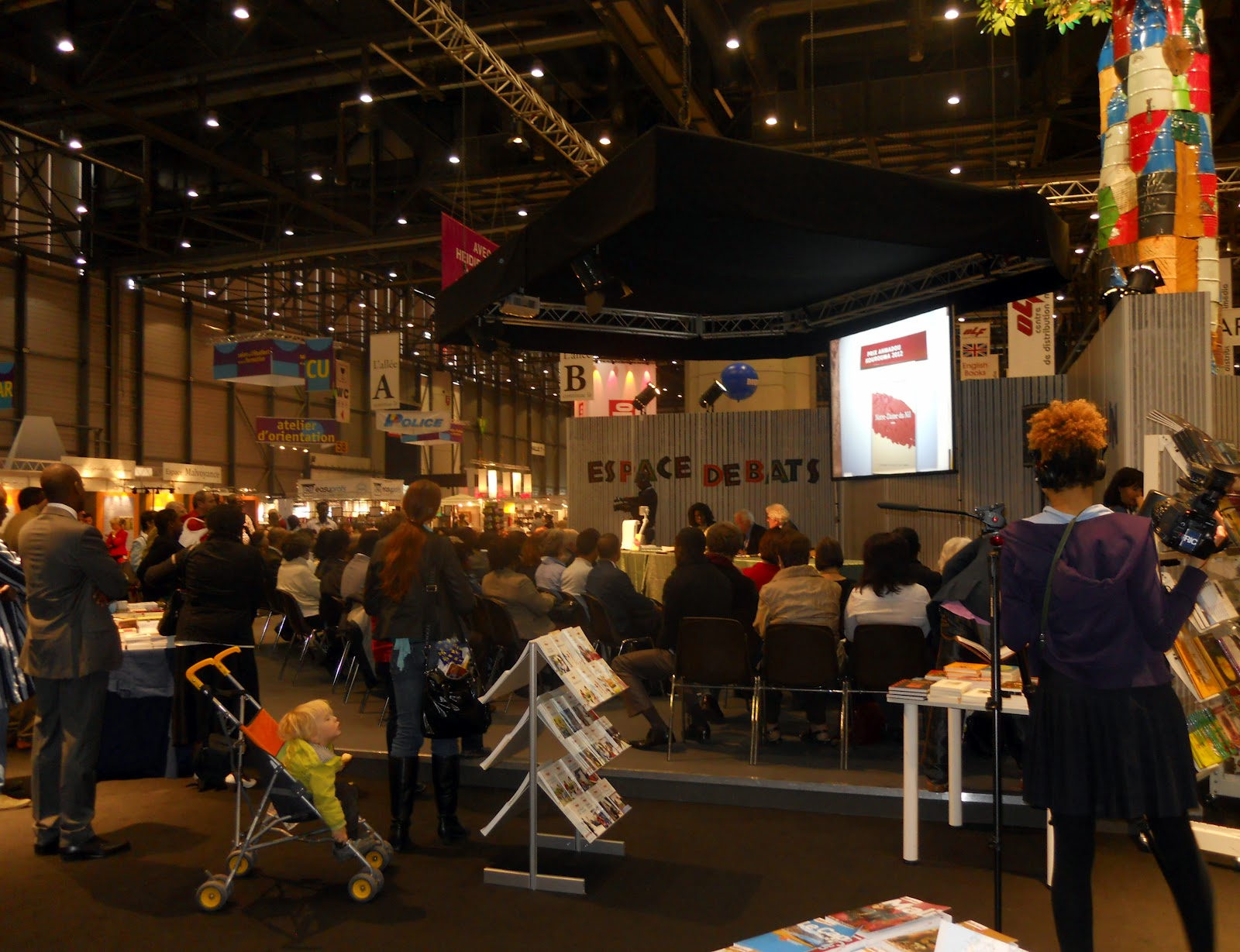
 Several people - young and old - were gathered for a presentation.
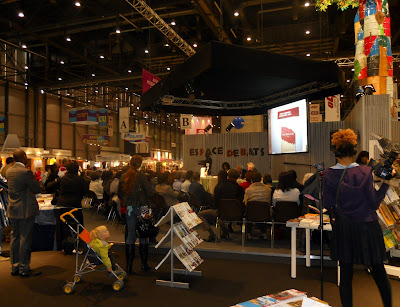 Being a weekday morning, the Palexpo was not as crowded as it will be tomorrow and Sunday. But I was happy to see that many visitors were there all the same. Reading must play a major role in any civilized society. Perhaps one indication of a society's degeneration is when it no longer places significant value on books or the learning and knowledge they represent. For a bibliophile such as myself, the experience was wonderful.
It was heightened further because the Book Fair Guest of Honor for 2012 was Morocco, a country I have long considered as a very special place and that has played significant roles in my own life, changing it entirely, in fact.
Yesterday, I visited the Book Fair with Friend J. The Fair is the 26th one to date. It began Wednesday, 25 April and will run through Sunday at the Geneva Palexpo. Part of the exposition dealt with opportunities for students to have study experiences abroad


It was heightened further because the Book Fair Guest of Honor for 2012 was Morocco, a country I have long considered as a very special place and that has played significant roles in my own life, changing it entirely, in fact.

More on the Moroccan expositions in a later post ...
31 March 2012
Caravans, Cranes and War Without End, Part 2
James Michener's 1963 novel "Caravans" was one of his characteristically sweeping sagas, this time set in Afghanistan and neighboring countries in the period immediately following World War II. The movie based on this book was filmed in Iran and released in 1978, the year that HWMBO returned to the US after four years living and working in Iran. HWMBO departed barely ahead of the revolution that would transform Iran from 1979 on.
The story deals with a protagonist who is stationed at the American Embassy in Kabul who is given the assignment to discover the whereabouts and condition of an American woman who had married an Afghani exchange student several months previously and then seemingly disappeared. Given the time (mid to late 1940s) and the state of race relations generally in the US, any white American woman who married a foreigner, particularly one whose skin color was darker than lily-white, was already in the extreme avant-garde. Interestingly, nearly 20 years later, another avant-garde white American woman married another even more dusky-hued exchange student although she did not follow him when he returned to his native country. The current US President, whom I am very proud to support wholeheartedly, was born of that union in Hawaii, another Michener novel locale. Unfortunately, it does not seem that race relations in certain parts of the US have progressed much beyond the post WWII-period. To our eternal shame.
As anyone who reads the novel discovers, no harm has befallen the American woman, who is supremely independent and very much the mistress of her own destiny. But the scenario does provide Michener with the excuse to explore the extremely interesting complexes and nuances of the primarily nomadic cultures that he describes. In fact, even with that arguably sketchy and fictional background about Afghanistan paired with my own experiences as a Peace Corps Volunteer in an Islamic culture, I likely understood much more about the region than the majority of those in the Reagan Administration who hated anything Russian with fanatical zeal. Thus, as soon as they possibly could, and in defiance of any long-term logic, they hastened to arm the most fundamentalist Islamic Afghan groups and extensively trained in military tactics anyone who was willing, Afghan or not, to fight the Russians who invaded Afghanistan in 1979. Of course, as we have all seen since, many of those who were armed and trained by the short-sighted Reagan-era fanatics were the same people who would later conspire successfully to bring down the Twin Towers on 9-11. Many of those trained and their successors continue to fight - successfully - against our own troops today.
So, I was delighted when in late January I had an opportunity to meet with and hear some of the first-hand experiences of the Swiss-American journalist, Edward Girardet. Girardet, who has a home in Geneva and who wrote principally for the Christian Science Monitor during the 30-year period from 1979-2009, published a book, "Killing the Cranes," in 2011 about his experiences during three decades of war in Afghanistan. Here is one book review. It is my fervent hope that those in the Obama Administration will read it and take heed. In fact, I think that every American should read it. After our extremely ill-advised commencement of war there in 2001, we seem caught there in a morass that destroyed empires long before our own was even a gleam in the eye of civilization.
As Girardet tells it, the title comes from an experience in March 2004 when Girardet was spending the evening with an Afghan friend in Kabul. His friend remarked, "For me, the end of March has always been the time when you cannot hear your voice for the sound of the migrating cranes." He meant the Siberian cranes that every spring have flown northward from the southern wetlands of Iran and Afghanistan to the Russian Arctic and northern Siberia. The friend continued, "You know, I have not heard a single crane since being here." Shaking his head wearily, he asked, "Have we even killed all the cranes?"
In September 2001, Girardet was in Afghanistan hoping to interview Ahmad Shah Massoud, the Afghan leader who likely presented the main challenge to the then-Taliban government and thus a counter to the growing influence of Al Qaeda. As it would happen, Girardet had a commitment to return to Switzerland for his wife's birthday and could not stay later than 8 September. Because weather conditions were such that Massoud's helicopter could not land at his command post until after Girardet's departure, Girardet missed getting his interview. Fortunately for him, he also likely just missed being killed along with Massoud on 9 September. In the book, Girardet describes how all the journalists waiting to interview Massoud were staying in the same guesthouse. Staying in the room next to his were two Arabs posing as journalists who turned out to be Massoud's assassins. Here is a link to a YouTube video of Girardet's conversation with Thom Hartmann.
Afghanistan has been in the headlines recently, but neither in the romantically exciting sense of "Caravans," nor in the vanished cranes symbolizing a similarly lost past. Now it is in the context of War Without End and commensurate atrocities. Thus, to tomorrow's post.
The story deals with a protagonist who is stationed at the American Embassy in Kabul who is given the assignment to discover the whereabouts and condition of an American woman who had married an Afghani exchange student several months previously and then seemingly disappeared. Given the time (mid to late 1940s) and the state of race relations generally in the US, any white American woman who married a foreigner, particularly one whose skin color was darker than lily-white, was already in the extreme avant-garde. Interestingly, nearly 20 years later, another avant-garde white American woman married another even more dusky-hued exchange student although she did not follow him when he returned to his native country. The current US President, whom I am very proud to support wholeheartedly, was born of that union in Hawaii, another Michener novel locale. Unfortunately, it does not seem that race relations in certain parts of the US have progressed much beyond the post WWII-period. To our eternal shame.
As anyone who reads the novel discovers, no harm has befallen the American woman, who is supremely independent and very much the mistress of her own destiny. But the scenario does provide Michener with the excuse to explore the extremely interesting complexes and nuances of the primarily nomadic cultures that he describes. In fact, even with that arguably sketchy and fictional background about Afghanistan paired with my own experiences as a Peace Corps Volunteer in an Islamic culture, I likely understood much more about the region than the majority of those in the Reagan Administration who hated anything Russian with fanatical zeal. Thus, as soon as they possibly could, and in defiance of any long-term logic, they hastened to arm the most fundamentalist Islamic Afghan groups and extensively trained in military tactics anyone who was willing, Afghan or not, to fight the Russians who invaded Afghanistan in 1979. Of course, as we have all seen since, many of those who were armed and trained by the short-sighted Reagan-era fanatics were the same people who would later conspire successfully to bring down the Twin Towers on 9-11. Many of those trained and their successors continue to fight - successfully - against our own troops today.
So, I was delighted when in late January I had an opportunity to meet with and hear some of the first-hand experiences of the Swiss-American journalist, Edward Girardet. Girardet, who has a home in Geneva and who wrote principally for the Christian Science Monitor during the 30-year period from 1979-2009, published a book, "Killing the Cranes," in 2011 about his experiences during three decades of war in Afghanistan. Here is one book review. It is my fervent hope that those in the Obama Administration will read it and take heed. In fact, I think that every American should read it. After our extremely ill-advised commencement of war there in 2001, we seem caught there in a morass that destroyed empires long before our own was even a gleam in the eye of civilization.
As Girardet tells it, the title comes from an experience in March 2004 when Girardet was spending the evening with an Afghan friend in Kabul. His friend remarked, "For me, the end of March has always been the time when you cannot hear your voice for the sound of the migrating cranes." He meant the Siberian cranes that every spring have flown northward from the southern wetlands of Iran and Afghanistan to the Russian Arctic and northern Siberia. The friend continued, "You know, I have not heard a single crane since being here." Shaking his head wearily, he asked, "Have we even killed all the cranes?"
In September 2001, Girardet was in Afghanistan hoping to interview Ahmad Shah Massoud, the Afghan leader who likely presented the main challenge to the then-Taliban government and thus a counter to the growing influence of Al Qaeda. As it would happen, Girardet had a commitment to return to Switzerland for his wife's birthday and could not stay later than 8 September. Because weather conditions were such that Massoud's helicopter could not land at his command post until after Girardet's departure, Girardet missed getting his interview. Fortunately for him, he also likely just missed being killed along with Massoud on 9 September. In the book, Girardet describes how all the journalists waiting to interview Massoud were staying in the same guesthouse. Staying in the room next to his were two Arabs posing as journalists who turned out to be Massoud's assassins. Here is a link to a YouTube video of Girardet's conversation with Thom Hartmann.
Afghanistan has been in the headlines recently, but neither in the romantically exciting sense of "Caravans," nor in the vanished cranes symbolizing a similarly lost past. Now it is in the context of War Without End and commensurate atrocities. Thus, to tomorrow's post.
30 March 2012
Caravans, Cranes and War Without End, Part 1
When I was much younger, among the books I loved to read were those by novelist James Michener. Michener's works were generally characterized by their scope and treatment of epic sagas. He often began literally at the geological or at least the pre-historical origins of the regions that he wished to encapsulate for his readers and described ensuing generations in detail. One literally needed a map of the territory or territories covered, along with family trees to keep the characters sorted, as the stories wound their way through the generations, with actual historical events often forming the backdrop. Michener's research was meticulous. But what also characterized his novels for me, especially in hindsight and upon reading some at my now more advanced age, was Michener's prescience. So many of the issues he treated, whether they concerned ethnic identities, religious zealotry, tolerance or the lack of it, individuals and their rights or identities being subsumed into a larger geopolitical military context or simply appreciation of the richness, beauty or vast expanses of the regions his novels dealt with, have emerged time and again as events in those regions have made headlines.
Some of his novels have resonated with me at different times in my life. More eerily, they have even paralleled my own life trajectory, although occasionally in their film as well as written forms. Thus, I first saw "South Pacific," the film made from the blockbuster Broadway musical of the same name based on his Pulitzer Prize-winning novel "Tales of the South Pacific," in the early 1950s when my family made its first-ever major family trip together. We had boarded the then-orange-and-black Empire Builder in our tiny rural home town in Montana - that was when the train made stops in other than major cities so that people could actually get from one place to another - and traveled westward for many, many hours through the Rocky Mountains to Spokane, Washington to visit my father's parents as well as other family members there. As if the Spokane visit were not already an adventure sufficient unto itself, while we were there, we attended a showing of the movie. The wonderful tunes, beautiful film footage and story line grabbed my soul and imbued it - once and forever - with the wanderlust that has been with me since.
Continuing Michener's fascination with Polynesia was his 1959 novel, "Hawaii," which I loved - even the seemingly-endless description of the birth of the islands themselves. While awaiting the birth of my older son in the mid-60s, I read "Caravans" and "The Source." After living in Tangier, Morocco in the late 60s and meeting descendants of those whose ancestors had fled to Morocco from Spain after the Spanish had reconquered Andalusia in the 15th century, I read "The Drifters." I read several other titles in the 1970s, courtesy of the Missoula County Public Library.
"Caravans" re-entered my life in film form late in 1980, when my sons and I were once again in Morocco, this time in Rabat. As an aid worker, I was entitled to attend English-language films at the Embassy and generally took my then-teen-aged sons with me - homesick as they were for anything American at the time. Somehow we had missed seeing the film in the States, so it was a new experience for us. A few months later when I had been introduced to the man who would later figure in my life as "HWMBO," I was delighted to learn that much of the film had been shot on location in Iran, near where HWMBO and several other US expatriates lived during the time when relations between our two governments were friendly. Some of these new friends had actually been "extras" on the set! Now we were together with them in Morocco. They were as affected with wanderlust as I!
Later, after marrying and returning with my newly increased family to Maryland, I read Michener's "Chesapeake." It was a lovely introduction to that home. That novel is here with me now. In Switzerland.
But all those life experiences were pre-9-11, that catastrophically tragic day when the world literally changed forever.
Michener was fortunate. He left us all in 1997, before the horror arrived, before the decade-plus thereafter when the US - if it ever truly had a claim as a "White Knight" had most certainly lost it, perhaps forever. And now for the Cranes ....
Some of his novels have resonated with me at different times in my life. More eerily, they have even paralleled my own life trajectory, although occasionally in their film as well as written forms. Thus, I first saw "South Pacific," the film made from the blockbuster Broadway musical of the same name based on his Pulitzer Prize-winning novel "Tales of the South Pacific," in the early 1950s when my family made its first-ever major family trip together. We had boarded the then-orange-and-black Empire Builder in our tiny rural home town in Montana - that was when the train made stops in other than major cities so that people could actually get from one place to another - and traveled westward for many, many hours through the Rocky Mountains to Spokane, Washington to visit my father's parents as well as other family members there. As if the Spokane visit were not already an adventure sufficient unto itself, while we were there, we attended a showing of the movie. The wonderful tunes, beautiful film footage and story line grabbed my soul and imbued it - once and forever - with the wanderlust that has been with me since.
Continuing Michener's fascination with Polynesia was his 1959 novel, "Hawaii," which I loved - even the seemingly-endless description of the birth of the islands themselves. While awaiting the birth of my older son in the mid-60s, I read "Caravans" and "The Source." After living in Tangier, Morocco in the late 60s and meeting descendants of those whose ancestors had fled to Morocco from Spain after the Spanish had reconquered Andalusia in the 15th century, I read "The Drifters." I read several other titles in the 1970s, courtesy of the Missoula County Public Library.
"Caravans" re-entered my life in film form late in 1980, when my sons and I were once again in Morocco, this time in Rabat. As an aid worker, I was entitled to attend English-language films at the Embassy and generally took my then-teen-aged sons with me - homesick as they were for anything American at the time. Somehow we had missed seeing the film in the States, so it was a new experience for us. A few months later when I had been introduced to the man who would later figure in my life as "HWMBO," I was delighted to learn that much of the film had been shot on location in Iran, near where HWMBO and several other US expatriates lived during the time when relations between our two governments were friendly. Some of these new friends had actually been "extras" on the set! Now we were together with them in Morocco. They were as affected with wanderlust as I!
Later, after marrying and returning with my newly increased family to Maryland, I read Michener's "Chesapeake." It was a lovely introduction to that home. That novel is here with me now. In Switzerland.
But all those life experiences were pre-9-11, that catastrophically tragic day when the world literally changed forever.
Michener was fortunate. He left us all in 1997, before the horror arrived, before the decade-plus thereafter when the US - if it ever truly had a claim as a "White Knight" had most certainly lost it, perhaps forever. And now for the Cranes ....
08 February 2012
Storks - Not Just for Delivering Babies
A few days ago, to much fanfare and ado, Punxatawney Phil "predicted" that there would be six more weeks of winter, at least in the USA. While this news was received with no small disbelief in the USA, which is having one of its warmest and mildest winters on record, it is no news at all to those of us freezing off various extremities in Central Europe right now. Still, we here in Central Europe are much better off than our neighbors to the east.
But it seems that Phil's forecast has now been given additional credence, just in case we needed it, by Max the Stork, the inadvertent, if beloved, weather guru for the Swiss. Max is a female stork ostensibly named for the Swiss conservationist Max Bloesch, although her name incidentally also reflects the first name of the founder of the German-based Max Planck Institute for Ornithology (MPIO). The MPIO has been watching the movements of white storks for more than 100 years and tracking their flights since 1991. Whichever namesake applies, Max the Stork has abruptly stopped her flight northward and is biding her time in Catalonia, northern Spain. She shows no signs of moving on anytime soon. Max is no dummy.
White storks are long-distance migrants that are found in Europe, Africa and Southeast Asia. The MPIO's satellite-tracking and bird-banding programs have allowed ornithologists to follow the movements of individual birds with greater accuracy so as better to understand how population movements change in response to environmental conditions. For more information on migration movements generally, see Movebank.
Max has been a regular seasonal feature in the English-language website Geneva Lunch, such as here where she is pictured and described while raising her three chicks from 2011. Max, going on for 13 years old, has been banded and tracked longer than any bird in the world. She migrates each fall to either southern Spain or northern Morocco and returns to the Swiss-German border area, Tuefingen, on the north coast of Lake Constance, to mate and raise her young. Counting her 2011 family, she has produced 26 offspring within nine years.
Max herself is a Swiss national, having been born in Avenches in 1999. The Museum of Natural History in Fribourg also tracks her movements (Max la Cigogne) on behalf of her ever-increasing fan club. She has also been immortalized in a book, A Stork Named Max - Life Is No Frog Buffet, which I have so far been unable to find on Amazon for my grandchildren, who are all voracious readers, thank heavens. But I will continue to look for it.
In the meantime, here is the link to a YouTube depiction of Max's flights over the first three years. Here is another showing how the batteries on her transmitter, once exhausted, get replaced. Happy flying, Max, we hope that you will be able to come home soon and bring some warmer weather with you!
But it seems that Phil's forecast has now been given additional credence, just in case we needed it, by Max the Stork, the inadvertent, if beloved, weather guru for the Swiss. Max is a female stork ostensibly named for the Swiss conservationist Max Bloesch, although her name incidentally also reflects the first name of the founder of the German-based Max Planck Institute for Ornithology (MPIO). The MPIO has been watching the movements of white storks for more than 100 years and tracking their flights since 1991. Whichever namesake applies, Max the Stork has abruptly stopped her flight northward and is biding her time in Catalonia, northern Spain. She shows no signs of moving on anytime soon. Max is no dummy.
White storks are long-distance migrants that are found in Europe, Africa and Southeast Asia. The MPIO's satellite-tracking and bird-banding programs have allowed ornithologists to follow the movements of individual birds with greater accuracy so as better to understand how population movements change in response to environmental conditions. For more information on migration movements generally, see Movebank.
Max has been a regular seasonal feature in the English-language website Geneva Lunch, such as here where she is pictured and described while raising her three chicks from 2011. Max, going on for 13 years old, has been banded and tracked longer than any bird in the world. She migrates each fall to either southern Spain or northern Morocco and returns to the Swiss-German border area, Tuefingen, on the north coast of Lake Constance, to mate and raise her young. Counting her 2011 family, she has produced 26 offspring within nine years.
Max herself is a Swiss national, having been born in Avenches in 1999. The Museum of Natural History in Fribourg also tracks her movements (Max la Cigogne) on behalf of her ever-increasing fan club. She has also been immortalized in a book, A Stork Named Max - Life Is No Frog Buffet, which I have so far been unable to find on Amazon for my grandchildren, who are all voracious readers, thank heavens. But I will continue to look for it.
In the meantime, here is the link to a YouTube depiction of Max's flights over the first three years. Here is another showing how the batteries on her transmitter, once exhausted, get replaced. Happy flying, Max, we hope that you will be able to come home soon and bring some warmer weather with you!
04 March 2011
"My Life in Books"
For the past couple weeks, I've been a fairly loyal viewer of a program on BBC 2 called "My Life in Books" brought to me courtesy of my local cable company. The program has been hosted by British TV personality Anne Robinson, who in her better-known role of TV game show host on "The Weakest Link," is the British rival of the late Leona Helmsley for the title of "Queen of Mean."
I should mention that HWMBO has always enjoyed "The Weakest Link." I have never been a fan. Despite my dislike of Ms Robinson in her game show host persona, however, she has done a bang-up job with the British celebrities that she has interviewed on "My Life in Books." She has asked them about the books that they have read and most enjoyed at various periods in their lives. It has been a very interesting set of interviews and has inspired me to write down several titles to follow up with myself. I, for one, am sorry to see the series end. I've really gotten "into" it.
Like so many, I cannot even begin to imagine a life without books or reading. Thus, it has been a major treat to see and hear so many personalities from stage, screen, journalism, politics and other careers talk about their own relationships with books. Sometimes these relationships are not always as literary (or even as "stuffy") as one might believe. One went on at great length, for example, about Barack Obama's books, "Dreams from My Father" and "The Audacity of Hope." Among their "guilty reading pleasures," others have cited Julia Child's Mastering the Art of French Cooking, the New York Times Crossword Puzzle Dictionary, and - one of my own great, if guilty, pleasures - any of Janet Evanovich's Stephanie Plum books. I challenge anyone to read Stephanie Plum's bounty hunting and "sleuthing" adventures without laughing out loud. Stephanie is often accompanied by her sidekick, Lula, ex-lady of the streets, her sassy Grandma Masur who attends every wake possible at the local funeral parlor, and two hunky suitors, Ranger and Morelli. It's literally impossible in my experience to read more than a couple pages without cracking up. It was gratifying to see that Stephanie has even won over the legendarily staid and proper British.
In these days of electronic media, of IPads, Twitter and Kindle, to mention only a few, it is still nice to see that actual books, that is, paper pages between covers - either in hard cover or paperback - are still very much appreciated. I am very happy if electronic media will make reading more accessible to those who might otherwise never sit down with a book. But for me, there is no pleasure quite the same as tucking oneself into a quiet corner to read a book without benefit of batteries or cords. That is nothing less than sheer bliss!
I should mention that HWMBO has always enjoyed "The Weakest Link." I have never been a fan. Despite my dislike of Ms Robinson in her game show host persona, however, she has done a bang-up job with the British celebrities that she has interviewed on "My Life in Books." She has asked them about the books that they have read and most enjoyed at various periods in their lives. It has been a very interesting set of interviews and has inspired me to write down several titles to follow up with myself. I, for one, am sorry to see the series end. I've really gotten "into" it.
Like so many, I cannot even begin to imagine a life without books or reading. Thus, it has been a major treat to see and hear so many personalities from stage, screen, journalism, politics and other careers talk about their own relationships with books. Sometimes these relationships are not always as literary (or even as "stuffy") as one might believe. One went on at great length, for example, about Barack Obama's books, "Dreams from My Father" and "The Audacity of Hope." Among their "guilty reading pleasures," others have cited Julia Child's Mastering the Art of French Cooking, the New York Times Crossword Puzzle Dictionary, and - one of my own great, if guilty, pleasures - any of Janet Evanovich's Stephanie Plum books. I challenge anyone to read Stephanie Plum's bounty hunting and "sleuthing" adventures without laughing out loud. Stephanie is often accompanied by her sidekick, Lula, ex-lady of the streets, her sassy Grandma Masur who attends every wake possible at the local funeral parlor, and two hunky suitors, Ranger and Morelli. It's literally impossible in my experience to read more than a couple pages without cracking up. It was gratifying to see that Stephanie has even won over the legendarily staid and proper British.
In these days of electronic media, of IPads, Twitter and Kindle, to mention only a few, it is still nice to see that actual books, that is, paper pages between covers - either in hard cover or paperback - are still very much appreciated. I am very happy if electronic media will make reading more accessible to those who might otherwise never sit down with a book. But for me, there is no pleasure quite the same as tucking oneself into a quiet corner to read a book without benefit of batteries or cords. That is nothing less than sheer bliss!
02 October 2010
Transitions
I realized yesterday afternoon that it was time to turn the calendar page. Yes, we are now in the throes of October, officially beginning the final three months of 2010. For me, October has often been a melancholy month, in part because the days get light later and dark earlier once the autumn solstice has passed.
October has also often been a personal transition month for me. I first consciously realized this in 1978, when I happened to be reading Gail Sheehy's Passages: Predictable Crises of Adult Life just after having made significant transitions in the preceding July-August-September period. After receiving a divorce that ended a 13-year marriage, I had uprooted my young sons and even some of the family pets from Montana to Arizona to spend a year studying for a graduate degree while on sabbatical leave from my teaching position. While most of those transitions had not actually occurred in October, it was in October that I had some time to take stock of all that had happened during the rather tumultuous three-month period preceding it. Similarly, October 1980 was my stock-taking moment after a transatlantic move from Montana to Morocco that also involved new employment. My long-suffering sons and the family dog accompanied me on this second adventure as well. It was intended to last for three years. That particular set of transitions ended up changing all our lives forever in ways that we never could have imagined - at least not during that particular October.
The most significant transitions that resulted in my current lifestyle occurred in October 1994, when HWMBO and I first came to Switzerland together. At the time, my projection was that our stay here would last from three to five years. In fact, funding for the institution that had engaged my services was on shaky footing, to say the least, so the move could have resulted in our departure much earlier. Prospects were so short-term at the time that we could never have imagined that our stay here would last for the 16 years it has! Had we been able to see the future, we would certainly have invested in real estate here 16 years ago because it would have cost a lot less in the long term than our rentals! As it happened, I got a realistic second bite at the real estate apple late in October 2005 and snapped at it - although with a very big gulp. And not without significant qualms.
In hindsight, that turned out to be an extremely fortuitous financial decision because that real estate has since appreciated. It also helped that the USD exchange rate for the amount that I had to convert for the purchase was significantly higher at the time. Like so many others with funds that were invested in equities and securities to aid us in our retirement lifestyle, we have watched with dismay verging on horror the various global financial crises. The absence of ethics and scruples in those who had fiduciary obligations but appropriated and squandered the funds of others for their own whimsy and pleasure - gambling that their Day of Reckoning would never come has been particularly disappointing, as was the failure of Government oversight. Institutions were in place but were simply not allowed to function as they should have because it did not suit those in power at the time. When the Day of Reckoning did come, those same scam artists - who without fail preach caveat emptor and "free markets" to others and who consider those who live in poverty to be there by choice - were the first to beg for Government-sponsored taxpayer bailouts, which in most instances translated into billions of dollars received with no strings attached. Today, the USD is trading almost at parity with the Swiss franc (CHF).
While the financial crises are indeed global, there is no denying the significant role of the unregulated market capitalism and shock doctrine-enforced "democracies" that principals from my own country have fostered at the expense of captive populations, including its own. Thanks a lot, scam artists and worse! Many of us are growing impatient with waiting for the "mills of God" to do their grinding. To this end, there will be demonstrations in the US today, a fact that was barely worthy of mention in the rightward-leaning Washington Post, which unceasingly gives disproportionate coverage to anything with a whiff of Tea Baggery. Even the New York Times finds other news more important to report. It's eerily similar to how the MSM virtually ignored the millions who protested the war in Iraq in 2003. Let's see whether they report anything about this tomorrow and, if so, whether it will be with the habitually disparaging bias they use towards progressives.
Whether transitions are for better or for worse, they inevitably lead at least to physical shifts in geographical location, lifestyle, health conditions and choices, among others, even if only for a short while. They can also lead to universal shifts in perspective and spiritual outlook. Given my own experience with transitions in October, that include changes in employment, international relocations, losses of loved ones, major surgeries, travel and so forth, it is no wonder that I greet the month with some melancholy. Still, given my experience, even that melancholy is tempered with anticipation rather than foreboding.
October has also often been a personal transition month for me. I first consciously realized this in 1978, when I happened to be reading Gail Sheehy's Passages: Predictable Crises of Adult Life just after having made significant transitions in the preceding July-August-September period. After receiving a divorce that ended a 13-year marriage, I had uprooted my young sons and even some of the family pets from Montana to Arizona to spend a year studying for a graduate degree while on sabbatical leave from my teaching position. While most of those transitions had not actually occurred in October, it was in October that I had some time to take stock of all that had happened during the rather tumultuous three-month period preceding it. Similarly, October 1980 was my stock-taking moment after a transatlantic move from Montana to Morocco that also involved new employment. My long-suffering sons and the family dog accompanied me on this second adventure as well. It was intended to last for three years. That particular set of transitions ended up changing all our lives forever in ways that we never could have imagined - at least not during that particular October.
The most significant transitions that resulted in my current lifestyle occurred in October 1994, when HWMBO and I first came to Switzerland together. At the time, my projection was that our stay here would last from three to five years. In fact, funding for the institution that had engaged my services was on shaky footing, to say the least, so the move could have resulted in our departure much earlier. Prospects were so short-term at the time that we could never have imagined that our stay here would last for the 16 years it has! Had we been able to see the future, we would certainly have invested in real estate here 16 years ago because it would have cost a lot less in the long term than our rentals! As it happened, I got a realistic second bite at the real estate apple late in October 2005 and snapped at it - although with a very big gulp. And not without significant qualms.
In hindsight, that turned out to be an extremely fortuitous financial decision because that real estate has since appreciated. It also helped that the USD exchange rate for the amount that I had to convert for the purchase was significantly higher at the time. Like so many others with funds that were invested in equities and securities to aid us in our retirement lifestyle, we have watched with dismay verging on horror the various global financial crises. The absence of ethics and scruples in those who had fiduciary obligations but appropriated and squandered the funds of others for their own whimsy and pleasure - gambling that their Day of Reckoning would never come has been particularly disappointing, as was the failure of Government oversight. Institutions were in place but were simply not allowed to function as they should have because it did not suit those in power at the time. When the Day of Reckoning did come, those same scam artists - who without fail preach caveat emptor and "free markets" to others and who consider those who live in poverty to be there by choice - were the first to beg for Government-sponsored taxpayer bailouts, which in most instances translated into billions of dollars received with no strings attached. Today, the USD is trading almost at parity with the Swiss franc (CHF).
While the financial crises are indeed global, there is no denying the significant role of the unregulated market capitalism and shock doctrine-enforced "democracies" that principals from my own country have fostered at the expense of captive populations, including its own. Thanks a lot, scam artists and worse! Many of us are growing impatient with waiting for the "mills of God" to do their grinding. To this end, there will be demonstrations in the US today, a fact that was barely worthy of mention in the rightward-leaning Washington Post, which unceasingly gives disproportionate coverage to anything with a whiff of Tea Baggery. Even the New York Times finds other news more important to report. It's eerily similar to how the MSM virtually ignored the millions who protested the war in Iraq in 2003. Let's see whether they report anything about this tomorrow and, if so, whether it will be with the habitually disparaging bias they use towards progressives.
Whether transitions are for better or for worse, they inevitably lead at least to physical shifts in geographical location, lifestyle, health conditions and choices, among others, even if only for a short while. They can also lead to universal shifts in perspective and spiritual outlook. Given my own experience with transitions in October, that include changes in employment, international relocations, losses of loved ones, major surgeries, travel and so forth, it is no wonder that I greet the month with some melancholy. Still, given my experience, even that melancholy is tempered with anticipation rather than foreboding.
26 April 2010
Millennium man and his women
Among my reading favorites, I love well-written, well-plotted mystery novels. Many of my favorite mystery authors are women, from classic doyennes of the genre such as Agatha Christie and Dorothy L. Sayers, with their various sleuths, to the wit and flair of Josephine Tey, whose early to mid-20th-century novels were regrettably too few - every one a stand-alone classic - to more modern writers such as Ruth Rendell, Elizabeth George and Minette Walters, where character and psychological studies, together with treatments of contemporary social issues, are interwoven so seamlessly that one hardly notices. They are an integral part of the suspense. While there are many authors whose latest novels I literally rush to read, it is more often those who have been writing for some time and whose work I already know to some extent. When I do find a new author whose work resonates with me, it is sheer and utter joy.
This happened to me last summer. I was browsing through the mystery fiction book section at a Maryland Borders bookstore when a helpful salesclerk asked whether I was looking for anything in particular. I wasn't, but was willing to listen to what she had to say ... and I am so happy that I did. She told me that, if I hadn't already read the work of Stieg Larsson, I should. She proceeded to direct me to a copy of "The Girl with the Dragon Tattoo" and then informed me of the very regrettable fact that Larsson had died in 2004, so that his fiction work is necessarily limited.
 In fact, "The Girl with the Dragon Tattoo" is the first novel of three referred to as "The Millennium Trilogy." The "Millennium" referred to has nothing to do with the ten-century benchmark and everything to do with "Millennium," a fictional magazine with in-depth stories covering various social, political and economic topics.
 I don't know what parallel universe I had been living in because I had totally missed the fact that Larsson's book sales had earned him the rank of second-best-selling author in international markets for 2008. One reason perhaps is because it was only in 2009 that his works, originally written in Swedish, were published in English. The titles in Swedish are also quite different from their English iterations. I have read the first two novels already and am impatiently awaiting the third. It will be distributed in the US this summer. Film versions of all three novels have been released in Sweden. "The Girl with the Dragon Tattoo" has been released in the UK, to critical acclaim. It has also been released in the US, but with English subtitles. It appears that a US version will eventually be made. But I can't help thinking that the details in Larsson's book are so intrinsically Swedish that films set in the US will have difficulty creating anywhere near the same effect.
Larsson's own life story is quite similar to that of his primary male character, Mikael Blomqvist, an investigative journalist. In fact, it was Larsson's career as a crusading investigative journalist that made him personally the target of numerous death threats, to the extent that his sudden death in 2004 caused suspicion that a death threat had actually been successful. One sad effect of these threats was that he did not marry his partner, Eva Gabrielsson, who had collaborated with him for 32 years. Because he died without leaving a valid will, his estate, including all rights to royalties, reverted under Swedish law to his father and brother, his only surviving family members. Many have found this to be quite unfair in the circumstances, particularly because Larsson had not had much direct contact with either family member for years and Eva had co-written the novels in many ways. Eva would have been completely left in the cold except that she holds the manuscript to the fourth "Millennium" novel, which gives her some leverage. She describes the situation in her own words here and here.
 "The Girl" referred to in the titles is an amazing new type of heroine named Lisbeth Salander. Salander, as she is most often referred to, sets an international standard for strong women, although she herself has been shamefully brutalized. According to Blomqvist, Salander is the "most moral person" that he knows. To others, she might appear "amoral," even frightening, especially in her punk appearance. But Salander certainly has a strict ethical code, lives by it fiercely, and has little to no tolerance for the hypocrisy and abuse that are rampant in the institutions surrounding her. In many ways, she creates her own reality.
 Larsson is someone whose work I admire. We lost him too soon. Thankfully, his writing will live on forever.
This happened to me last summer. I was browsing through the mystery fiction book section at a Maryland Borders bookstore when a helpful salesclerk asked whether I was looking for anything in particular. I wasn't, but was willing to listen to what she had to say ... and I am so happy that I did. She told me that, if I hadn't already read the work of Stieg Larsson, I should. She proceeded to direct me to a copy of "The Girl with the Dragon Tattoo" and then informed me of the very regrettable fact that Larsson had died in 2004, so that his fiction work is necessarily limited.


Larsson's own life story is quite similar to that of his primary male character, Mikael Blomqvist, an investigative journalist. In fact, it was Larsson's career as a crusading investigative journalist that made him personally the target of numerous death threats, to the extent that his sudden death in 2004 caused suspicion that a death threat had actually been successful. One sad effect of these threats was that he did not marry his partner, Eva Gabrielsson, who had collaborated with him for 32 years. Because he died without leaving a valid will, his estate, including all rights to royalties, reverted under Swedish law to his father and brother, his only surviving family members. Many have found this to be quite unfair in the circumstances, particularly because Larsson had not had much direct contact with either family member for years and Eva had co-written the novels in many ways. Eva would have been completely left in the cold except that she holds the manuscript to the fourth "Millennium" novel, which gives her some leverage. She describes the situation in her own words here and here.


Subscribe to:
Posts (Atom)