I'm taking a brief break from the China tour to note that we are experiencing typical Fall weather hereabouts. It's been much cooler generally and we've had quite a few showers. I'm hoping that we'll have a spell of what we in North America call "Indian Summer," that last gasp of Summer warmth amid the splendor of blazing Autumn colors.
Vintners have officially begun les vendanges (wine harvest) this week, although they have yet to start on "my" vines. Since my return to Switzerland, I've been enjoying seasonal goodies such as muscat grapes, which I can only find in the late August-early October period, as well as the last of the Reine Claude (greengage) plums, which I adore!
Autumn also signals the return of hunting season, which means that grocery stores and most restaurants also feature game entrees that can be very tasty. I am particularly fond of roast sanglier (wild boar).
The most recent hunting season began on 9 September. Even after all the years I've lived here, I didn't realize until today that the Canton of Geneva has actually banned hunting within its borders since 1974. An article in today's Geneva Tribune described that. It also mentioned that because hunting is allowed in nearby France and in my own Canton of Vaud, game animals such as deer and wild boar actually cross into Geneva to take refuge along the Versoix stream, where they cross paths with the occasional hiker and irritate any farmers whose crops they damage in their travels.
Over the past couple years, game wardens have been surveying the animals' movements. As a result, they have concluded that in some cases, deer and boar have crossed into Geneva canton during the daylight and then returned to their regular habitat in Vaud at dusk, taking advantage of the "truce" after 20:30, after which hunting is not allowed.
Apparently those who survived hunts after 1974 have transmitted this experience to their young. Geneva is not simply a refuge for human beings, but also for our animal counterparts.
Showing posts with label Ecology. Show all posts
Showing posts with label Ecology. Show all posts
25 September 2012

28 May 2012
More Wine Tasting
On my way up the slope to Fechy-Dessus, I passed by this winery, but did not stop in. After all, it was early steps yet in my hike. Even though one is not expected to - and doesn't usually - drink all the wine one is given (there are little containers provided like the one shown here into which one can spit the remainder or simply empty the contents of one's glass), it's never a good idea to overindulge. Alcohol is dehydrating, after all, and the day was getting hotter.
 I also noted this little house with a quaint - and distinctive - window placement.
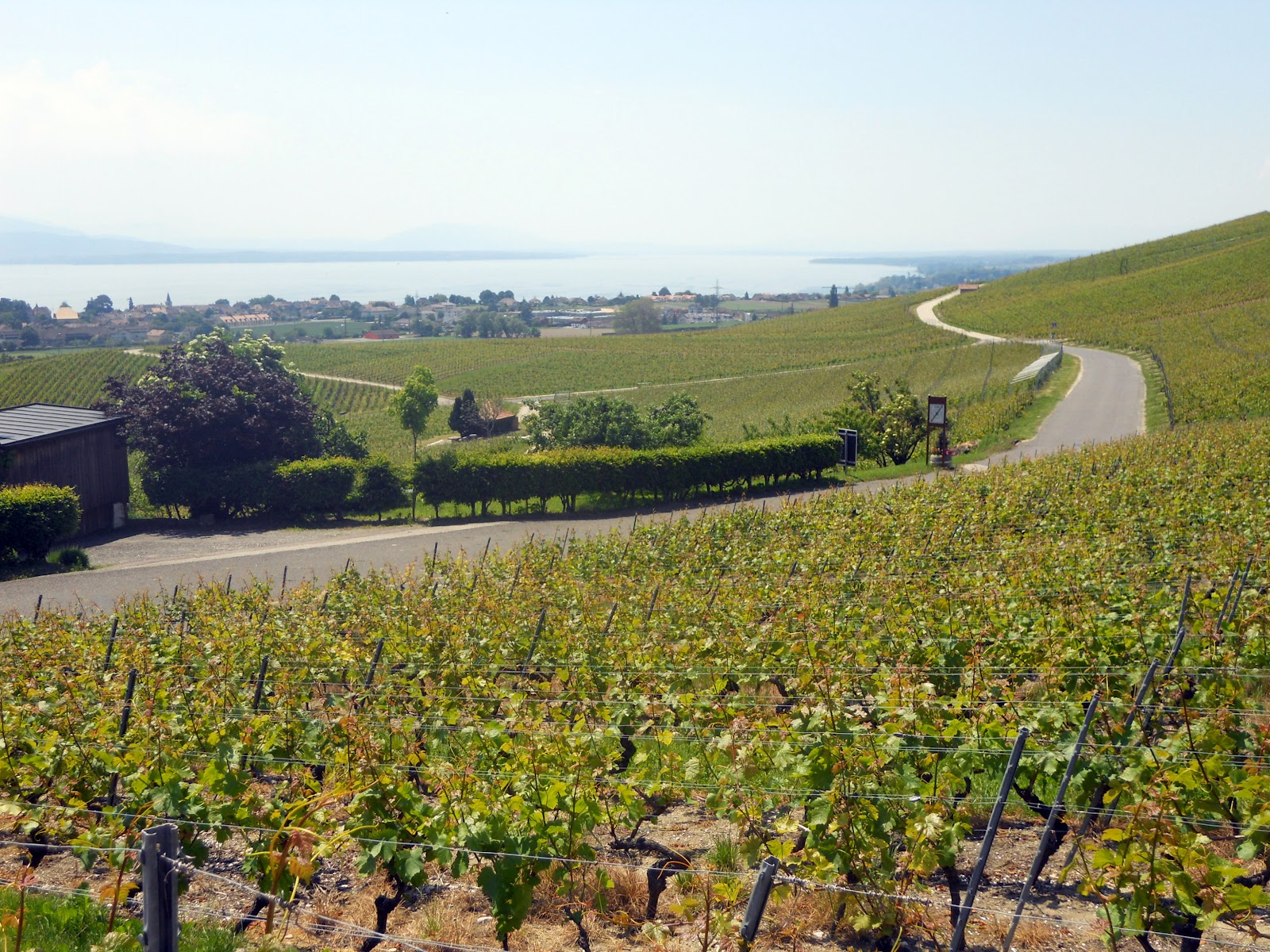
 Looking back towards Fechy, with Lake Geneva in the background, one can see that while the slope is gentle, it is indeed an incline. The Alps are mostly hazy, as is common in mid-Spring.
 The vines are still in early growing stages and look spindly and sparse compared to the way they will look in a few more weeks. Most did not even put out leaves until the beginning of May. Here is the center of Fechy-Dessus, which is a beautiful little village. There is even a shuttle stop to the left, just in case I had changed my mind about hiking!
 Here is also where I decided to experience my second tasting of the day. One can taste as many wines as one wishes at each stop, so full disclosure requires that it wouldn't just be my second wine!
 This beautiful location had the most splendid viewing terrace, with a panoramic view of the region. Best of all, I was their first visitor of the day, so they had plenty of time to chat.
 Remember the winery I passed on the way up the slope. Here's another view from the terrace.
 As you can see from the photo above, just below the viewing terrace, this enterprising family also had a terraced vegetable garden, still in early growing stages. Here's another view.
 Saying adieu to Fechy-Dessus,
 I began hiking towards Bougy-Villars, generally in the direction towards Geneva.
 What a magnificent vista!


08 February 2012
Storks - Not Just for Delivering Babies
A few days ago, to much fanfare and ado, Punxatawney Phil "predicted" that there would be six more weeks of winter, at least in the USA. While this news was received with no small disbelief in the USA, which is having one of its warmest and mildest winters on record, it is no news at all to those of us freezing off various extremities in Central Europe right now. Still, we here in Central Europe are much better off than our neighbors to the east.
But it seems that Phil's forecast has now been given additional credence, just in case we needed it, by Max the Stork, the inadvertent, if beloved, weather guru for the Swiss. Max is a female stork ostensibly named for the Swiss conservationist Max Bloesch, although her name incidentally also reflects the first name of the founder of the German-based Max Planck Institute for Ornithology (MPIO). The MPIO has been watching the movements of white storks for more than 100 years and tracking their flights since 1991. Whichever namesake applies, Max the Stork has abruptly stopped her flight northward and is biding her time in Catalonia, northern Spain. She shows no signs of moving on anytime soon. Max is no dummy.
White storks are long-distance migrants that are found in Europe, Africa and Southeast Asia. The MPIO's satellite-tracking and bird-banding programs have allowed ornithologists to follow the movements of individual birds with greater accuracy so as better to understand how population movements change in response to environmental conditions. For more information on migration movements generally, see Movebank.
Max has been a regular seasonal feature in the English-language website Geneva Lunch, such as here where she is pictured and described while raising her three chicks from 2011. Max, going on for 13 years old, has been banded and tracked longer than any bird in the world. She migrates each fall to either southern Spain or northern Morocco and returns to the Swiss-German border area, Tuefingen, on the north coast of Lake Constance, to mate and raise her young. Counting her 2011 family, she has produced 26 offspring within nine years.
Max herself is a Swiss national, having been born in Avenches in 1999. The Museum of Natural History in Fribourg also tracks her movements (Max la Cigogne) on behalf of her ever-increasing fan club. She has also been immortalized in a book, A Stork Named Max - Life Is No Frog Buffet, which I have so far been unable to find on Amazon for my grandchildren, who are all voracious readers, thank heavens. But I will continue to look for it.
In the meantime, here is the link to a YouTube depiction of Max's flights over the first three years. Here is another showing how the batteries on her transmitter, once exhausted, get replaced. Happy flying, Max, we hope that you will be able to come home soon and bring some warmer weather with you!
But it seems that Phil's forecast has now been given additional credence, just in case we needed it, by Max the Stork, the inadvertent, if beloved, weather guru for the Swiss. Max is a female stork ostensibly named for the Swiss conservationist Max Bloesch, although her name incidentally also reflects the first name of the founder of the German-based Max Planck Institute for Ornithology (MPIO). The MPIO has been watching the movements of white storks for more than 100 years and tracking their flights since 1991. Whichever namesake applies, Max the Stork has abruptly stopped her flight northward and is biding her time in Catalonia, northern Spain. She shows no signs of moving on anytime soon. Max is no dummy.
White storks are long-distance migrants that are found in Europe, Africa and Southeast Asia. The MPIO's satellite-tracking and bird-banding programs have allowed ornithologists to follow the movements of individual birds with greater accuracy so as better to understand how population movements change in response to environmental conditions. For more information on migration movements generally, see Movebank.
Max has been a regular seasonal feature in the English-language website Geneva Lunch, such as here where she is pictured and described while raising her three chicks from 2011. Max, going on for 13 years old, has been banded and tracked longer than any bird in the world. She migrates each fall to either southern Spain or northern Morocco and returns to the Swiss-German border area, Tuefingen, on the north coast of Lake Constance, to mate and raise her young. Counting her 2011 family, she has produced 26 offspring within nine years.
Max herself is a Swiss national, having been born in Avenches in 1999. The Museum of Natural History in Fribourg also tracks her movements (Max la Cigogne) on behalf of her ever-increasing fan club. She has also been immortalized in a book, A Stork Named Max - Life Is No Frog Buffet, which I have so far been unable to find on Amazon for my grandchildren, who are all voracious readers, thank heavens. But I will continue to look for it.
In the meantime, here is the link to a YouTube depiction of Max's flights over the first three years. Here is another showing how the batteries on her transmitter, once exhausted, get replaced. Happy flying, Max, we hope that you will be able to come home soon and bring some warmer weather with you!
11 August 2011
Les Cascades du Hérisson
While HWMBO was still visiting me in Switzerland, but before our other summer visitors began arriving, we decided to check out a few spots that had been recommended to us for ourselves so that we could give our visitors the "real scoop." So one day early in June, we headed into the nearby Jura Mountains for a drive into France to visit les Cascades du Hérisson (the waterfalls of the Hérisson river).
 The Hérisson has its source on a high plateau (805 meters = 2,641 feet) in the Jura Mountains between France and Switzerland. The river then tumbles down a series of slopes for 280 meters (almost 919 feet) in a distance of three kilometers (1.86 miles), forming numerous waterfalls along the way.
 When the water is high, the falls are spectacular. When the water is low, as it was when we visited, the falls themselves are not quite as spectacular and the torrents are mere trickles, but the trail is much less slippery
 and one also has time to appreciate the beauty of the other natural scenery that abounds there,
 as well as the multi-storied cave systems.

 We began with a visit to the visitors' center where we learned about the history of the region, the development of the falls and the industries that once utilized their power, together with the customs, traditions and legends of the people who have lived there for centuries. We also viewed a film that showed the falls during the seasons.
 We also learned about the various hiking paths. We could take the entire route, which would last about three hours, or we could break off at any point. We actually went about three-quarters of the full route.
 The site itself has been a listed natural heritage site in France since April 2002 and is also referred to as the "Valley of Seven Waterfalls" for obvious reasons.
 We had been warned to wear appropriate footgear (hiking boots or shoes) and to be dressed appropriately. If the weather is at all damp, the trail can be very slippery. It is also very steep at points and I was extremely happy to have my walking stick with me. HWMBO, of course, was too proud to use a walking stick!
 We finally stopped at this point,
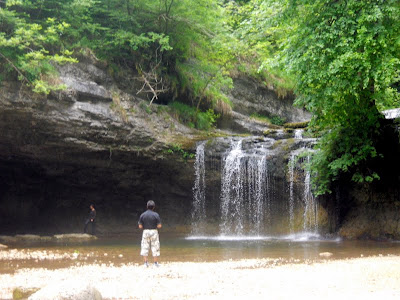 close to a cave which, according to one of the stories we had been told, had been used by smugglers.
 While searching for some of the links that I used in this post this afternoon, I was delighted to discover that a YouTube link from a more recent visit was posted just last week by "drumpiedumpie." The link gives an idea of what the cascades are like in full spate. I am much obliged to the poster, so please click on the link and enjoy!


26 May 2011
Catch-Up Interlude
Whew! It's been a while since I've posted. Fortunately, nothing is wrong here. It's just that days actually seem to pass more quickly as our chronological ages increase. I remember when I was much, much younger how interminable an hour seemed to be - particularly if one had to do something particularly unpleasant like pulling weeds in the hot summer sun, which is the kind of chore my mother was famous (infamous?) for initiating.
On the contrary, HWMBO and I have not been pulling weeds or anything so onerous or unpleasant. Instead, we have been on a mild and pleasant social whirl since our return from Italy and all last week's hullaballoo surrounding the demise of our giant blue spruce. And I am also most happy to confirm that we were not among those Raptured last Saturday, 21 May. Not that there was ever the slightest chance of that happening in my case. Perhaps HWMBO might have made the cut. But I, most certainly not. At least not according to the criteria outlined.
In fact, if any individuals were Raptured, they were apparently not among the flock of the deluded Reverend Camping, who is the latest in a long line of individuals who have predicted Doomsday - so far, signally without success. I understand that Mr. Camping has not given up belief in the End of the World, which will occur, according to him, on 21 October this year. Keep in mind, however, that he is 0 for 2 so far. Who knows? Perhaps the third time will be the charm. But I prefer to tune him out altogether.
We already seem to have enough on our plates in this world without the Almighty dumping on us. And why, in any event, would a Supreme Being who is supposed to be Everything That Is Good deliberately invoke such horrors? If it is simply to punish Sinners (the definition of such seems to be uniquely within the province of people like Camping, et al), what about all those good people - like hapless civilians in the ongoing civil war in Libya - who get caught in an End-of-the-World crossfire? Are they simply Friendly Fire casualties that are acceptable to a supposedly Just and Loving Being? Well, I certainly don't know. But I do strongly doubt it. And if the Almightly did not see fit to end the world during a time when Evil was truly rampant - WWII and the Nazi Regime come to mind - why on earth is now a better time? Bad as things may be for some - and things are VERY bad indeed for too many - there does not seem to be a universal Final Solution effective or operational that is deliberately targeting certain groups, sending millions to be worked or starved to death in concentration camps, gassed and cremated in death camps or executed en masse. To my mind, the years from 1939-1945 (and some years before and after both in Nazi Germany and in Stalin's USSR) were literally the End of the World for millions. If not Then, why Now?
Mr. Camping believes that the natural disasters that appear to be occurring more often, or at least are more publicized than in the past, are signs of the impending End. I am sure that he is correct about this in one sense. We human beings have not been good stewards of this wonderful planet that we inhabit. Our addiction to fossil fuels and industries that pollute our atmosphere and destroy our protective ozone layer may ultimately have sown the seeds for our own destruction. Global climate change, often described as
global warming, is sending us strong signals that we should be paying attention to. Hereabouts we've had one of the hottest Mays in this area that many can remember and temperature comparison charts of the past three years show that temperatures for the past three months have consistently been higher this year.
Horrific events such as the tornadoes in Missouri that have so far killed 125, with the death toll expected to rise significantly, and in Oklahoma appear to be symptoms of this climate change phenomenon. Earthquakes such as the one that caused a nuclear disaster in Fukushima, Japan could also lead to our eventual undoing as a species. But I simply do not believe that they are wished on us by a Higher Power. They are, in large part, results of our own badly conceived actions, policy decisions and lifestyle choices. Reputable scientists and others have been warning us for years.
It's all too similar to a story called "The Drowning Man" which goes as follows:
On the contrary, HWMBO and I have not been pulling weeds or anything so onerous or unpleasant. Instead, we have been on a mild and pleasant social whirl since our return from Italy and all last week's hullaballoo surrounding the demise of our giant blue spruce. And I am also most happy to confirm that we were not among those Raptured last Saturday, 21 May. Not that there was ever the slightest chance of that happening in my case. Perhaps HWMBO might have made the cut. But I, most certainly not. At least not according to the criteria outlined.
In fact, if any individuals were Raptured, they were apparently not among the flock of the deluded Reverend Camping, who is the latest in a long line of individuals who have predicted Doomsday - so far, signally without success. I understand that Mr. Camping has not given up belief in the End of the World, which will occur, according to him, on 21 October this year. Keep in mind, however, that he is 0 for 2 so far. Who knows? Perhaps the third time will be the charm. But I prefer to tune him out altogether.
We already seem to have enough on our plates in this world without the Almighty dumping on us. And why, in any event, would a Supreme Being who is supposed to be Everything That Is Good deliberately invoke such horrors? If it is simply to punish Sinners (the definition of such seems to be uniquely within the province of people like Camping, et al), what about all those good people - like hapless civilians in the ongoing civil war in Libya - who get caught in an End-of-the-World crossfire? Are they simply Friendly Fire casualties that are acceptable to a supposedly Just and Loving Being? Well, I certainly don't know. But I do strongly doubt it. And if the Almightly did not see fit to end the world during a time when Evil was truly rampant - WWII and the Nazi Regime come to mind - why on earth is now a better time? Bad as things may be for some - and things are VERY bad indeed for too many - there does not seem to be a universal Final Solution effective or operational that is deliberately targeting certain groups, sending millions to be worked or starved to death in concentration camps, gassed and cremated in death camps or executed en masse. To my mind, the years from 1939-1945 (and some years before and after both in Nazi Germany and in Stalin's USSR) were literally the End of the World for millions. If not Then, why Now?
Mr. Camping believes that the natural disasters that appear to be occurring more often, or at least are more publicized than in the past, are signs of the impending End. I am sure that he is correct about this in one sense. We human beings have not been good stewards of this wonderful planet that we inhabit. Our addiction to fossil fuels and industries that pollute our atmosphere and destroy our protective ozone layer may ultimately have sown the seeds for our own destruction. Global climate change, often described as
global warming, is sending us strong signals that we should be paying attention to. Hereabouts we've had one of the hottest Mays in this area that many can remember and temperature comparison charts of the past three years show that temperatures for the past three months have consistently been higher this year.
Horrific events such as the tornadoes in Missouri that have so far killed 125, with the death toll expected to rise significantly, and in Oklahoma appear to be symptoms of this climate change phenomenon. Earthquakes such as the one that caused a nuclear disaster in Fukushima, Japan could also lead to our eventual undoing as a species. But I simply do not believe that they are wished on us by a Higher Power. They are, in large part, results of our own badly conceived actions, policy decisions and lifestyle choices. Reputable scientists and others have been warning us for years.
It's all too similar to a story called "The Drowning Man" which goes as follows:
A fellow was stuck on his rooftop in a flood. He was praying to God for help. Soon a man in a rowboat came by and the fellow shouted to the man on the roof, “Jump in, I can save you.”This is the kind of Supreme Being I can be comfortable with: one with a wry sense of humor who realizes that, in spite of our incredible stupidity in not taking advantage of the opportunities before us and, despite whatever we label ourselves and our beliefs, if we truly treat others as we would wish to be treated and honor the planet where we live, we will be found to be good enough to make it through the Pearly Gates, whatever and wherever they are.
The stranded fellow shouted back, “No, it’s OK, I’m praying to God and he is going to save me.” So the rowboat went on.
Then a motorboat came by. “The fellow in the motorboat shouted, “Jump in, I can save you.”
To this the stranded man said, “No thanks, I’m praying to God and he is going to save me. I have faith.” So the motorboat went on.
Then a helicopter came by and the pilot shouted down, “Grab this rope and I will lift you to safety.”
To this the stranded man again replied, “No thanks, I’m praying to God and he is going to save me. I have faith.” So the helicopter reluctantly flew away.
Soon the water rose above the rooftop and the man drowned. He went to Heaven. He finally got his chance to discuss this whole situation with God, at which point he exclaimed, “I had faith in you but you didn’t save me, you let me drown. I don’t understand why!”
To this God replied, “I sent you a rowboat and a motorboat and a helicopter, what more did you expect?”
20 May 2011
35+ Years to Mature - Mere Hours to Destroy
The aftermath of last weekend's tree drama was very sad. In order to ensure that no property damage or injury would result, the sad consensus was that our beautiful blue spruce, planted in days of yore when my sons and I were all much younger, would have to come down. And so, with a great gulp, many sighs and general mourning, arrangements were made for the dastardly, but necessary, deed.
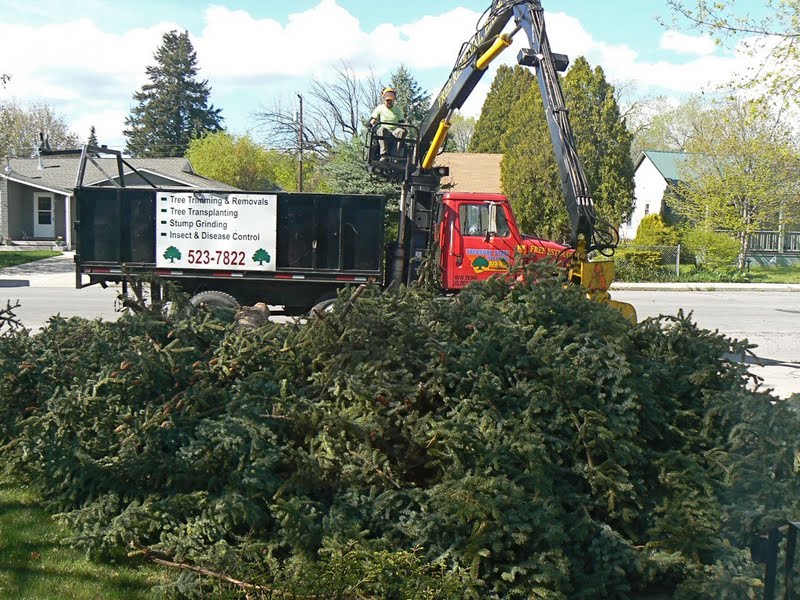
This was how matters stood as of last Sunday. Branches and chunks of wood were piled high, remnants of the half that had fallen, badly frightening the neighborhood on Saturday night.
 Unfortunately, what was left standing after Saturday's freakish windstorms was much too likely to fall victim to other such occurrences.
 The serious cutting down began Tuesday morning.
 In a mere couple hours, only a trunk surrounded by many branches remained.
 The sad demise of a proud monarch didn't take long.
 The removal work began in earnest on Tuesday afternoon.
 Heavy machinery made lifting chunks of the thick trunk look like child's play.
 The debris disappeared altogether - literally in moments.
 The house literally looks naked without the tree. My renter says that she almost needs sunglasses when she goes into the living room.
 The next day, even the stump was removed and ground up. Now there is nothing but bare earth in its place.
 And that was that. It took no small amount of time for my tree to grow to the size that it was when we planted it in 1976. Add to that the 35 years since we planted it. Since that time, whole lifetimes for my ex, my sons and I have occurred, just as they have for the various renters who have occupied the house since our departure. My country also seems in many ways to be an entirely different country than I remember it to be. What a history our tree lived through and what stories it could have told!
It was there with us in 1976 when we celebrated the US Centennial. It was a witness to 1978, when my ex and I decided to go our separate ways. It was a solace to my sons and me in 1980 when we were confined inside for a week after Mount Saint Helens blew up in May. Later that same year, we said good-bye as we returned to Morocco again, there to begin whole new lives none of us had even imagined. Our tree continued growing just as we ourselves grew and matured in those lives.
It takes such a long time to build something great and beautiful. It takes only moments to destroy it. That is a very sober fact of life that unfortunately happens too often. But I am very happy to say that, where this story is concerned, the destruction of our beautiful tree is not the end. It will be a new beginning. More on that in due course ....
This was how matters stood as of last Sunday. Branches and chunks of wood were piled high, remnants of the half that had fallen, badly frightening the neighborhood on Saturday night.




It was there with us in 1976 when we celebrated the US Centennial. It was a witness to 1978, when my ex and I decided to go our separate ways. It was a solace to my sons and me in 1980 when we were confined inside for a week after Mount Saint Helens blew up in May. Later that same year, we said good-bye as we returned to Morocco again, there to begin whole new lives none of us had even imagined. Our tree continued growing just as we ourselves grew and matured in those lives.
It takes such a long time to build something great and beautiful. It takes only moments to destroy it. That is a very sober fact of life that unfortunately happens too often. But I am very happy to say that, where this story is concerned, the destruction of our beautiful tree is not the end. It will be a new beginning. More on that in due course ....
28 June 2010
Meandering through Bozel
After an adventure-filled morning and a delicious lunch of quiche, we drove down the mountain a bit to the community of Bozel, which is a larger ski station than Champagny and closer to Courchevel, one of the well-known ski areas of the French Alps. As Sweet V explained to us, her little Princess I will attend middle school in Bozel when she is quite a bit older. Now, at 2.5 years, she attends the local crèche (day care center) in Champagny, just as she will later attend elementary school there.
 Friend G filled the prescriptions that she had received from her doctor visit earlier. Then, because the sun was shining and we were enjoying the fresh air, we strolled about the picturesque town, enjoying some of the houses
 the flowers decorating them
 and the lovely Alpine flowers.
 Sweet V suggested that we might want to stroll down to the town's artificial lake, so we took her up on the suggestion. As we approached the lake and park, we realized that an event was being held there. We had happened upon one of the many community festivals organized in support of environmental issues. While the major crowds from earlier in the day had largely dissipated, we were still able to see the stands
 many that had been set up to demonstrate
 or to inform
 or to entertain while informing
 or to sell items found in nature.
 There was an opportunity for Princess I to meet up with friends by the lake
 and a nearby playground where more little ones were having a ball!
 What a beautiful, wonderful place for little ones to grow up!


17 May 2010
Bless the beasts . . .
In an effort to assist rare and endangered species of animals and plants that are only categorized as such because of man's influence on their environment, the Swiss have created foundations specifically to promote the genetic heritage of those that are native to Switzerland. One such, ProSpecie Rara, was created to safeguard the diversity of plants cultivated for crops and animals raised or used on farms.
Some success stories recently reported have dealt with poultry, sheep, goats and even one horse breed. The poultry group, for example, includes chickens known as "la barbue d'Appenzell" ("the bearded Appenzeller"), which comes from the Swiss region of Appenzell. Here they are generally black, with a tufted crest on top with two hornlike little red flaps. Their feathers are long and they are actually able to fly, preferring to roost in trees when possible. They are more like wild birds than are ordinary domesticated chickens, but are good layers. Unfortunately, the eggshells are so hard that their chicks are occasionally unable to break through and, instead, smother inside. The Foundation has managed to create a genetic reserve in order to ensure their survival.
 Included among the goats is a species called the "chèvre bottée" (booted goat). The breed originated in the Swiss Oberland, are very much at home on steep slopes and are also known by the German name "Stiefelgeiss." They are able to find nourishment in brush and weeds to the extent that small herds of them have been used to clear areas along the mountainous railroad lines more efficiently than can be done using men and machines.
 There are two breeds of sheep among the Foundation's success stories. First, there is the "rouquin du Valais," also known as the "roux du Valais," a rusty-coated sheep with long horns curled behind its ears which comes from the Swiss canton of the same name, the Valais. It has had to prove hardy. Many breeds related to it no longer exist. It has only survived because it was specifically integrated into a rehabilitation project at the beginning of the 1980s. Like the booted goat, it can also be used for weed control since it likes to graze on weeds.
 The other breed is the "mouton de l'Oberland Grison," small, agile and hardy. These sheep are similar to the Tavet sheep which dated from the Stone Age, but which no longer survives. They are also horned sheep. Because their numbers are so few, they are still classified as "scarce.
 While it is certainly not the last animal that has been helped by the efforts of ProSpecieRara, the last that I will discuss today is the horse. Of course! The "cheval des Franches-Montagnes," from the Franches-Montagnes district of the Swiss Jura, is the only horse breed that originated in Switzerland. Today's horses are the result of cross-breeding of indigenous Swiss mares with stallions from other European countries, most notably France. While the Franches-Montagnes is primarily a draft horse, it is also versatile emough to be used for all styles of riding and has a gentle disposition. It's often used in the sport of "attelage" (horse-drawn vehicles), a video of which can be seen here. The Swiss Army also still uses it for certain tasks. But its numbers are diminishing.
 Bravo to ProSpecieRara for its efforts! May those efforts continue to bear the fruits of diversity.
Some success stories recently reported have dealt with poultry, sheep, goats and even one horse breed. The poultry group, for example, includes chickens known as "la barbue d'Appenzell" ("the bearded Appenzeller"), which comes from the Swiss region of Appenzell. Here they are generally black, with a tufted crest on top with two hornlike little red flaps. Their feathers are long and they are actually able to fly, preferring to roost in trees when possible. They are more like wild birds than are ordinary domesticated chickens, but are good layers. Unfortunately, the eggshells are so hard that their chicks are occasionally unable to break through and, instead, smother inside. The Foundation has managed to create a genetic reserve in order to ensure their survival.


13 May 2010
Spring trinkets
Flowers are not the only welcome things of color that are bursting onto the gray scene these days. As reminders that Spring is an invitation to the outdoor life and that flowers do not provide the only means for brightening the outdoor scene, here is a sampling from a few booths at last weekend's flower show. In these, gardens, plants and flowers merely served to provide points of departure for the imagination.
First, for pampering the feet. Planting and working in the garden don't have to be excuses to wear tattered old shoes.
 Nor does mucking about in soil necessarily require black "wellies" or dull gloves.
 This garden art is clever and full of movement. It also provides a way to recycle damaged bicycle wheel rims.
 These little ceramic pigs look right at home, fat and sassy among the plants.
 And these ceramic pots, with their flower motif, provide a hint of cosy worthy of a tea set.
 For those who love the idea of birds among their flowers, here are some that will kindly sit and stay wherever one places them.
 Spring can be a most glorious time to be able to sit outdoors - in greater or lesser style.
 I am so glad that I was able to snatch these fleeting moments of sun from last weekend before these days of rain returned.
First, for pampering the feet. Planting and working in the garden don't have to be excuses to wear tattered old shoes.


Subscribe to:
Posts (Atom)