From 19-23 June this year, Royal Ascot, one of the world's oldest and most prestigious race meets was held at Ascot Racecourse in the UK. Ascot Racecourse dates back to 1711, when it was founded by Queen Anne. Fittingly, its inaugural race was Her Majesty's Plate, for a prize of 100 guineas. The early version of that race was open to any horse, mare or gelding over six years of age and consisted of three heats, each of which was four miles long. Today, races at Ascot have been mightily shortened from those early ordeals. Here is an interactive timeline with historical highlights of the past 300 years.
Royal Ascot is considered the "pinnacle" of the racing calendar at Ascot. During her 60 years as the UK's reigning monarch, Queen Elizabeth II has never failed to attend the meet, arriving each day in a horse-drawn carriage, often with other members of the Royal Family in attendance. A timelapse of the procession can be seen here. Once the Royal Procession has passed before the stands and the Royals have been comfortably settled in their sky box, the day's activities are officially launched.
Press coverage is often focused more on those who attend and how they are dressed, as if the meet were a fashion show, and attendees are only too happy to conform to the rigorous dress code. Those who remember the film, My Fair Lady, will no doubt remember the Ascot Racecourse scenes. A memory jog can be found here. And yes, the men do still wear top hats and tails. Other than dress length modifications, the women's coordinating dresses and hats are still very much de rigueur and l'ordre du jour. That 19th century Ascot crowd would feel quite at home at Ascot today - insofar as style is concerned.
But the real stars of the show, IMO, are the horses and their respective entourages, including owners, trainers, jockeys, grooms, stablepersons, etc. There were many gallant horses who ran, not all of them winners. As usual, there were many associated human interest stories. But over the course of the five-day meet, there were two standout horses: Frankel and Black Caviar.
Frankel is a British thoroughbred colt, undefeated in ten starts prior to the Ascot meet, who has been the highest-rated racehorse in the world since May 2011. At Ascot, he extended his winning streak to 11, adding a convincing victory in the Queen Anne Stakes, as shown here. Once Frankel turned on the speed, there was no question as to the outcome. Wow!
Black Caviar, on the other hand, is an Australian thoroughbred mare, rated as one of the top racehorses in the world. She had 21 wins to her record before making the 10,000+ mile journey to Ascot to race outside her native Australia for the first time. Her target was the Diamond Jubilee Stakes. Her fans in Melbourne, Australia were clustered around a large TV screen after midnight their time, hoping to see her add a 22nd victory to her record in real time.
Well, for a few heart-stopping moments, no one was sure exactly what had happened. She was in the lead until the last couple seconds when two French horses rushed up and it looked as if one of them might have just beaten her. It also seemed as if her jockey had misunderstood where the finish line was and had started to relax instead of continuing to urge her on. Thankfully for her fans worldwide, Black Caviar had just managed to keep her head in front, as shown here.
For Black Caviar, however, being undefeated throughout her career has had a price. The latest word is that she apparently suffered two muscle tears and bruising to her hindquarters - exactly when and how are not clear. That she was still able to run - and win - in the circumstances is very impressive. Best of all, it appears that her racing career is not over yet, although she will have a good, long, and well-deserved rest before she races again.
Showing posts with label Horses. Show all posts
Showing posts with label Horses. Show all posts
24 June 2012

10 June 2012
Union Rags and Camelot
For those who follow the US Triple Crown thoroughbred races, it will come as no surprise that there was no Triple Crown winner there this year. We have known that there would not be since last Friday, when the one horse, I'll Have Another, that had any chance of becoming the first US Triple Crown winner in 34 years was pulled from the race, as described in my preceding post. As it happens, I'll Have Another was also retired from thoroughbred racing altogether. He will live out the rest of his life trying to produce little horses like himself. This is only a bad outcome if you were one of the fans hoping to see him win the Belmont Stakes, the third jewel in the US Triple Crown races, yesterday.
The Belmont turned out to be a good race even without the Triple Crown hoopla, won by a horse called "Union Rags." You can see a podcast of the race here. May the racing career of Union Rags continue safely!
But on this side of "The Pond," there is still hope for a Triple Crown Winner. In the United Kingdom, there is much excitement in the air about the prospect of the first UK Triple Crown winner since 1970. In the UK, the three races that comprise the Triple Crown are the 2,000 Guineas Stakes, the Epsom Derby (pronounced "dah-by" in the UK) and the St. Leger Stakes. The Guineas is the shortest race and the St. Leger Stakes is the longest.
This year, a beautiful horse with the princely name of "Camelot" has won both the 2,000 Guineas (shown here) and just recently - on 2 June - the Epsom Darby (shown here) in front of the British Royal Family - with Queen Elizabeth II in attendance as part of her Diamond Jubilee festivities.
Those who follow racing in both countries will not be surprised that most British races - both flat races and steeplechases - are run on turf (natural grass surface). This is also the case in the rest of Europe. In the US, more flat races, including all of the Triple Crown races, are run on dirt or synthetic tracks.
If I were a horse, I would prefer to run on turf. But that's just MO.
Aficionados will also not be surprised to see - as in the Guineas, where there were several candidates vying for the win - that the horses often use the whole track. That is, instead of all horses grouping together on one side for the running of the race, there may be an entire group racing together completely on the other side, or even down the center of the track. This can also be seen in this year's Guineas. Fewer horses were entered in the Epsom Derby, mostly because Camelot is seen as a superhorse. Judging from the Derby, where Camelot was still pulling away from the field at the finish, he proved the point. Even the usually imperturbable British announcer showed more than modest excitement in the final moments.
I also have a personal soft spot for Camelot - not simply because of the name, which brings back memories both of Arthurian legends and the Lerner and Loewe musical, which I loved. It is also because of the era it signifies for me in my own country. "Camelot" - rightly or wrongly - was used to refer to the Kennedy Administration, the last era of national innocence that I can remember, as far remote from today's events in the US as the legendary Arthurian "Camelot" ever was from events in Britain today. Finally, Camelot's trainer and jockey are a father-son team, Aidan and Joey O'Brien. Because "O'Brien" was my maiden name, I will always be rooting for an "O'Brien combo" - especially where horses are concerned.
So I am still able to hope for a Triple Crown winner this year. It's just that I'll have to hope for one on this side of The Pond.
The Belmont turned out to be a good race even without the Triple Crown hoopla, won by a horse called "Union Rags." You can see a podcast of the race here. May the racing career of Union Rags continue safely!
But on this side of "The Pond," there is still hope for a Triple Crown Winner. In the United Kingdom, there is much excitement in the air about the prospect of the first UK Triple Crown winner since 1970. In the UK, the three races that comprise the Triple Crown are the 2,000 Guineas Stakes, the Epsom Derby (pronounced "dah-by" in the UK) and the St. Leger Stakes. The Guineas is the shortest race and the St. Leger Stakes is the longest.
This year, a beautiful horse with the princely name of "Camelot" has won both the 2,000 Guineas (shown here) and just recently - on 2 June - the Epsom Darby (shown here) in front of the British Royal Family - with Queen Elizabeth II in attendance as part of her Diamond Jubilee festivities.
Those who follow racing in both countries will not be surprised that most British races - both flat races and steeplechases - are run on turf (natural grass surface). This is also the case in the rest of Europe. In the US, more flat races, including all of the Triple Crown races, are run on dirt or synthetic tracks.
If I were a horse, I would prefer to run on turf. But that's just MO.
Aficionados will also not be surprised to see - as in the Guineas, where there were several candidates vying for the win - that the horses often use the whole track. That is, instead of all horses grouping together on one side for the running of the race, there may be an entire group racing together completely on the other side, or even down the center of the track. This can also be seen in this year's Guineas. Fewer horses were entered in the Epsom Derby, mostly because Camelot is seen as a superhorse. Judging from the Derby, where Camelot was still pulling away from the field at the finish, he proved the point. Even the usually imperturbable British announcer showed more than modest excitement in the final moments.
I also have a personal soft spot for Camelot - not simply because of the name, which brings back memories both of Arthurian legends and the Lerner and Loewe musical, which I loved. It is also because of the era it signifies for me in my own country. "Camelot" - rightly or wrongly - was used to refer to the Kennedy Administration, the last era of national innocence that I can remember, as far remote from today's events in the US as the legendary Arthurian "Camelot" ever was from events in Britain today. Finally, Camelot's trainer and jockey are a father-son team, Aidan and Joey O'Brien. Because "O'Brien" was my maiden name, I will always be rooting for an "O'Brien combo" - especially where horses are concerned.
So I am still able to hope for a Triple Crown winner this year. It's just that I'll have to hope for one on this side of The Pond.
08 June 2012
Sadly, I'll Have Another Won't
As one who has been a devoted admirer of horses for as long as I can remember, I routinely pay attention to thoroughbred racing, horse shows and other equine events. I attend in person whenever I can. When I was much, much younger, I used to try to wheedle rides from whoever owned a horse whenever I could. The greatest disappointments of my youth were that my family did not live on a farm and that I didn't have a horse of my own. I must confess that I badgered my long-suffering parents unmercifully about both.
Just about when I had accepted my horseless lot in life, my father received a two-year old pinto as barter for an outstanding bill. Of course, as we lived in town, finding a pasture for "Lucky," as I dubbed this astonishing bit of fortune that had appeared in my life in deus ex machina fashion, became a major project over the following years, with Lucky being ferried to several different locales during his time with my family. Unfortunately, Lucky's arrival late in my sophomore year in high school occurred only shortly before my departure for the Big City for my last two years of secondary school, so a lot of his care and riding over the years actually fell to my hapless younger sister, Artist Sis. Unsurprisingly, she likes to remind me about this from time to time.
But Lucky is only a sidebar in this post. He certainly deserves at least one post of his own! My main topic today, however, features an American thoroughbred horse known as "I'll Have Another." I'll Have Another has been making headlines in the United States because he has so far won two of the three races that make up the US Triple Crown of thoroughbred racing. On the first Saturday in May, he won the 2012 Kentucky Derby decisively, as can be seen in this video. Two weeks later, he won the 2012 Preakness Stakes in one of the most thrilling finishes I have ever seen, as shown here.
This meant that in 2012, there was a real chance that I'll Have Another could be a Triple Crown winner, something that has not happened since 1978! All that remained was the last hurdle: the Belmont Stakes, scheduled for tomorrow afternoon.
But alas, even the possibility of a Triple Crown winner is not to be this year. In today's news, there was a very disappointing report. I'll Have Another will not run in tomorrow's race. After a workout this morning, the horse experienced swelling in his left front leg. The veterinarian declared the swelling to be the beginning of tendinitis. While this situation will hopefully not destroy the horse's racing career, it will certainly put an end to the dream of a Triple Crown winner in 2012 - at least in the United States.
But there is still a chance of a Triple Crown winner in the UK this year. So there is still room for hope! More on that in another post.
Just about when I had accepted my horseless lot in life, my father received a two-year old pinto as barter for an outstanding bill. Of course, as we lived in town, finding a pasture for "Lucky," as I dubbed this astonishing bit of fortune that had appeared in my life in deus ex machina fashion, became a major project over the following years, with Lucky being ferried to several different locales during his time with my family. Unfortunately, Lucky's arrival late in my sophomore year in high school occurred only shortly before my departure for the Big City for my last two years of secondary school, so a lot of his care and riding over the years actually fell to my hapless younger sister, Artist Sis. Unsurprisingly, she likes to remind me about this from time to time.
But Lucky is only a sidebar in this post. He certainly deserves at least one post of his own! My main topic today, however, features an American thoroughbred horse known as "I'll Have Another." I'll Have Another has been making headlines in the United States because he has so far won two of the three races that make up the US Triple Crown of thoroughbred racing. On the first Saturday in May, he won the 2012 Kentucky Derby decisively, as can be seen in this video. Two weeks later, he won the 2012 Preakness Stakes in one of the most thrilling finishes I have ever seen, as shown here.
This meant that in 2012, there was a real chance that I'll Have Another could be a Triple Crown winner, something that has not happened since 1978! All that remained was the last hurdle: the Belmont Stakes, scheduled for tomorrow afternoon.
But alas, even the possibility of a Triple Crown winner is not to be this year. In today's news, there was a very disappointing report. I'll Have Another will not run in tomorrow's race. After a workout this morning, the horse experienced swelling in his left front leg. The veterinarian declared the swelling to be the beginning of tendinitis. While this situation will hopefully not destroy the horse's racing career, it will certainly put an end to the dream of a Triple Crown winner in 2012 - at least in the United States.
But there is still a chance of a Triple Crown winner in the UK this year. So there is still room for hope! More on that in another post.
15 April 2012
Grand National Update
Although she did not win the Grand National yesterday, jockey Katie Walsh acquitted herself marvelously, coming in an exceedingly respectable third. For a time, it seemed as if she might actually win the extremely grueling four-mile+ race, but in the last few seconds, her mount Seabass was caught by Sunnyhillboy, who was himself caught at the wire by the eventual winner, Neptune Collonges, in a photo finish. The winning horse was later paraded around his home village in Somerset, to the delight of hundreds of villagers.
The race began late when one of the favorites, the gorgeous Synchronised, winner of the Cheltenham Gold Cup race earlier this year, tossed his rider during the grandstand parade. He cantered off, thoroughly enjoying himself and delayed the start of the race until he could be collected and remounted. The start of the race was further delayed by two false starts with horse breaking through the starting tape early. Synchronised then managed to lose his rider again at the fence known as Becher's Brook on the first circuit of the course and galloped merrily along, continuing to jump, until he incurred a fracture to a hind leg. Another horse, According to Pete, fell at Becher's Brook during the second circuit and also fractured a leg. So my wish for a safe race for all was not granted.
To the devastation of their owners - both horses were home-bred, practically family members - the injuries were such that both animals had to be euthanized. It was particularly sad for Synchronised's following who were looking forward to a double win. As required, an investigation into the injuries is ongoing, but is currently at an advanced stage.
This is the second year in a row that two horses have died while attempting to negotiate the complex and exhausting Grand National course. Following last year's tragedy, improvements were made in accordance with safety recommendations. This year's events will likely result in additional modifications. This particular race is prima facie dangerous. But even knowing that and accepting those risks will never replace the beautiful animals who are sacrificed to it even while they give those of us who view them the thrill of a lifetime.
The race began late when one of the favorites, the gorgeous Synchronised, winner of the Cheltenham Gold Cup race earlier this year, tossed his rider during the grandstand parade. He cantered off, thoroughly enjoying himself and delayed the start of the race until he could be collected and remounted. The start of the race was further delayed by two false starts with horse breaking through the starting tape early. Synchronised then managed to lose his rider again at the fence known as Becher's Brook on the first circuit of the course and galloped merrily along, continuing to jump, until he incurred a fracture to a hind leg. Another horse, According to Pete, fell at Becher's Brook during the second circuit and also fractured a leg. So my wish for a safe race for all was not granted.
To the devastation of their owners - both horses were home-bred, practically family members - the injuries were such that both animals had to be euthanized. It was particularly sad for Synchronised's following who were looking forward to a double win. As required, an investigation into the injuries is ongoing, but is currently at an advanced stage.
This is the second year in a row that two horses have died while attempting to negotiate the complex and exhausting Grand National course. Following last year's tragedy, improvements were made in accordance with safety recommendations. This year's events will likely result in additional modifications. This particular race is prima facie dangerous. But even knowing that and accepting those risks will never replace the beautiful animals who are sacrificed to it even while they give those of us who view them the thrill of a lifetime.
14 April 2012
Spring Springing Up All Over
We have certainly had our share of April showers this month. This is excellent because the past winter was much too dry here in the plains around the lake. Given the voluminous snowfalls in the mountains, which have - in spite of the strong Swiss franc - helped to make the ski season profitable in the communities that depend on tourism, it is likely that some parts of Switzerland will later on have more problems with flooding than with drought. But for right now, farmers, gardeners and plants in this area are happy to see the moisture. Colors from one of the small community gardens nearby are brightening up a still drab outdoors.

 Much of this community garden is still lying fallow. Plant covers, such as that to the left in this photo, are still protecting fragile sprouts from temperatures that have made this April the coolest of the past three years.
 Of late I have had to seize a moment between showers to get in a bike ride. But yesterday morning was one of the nicest in several days, so I attempted one of my favorite paths, which has become green once again.
 Today, I am happy to spend this afternoon indoors watching one of the classic English race meets, that held at Aintree. In about an hour, the famous Grand National steeplechase will take place. While there are lots of potential story lines, one that particularly cheers me up is that there are two women jockeys, Katie Walsh and her sister-in-law, Nina Carberry, in the classic race this year. Both hail from Anglo-Irish racing dynasties and both will be mounted on horses that could win. They're both getting backing from the racing public.
What great fun if one of them could win! Velvet Brown, the famous fictional jockey who won the Grand National in National Velvet and who was denied the win simply because she was female would be fully vindicated! So I am naturally rooting for both female hockeys. Whatever happens, I hope that all 40 horses and their jockeys will have a good race and wish especially that no horse and no jockey will be hurt. That has happened much too often of late.


What great fun if one of them could win! Velvet Brown, the famous fictional jockey who won the Grand National in National Velvet and who was denied the win simply because she was female would be fully vindicated! So I am naturally rooting for both female hockeys. Whatever happens, I hope that all 40 horses and their jockeys will have a good race and wish especially that no horse and no jockey will be hurt. That has happened much too often of late.
27 March 2012
Spring Cleaning Interlude
Nearly two years ago, I wrote a post about some neighbors that had just moved in, displacing the former "residents" of a nearby poultry farm after that facility had been cleaned and renovated. Since that time, these horsey neighbors have settled in nicely. In addition to passing by their stables and paddocks while taking walks or biking, I occasionally have the great pleasure to meet them while they are being exercised or ridden.
The horses plus cart make weekly circuits through various neighborhoods to pick up large objects such as used furniture that are generally difficult or cumbersome for ordinary householders to deal with. Once loaded onto the cart, these objects are taken to the recycling center that my village shares with a neighboring village. I am delighted to report that I met my neighbors on their route this morning. It was a glorious morning to be out biking. Meeting such pleasant neighbors along the way was a real bonus.
 They were accompanied by the adolescents from Geneva City who come out daily as apprentices to learn the basics of horsemanship along with the particulars of maintaining these lovely animals. These young apprentices also accompany the horses on their rounds and perform the clean-up service for us all.
 So far, it has proven to be a win-win service for all concerned.
The horses plus cart make weekly circuits through various neighborhoods to pick up large objects such as used furniture that are generally difficult or cumbersome for ordinary householders to deal with. Once loaded onto the cart, these objects are taken to the recycling center that my village shares with a neighboring village. I am delighted to report that I met my neighbors on their route this morning. It was a glorious morning to be out biking. Meeting such pleasant neighbors along the way was a real bonus.


07 March 2012
Revisiting "Under the Volcano"
Nearly two years ago, I wrote a post about the volcano in Iceland that literally disrupted skies throughout Europe with severe repercussions for global travel. At the time, I had been enchanted to discover that Iceland has its own special breed of horses, going back to the days of the Vikings.
Thus, I was also enchanted to discover this morning that the Guardian newspaper has revisited the area through one of its roving reporters, Marcel Theroux. By writing about his travels generally, Marcel is following in the footsteps of his father, writer Paul Theroux. Much as I myself had, the older Theroux became a Peace Corps Volunteer in the 60s, travelling to Malawi in 1963. Unfortunately, Paul got into trouble by helping a political opponent of the regime in power at the time escape to Uganda. For doing so, he was unceremoniously expelled from Malawi and booted out of the Peace Corps.
I suspect that he had many sympathizers both in and out of the Corps and I confess to a sneaking admiration for his courage. But it is true that getting involved in local politics was - and is still - a Big No-No for members of that organization.
But enough about that. On his visit to Iceland, the younger Theroux actually hiked up to Eyjafjallajökull, the volcano that erupted in 2010 and that had caused airports across Europe to close as an ash cloud drifted towards the continent. I remember well the eerie silence in these parts at the time. If you check out his video of that experience, it is amazing to see nature's renaissance after the devastation.
In the meantime, the little Icelandic horses not only survived the volcano, but remain at the heart of traditional Icelandic custom. It is also a treat to view this video of Theroux's experience of participating in a local round-up and sorting of the horses so that their owners can reclaim them after a season at pasture.
Yes. Life. Goes. On.
Thus, I was also enchanted to discover this morning that the Guardian newspaper has revisited the area through one of its roving reporters, Marcel Theroux. By writing about his travels generally, Marcel is following in the footsteps of his father, writer Paul Theroux. Much as I myself had, the older Theroux became a Peace Corps Volunteer in the 60s, travelling to Malawi in 1963. Unfortunately, Paul got into trouble by helping a political opponent of the regime in power at the time escape to Uganda. For doing so, he was unceremoniously expelled from Malawi and booted out of the Peace Corps.
I suspect that he had many sympathizers both in and out of the Corps and I confess to a sneaking admiration for his courage. But it is true that getting involved in local politics was - and is still - a Big No-No for members of that organization.
But enough about that. On his visit to Iceland, the younger Theroux actually hiked up to Eyjafjallajökull, the volcano that erupted in 2010 and that had caused airports across Europe to close as an ash cloud drifted towards the continent. I remember well the eerie silence in these parts at the time. If you check out his video of that experience, it is amazing to see nature's renaissance after the devastation.
In the meantime, the little Icelandic horses not only survived the volcano, but remain at the heart of traditional Icelandic custom. It is also a treat to view this video of Theroux's experience of participating in a local round-up and sorting of the horses so that their owners can reclaim them after a season at pasture.
Yes. Life. Goes. On.
27 September 2010
Picking Apples
There are few activities that bring to mind the sights, smells, tastes and overall "feel" of autumn as picking apples. The apple, wonderful fruit that it is, was one of the earliest tree fruits to be cultivated. It is thought to have originated in Western Asia. Apples appear in many religious traditions, often as symbols of forbidden fruit - which is ironic considering how widely apples are used as everyday food.
 There is a real crispness to the air this last week of September. The outside temperature has dropped from a high of 25 degrees Celsius (77 degrees Fahrenheit) last week to 14 Celsius (57 Fahrenheit). It is indeed still pleasant, but there is a distinct chill and I'm wearing a sweater even as I sit indoors. But as I was taking a morning walk with a friend late last week, it was clear that harvest efforts are beginning in earnest, and particularly harvests related to apples. Here, for example, are the kinds of crates that are used to contain the apples that have been picked.
 This interestingly-looking piece of equipment is more often used to work in the vineyards, but it is clearly dual-purpose, as here. It will take the empty crates to where they are needed,
 drop them at strategic points, and return with the filled crates to be loaded into a truck waiting nearby.
 I had noticed, while walking earlier in the week, that the apples were clearly changing colors. So I brought my camera with me on this walk in order to get some photos before the apples were all gone.
 Some apples had changed color much faster than others. Being somewhat apple-growing-challenged, I had no idea as to whether it was because the apples were of different species or simply that some apples had matured more quickly.
 The apples themselves are picked by hand, with care taken not to bruise them accidentally. This particular crew looks very cheerful, considering that picking apples is hard manual labor.
 The pickers even have to climb ladders to reach the apples that are on high branches.
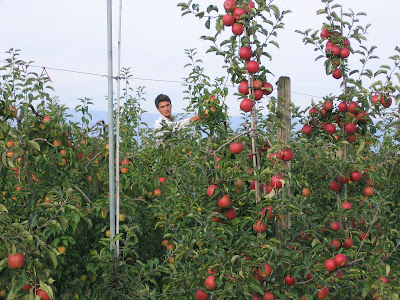 The spectacle had some attentive watchers in addition to my walking companion and me. A nearby mare and her foal
 were obviously hoping to get at least a taste of any windfalls.


06 June 2010
The Sport of Kings ... and others
Among the classic horse races held this weekend, the Belmont Stakes, the third race in the US Triple Crown for three-year old Thoroughbreds, was run at Belmont Park, NY yesterday. Because neither the winner of the Kentucky Derby nor the winner of the Preakness was in the Belmont, the usual hyperbolic media frenzy was largely absent in the days leading up to the race. As it turned out, the major drama in the race occurred when a horse named "Drosselmeyer" zipped by another horse, unfortunately named "First Dude" - apparently after the infamous husband of the erstwhile US Republican Vice-Presidential candidate - to cross the finish line first. Good for Drosselmeyer! Given the demonstrated US MSM tendency to give tons of press to the least deserving of personalities, a win for "First Dude" would have forced the barely half-term governor's presence on us all even more than ever. Thank God that bullet was dodged!
Meanwhile, on the European side of The Pond, there was quite a spectacular win at the Epsom Derby yesterday, with lightly-raced "Workforce" distancimg himself from the field and setting a new course record in his win. Veterans of the Derby remarked that the race reminded them most of the spectacular race run in 1981 by the ill-fated champion "Shergar." It was the fifth Derby win for trainer Sir Michael Stoute. I find it interesting that the Brits actually knight some of their sports heroes. And Derby Day at Epsom, with men dressed in top hats and tails, along with women in frilly dresses and splendid hats, is quite fun to watch. It was made famous in the musical "My Fair Lady." The Derby was also a victory for three-time champion jockey, Ryan Moore - his second of the day, in fact. Moore at 26 has already amassed an amazingly impressive array of racing records and trophies and is well on his way to making racing history in the UK.
 Yesterday, a young Italian woman won her country's first French Open Women's Singles title. By the final, most of the top-seeded women had been eliminated, but that should take nothing away from Francesca Schiavone's win. Today, it was less of a surprise that Rafal Nadal, who met erstwhile giant-slayer Robin Soderling in the French Open final, romped away with the Men's Singles title for the fifth time. In doing so, he not only got his own back from Soderling for last year's defeat earlier in the tourney but also recaptured the No. 1 ranking that he forfeited to Roger Federer last season. Clay is Nadal's best surface. It will be interesting to see what happens during the rest of the tennis season. But if Federer wants to reclaim his No. 1 rank, he'll need more fire in his belly than he's demonstrated so far in 2010. Not that Federer needs to prove anything. At all.
Attention here now is turning towards the upcoming World Cup playoffs to be held for the first time ever in the Republic of South Africa. I received a flyer in my mailbox yesterday advertising that all matches will be retransmitted outdoors on a giant screen set up in nearby Nyon. Entrance is free. There are many other similar opportunities in the area. Because some of the visitors who will be arriving soon are major soccer (aka football everywhere in the world except in the US) fans, they may be interested in checking these out for the ambiance, if nothing else. We will, of course, also be able to view the games on TV at home.
Meanwhile, on the European side of The Pond, there was quite a spectacular win at the Epsom Derby yesterday, with lightly-raced "Workforce" distancimg himself from the field and setting a new course record in his win. Veterans of the Derby remarked that the race reminded them most of the spectacular race run in 1981 by the ill-fated champion "Shergar." It was the fifth Derby win for trainer Sir Michael Stoute. I find it interesting that the Brits actually knight some of their sports heroes. And Derby Day at Epsom, with men dressed in top hats and tails, along with women in frilly dresses and splendid hats, is quite fun to watch. It was made famous in the musical "My Fair Lady." The Derby was also a victory for three-time champion jockey, Ryan Moore - his second of the day, in fact. Moore at 26 has already amassed an amazingly impressive array of racing records and trophies and is well on his way to making racing history in the UK.

Attention here now is turning towards the upcoming World Cup playoffs to be held for the first time ever in the Republic of South Africa. I received a flyer in my mailbox yesterday advertising that all matches will be retransmitted outdoors on a giant screen set up in nearby Nyon. Entrance is free. There are many other similar opportunities in the area. Because some of the visitors who will be arriving soon are major soccer (aka football everywhere in the world except in the US) fans, they may be interested in checking these out for the ambiance, if nothing else. We will, of course, also be able to view the games on TV at home.
17 May 2010
Bless the beasts . . .
In an effort to assist rare and endangered species of animals and plants that are only categorized as such because of man's influence on their environment, the Swiss have created foundations specifically to promote the genetic heritage of those that are native to Switzerland. One such, ProSpecie Rara, was created to safeguard the diversity of plants cultivated for crops and animals raised or used on farms.
Some success stories recently reported have dealt with poultry, sheep, goats and even one horse breed. The poultry group, for example, includes chickens known as "la barbue d'Appenzell" ("the bearded Appenzeller"), which comes from the Swiss region of Appenzell. Here they are generally black, with a tufted crest on top with two hornlike little red flaps. Their feathers are long and they are actually able to fly, preferring to roost in trees when possible. They are more like wild birds than are ordinary domesticated chickens, but are good layers. Unfortunately, the eggshells are so hard that their chicks are occasionally unable to break through and, instead, smother inside. The Foundation has managed to create a genetic reserve in order to ensure their survival.
 Included among the goats is a species called the "chèvre bottée" (booted goat). The breed originated in the Swiss Oberland, are very much at home on steep slopes and are also known by the German name "Stiefelgeiss." They are able to find nourishment in brush and weeds to the extent that small herds of them have been used to clear areas along the mountainous railroad lines more efficiently than can be done using men and machines.
 There are two breeds of sheep among the Foundation's success stories. First, there is the "rouquin du Valais," also known as the "roux du Valais," a rusty-coated sheep with long horns curled behind its ears which comes from the Swiss canton of the same name, the Valais. It has had to prove hardy. Many breeds related to it no longer exist. It has only survived because it was specifically integrated into a rehabilitation project at the beginning of the 1980s. Like the booted goat, it can also be used for weed control since it likes to graze on weeds.
 The other breed is the "mouton de l'Oberland Grison," small, agile and hardy. These sheep are similar to the Tavet sheep which dated from the Stone Age, but which no longer survives. They are also horned sheep. Because their numbers are so few, they are still classified as "scarce.
 While it is certainly not the last animal that has been helped by the efforts of ProSpecieRara, the last that I will discuss today is the horse. Of course! The "cheval des Franches-Montagnes," from the Franches-Montagnes district of the Swiss Jura, is the only horse breed that originated in Switzerland. Today's horses are the result of cross-breeding of indigenous Swiss mares with stallions from other European countries, most notably France. While the Franches-Montagnes is primarily a draft horse, it is also versatile emough to be used for all styles of riding and has a gentle disposition. It's often used in the sport of "attelage" (horse-drawn vehicles), a video of which can be seen here. The Swiss Army also still uses it for certain tasks. But its numbers are diminishing.
 Bravo to ProSpecieRara for its efforts! May those efforts continue to bear the fruits of diversity.
Some success stories recently reported have dealt with poultry, sheep, goats and even one horse breed. The poultry group, for example, includes chickens known as "la barbue d'Appenzell" ("the bearded Appenzeller"), which comes from the Swiss region of Appenzell. Here they are generally black, with a tufted crest on top with two hornlike little red flaps. Their feathers are long and they are actually able to fly, preferring to roost in trees when possible. They are more like wild birds than are ordinary domesticated chickens, but are good layers. Unfortunately, the eggshells are so hard that their chicks are occasionally unable to break through and, instead, smother inside. The Foundation has managed to create a genetic reserve in order to ensure their survival.


02 May 2010
Running for the roses

The official race video of the Kentucky Derby, also known as the "Run for the Roses" because a blanket of 554 red roses is draped over the withers of the winning horse, can be found here. More detailed coverage, with commenting and pertinent backstories, can be found in the ESPN video and story here. One backstory tells how the race was trainer Todd Pletcher's first win ever at the Derby, after having saddled 24 runners for the race during the past ten years. A more amazing story is that of Cajun jockey Calvin Borel who has managed to win three of the past four Kentucky Derby races.
Now begins the inevitable speculation as to whether Super Saver will be able to win all three of the Triple Crown races, something that has not happened for 32 years. Many horses have won two out of three in the interim. But since the legendary match-ups of Affirmed and Alydar in 1978 when Affirmed finished first in all three Triple Crown races and Alydar finished second - a major feat in itself - no horse has managed to achieve that accomplishment.
In all, only eleven horses have won the US Triple Crown. After Citation won in 1948, there was a similar dearth of Triple Crown winners. But that lasted only 25 years in comparison, until the great Secretariat won in 1973. That feat was followed almost immediately in 1974 by the also-great Seattle Slew.
In the fall of 2007, HWMBO and I travelled to Kentucky horse country to visit friends. While there, we visited Claiborne Farm and saw Secretariat's last resting place.


01 May 2010
Airs of May
Today is May Day, but April apparently didn't get the message that its showers are supposed to be gone. After a truly glorious week, with temperatures making us believe that we were in July rather than April, we are now back to April weather. Still, all the green plants have had major growth spurts and May flies have been dropping like ... er, flies.
In many countries, 1 May is celebrated as International Workers' Day and is also a public holiday. In Europe, it is also related to ancient Celtic celebrations that were often merged into Christian or other holidays, so many of the pagan traditions and festivities have been incorporated and are practiced even today. A dear friend and former colleague, Sweet I, recently forwarded photos of the raising of the May Pole that precedes the celebrations held at five-year intervals in her Bavarian village of some 500 souls. These photos date from 2005.
 That is one B-I-I-I-G May Pole! Humongous could be considered an understatement.
 And yes, they really do dress that way for local festivals. It isn't done just for tourists.
 This will be the first such May Day celebration for her small daughters, Princess L and Princess E, who were not even born in 2005. As it happens, her Princess L is exactly three months younger than my own Princess Butterfly. Here Princess L demonstrates her riding prowess on the family farm in Bavaria.
 Sweet I's May Day pictures reminded me of some photos I took during a brief trip to Bavaria in early summer 2005 with Healer Sis and Sweet L. While travelling from one tourist site to another, we literally happened upon a local folk dance festival. Wondering what was happening, we stopped and followed people dressed in dance costume to a large but ancient hall where various groups were performing.
 While we were clearly outsiders, the only "tourists" there, and clearly quite underdressed for the event, we were quite warmly welcomed into the hall, had some bratwurst and beer with everyone, and spent some very pleasant time there before continuing to our destination. It was great fun, all the more so for being completely spontaneous and unexpected. We were literally enchanted by the intricate braiding in the hair of the women and young girls, as can be seen here.
 and here.
 Even the children were dressed in costume.
 Here is Sweet L, either bemused or still jet-lagged (quite likely - it was only about her third day on this side of The Pond), standing next to a stalwart young man.
 When I was young, we used to make May baskets out of construction paper, fill them with sweets, hang them over doorknobs anonymously, and then run like heck, after knocking on the door or ringing the doorbell. To make the basket shown below, see here.
 Whatever you do today, please have a very Happy May Day!
In many countries, 1 May is celebrated as International Workers' Day and is also a public holiday. In Europe, it is also related to ancient Celtic celebrations that were often merged into Christian or other holidays, so many of the pagan traditions and festivities have been incorporated and are practiced even today. A dear friend and former colleague, Sweet I, recently forwarded photos of the raising of the May Pole that precedes the celebrations held at five-year intervals in her Bavarian village of some 500 souls. These photos date from 2005.


22 April 2010
Under the volcano
Planes are in the skies here once again. The poignant situations for thousands of stranded travelers are beginning - just barely - to lumber slowly toward resolution. The logjams are beginning to become unstuck. The airlines have racked up nearly USD two billion in losses. To date, however, there appear not to have been human casualties, at least not directly resulting from the volcano, although it is still spewing ash. There are also still major concerns that neighbor Katla could erupt, as indeed has been the case each time after Eyjafjallajökull has erupted. They're saying that Katla has the potential to be much more disruptive than its sister volcano.
 While the ash cloud that arrived here Saturday morning obscured the view of the surrounding mountains and even of the lake for a while, it remained at high elevations and never manifested as anything tangibly physical. It was nothing like my previous experience with Mount St. Helens. But photos and videos of Iceland, and even of parts of Scotland and northern England, with passing vehicles causing gray ash to rise in clouds or to drift like dingy snow certainly reminded me of the week that we spent under the volcano.
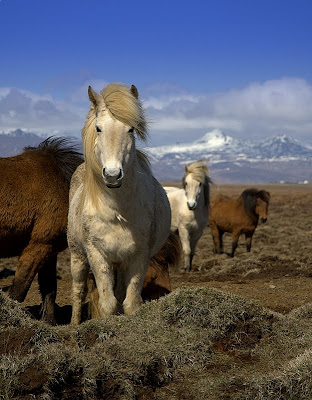
 The photos also showed some of Iceland's livestock. As one who has always been fascinated by horses, I was moved to learn something about the history of Icelandic horses, also referred to as ponies because of their small stature. These sturdy animals were first brought to Iceland by Scandinavian settlers in the 9th and 10th centuries. They are known for their sure-footedness and their ability to cross rough terrain. They also are known as a "five-gaited" breed. In addition to having gaits such as the walk, trot and canter/gallop, they perform a four-beat ambling gait known as the tölt. It is a comfortable and ground-covering accelerated walk comparable to the running walk of the Tennessee Walking Horse. The fifth gait is the flugskeið or "flying pace," used in pacing races. While the breed is recognized by organizations in at least 19 different nations, once a horse leaves Iceland, it is never allowed to return. This may seem extreme but it helps to ensure that diseases affecting the horses remain practically non-existent in Iceland itself.
 These gallant little horses have borne the eruption of this most recent volcano, as they have borne earlier eruptions, with forebearance and steadfastness. They had little choice in the matter, to be sure. Indeed, in the 1780s, the breed was nearly rendered extinct by a volcano! But seeing these little animals, together with the other animals and humans who must endure proximity to disaster on a daily basis, is somewhat reassuring. So far, they have survived. Long may that survival continue!


19 April 2010
Airs above the ground
With all the flurry and ado (or rather, the problematic lack of ado) in and about the air above us these days, it is a nice change to focus on events closer to the ground. From Thursday to yesterday, Geneva hosted the 2010 World Cup of show jumping. Top riders from around the globe and their magnificent steeds were featured in a grueling competition. Fortunately, all had arrived before the flight ban throughout Europe was imposed. At least some are still among the many hapless individuals who are stranded here now.
The winner of this year's competition was the German rider, Marcus Ehning. Swiss rider Pius Schwizer came in second and another German rider, perennial top finisher Ludger Beerbaum, took third. [Correction: Schwizer and Beerbaum were co-second place finalists.] Of course, none of them could have done as well as they did had it not been for their mounts - Plot Blue, Carlina and Gotha respectively. Ehning was especially happy because he now joins the select group of riders who have a World Cup final three times: Hugo Simon of Austria; Rodrigo Pessoa of Brazil; and Meredith Michaels-Beerbaum, Ludger's American-born sister-in-law who is now a German national.
 I watched the events on television this year. Because I love to watch this beautiful sport - especially to see the horses and to watch how well the horses and riders work together - I have attended the World Cup Final in person during other years. The event is usually held in Geneva in December. Receiving tickets for it has been one of my favorite birthday presents. While I love the whole atmosphere of the Final, the exhibits on display, people-watching in general, and the ability to stroll around and see the horses warming up, it is also very satisfying to watch it on television because the coverage here is excellent.
There is controversy about this event this year because one of the favorites, American McLain Ward, an Olympic Gold Medal team winner, and Sapphire, his best horse, were disqualified before Sunday's final, allegedly because of hypersensitivity in one of Sapphire's forelegs. Apparently a condition such as this can be and is sometimes caused deliberately so that a horse will pay special attention to ensuring that its forefeet will clear the jumps. The results of various blood and urine tests should provide more definitive information. While I hope that that this allegation is not true, it is a shame that there are people in horse-related sports who administer drugs or otherwise mistreat these beautiful and steadfast animals in any way so as to even raise a suspicion. It's even worse for those who have done nothing but who are suspected of doing so. I hope that Mr. Ward's name will be cleared and that the hypersensitivity, if it exists, was due to one of many other potential causes. Even more, I hope that Sapphire is well.
 My favorite of the World Cup final competitions that I personally attended was that in 2000, when Rodrigo Pessoa won his third victory on the legendary French stallion, Baloubet du Rouet. It was poetry in motion. All Pessoa had to do with the wondrous Baloubet was to hang on, or at least that was the way that it seemed. I have never seen anything like it. It was magic. Meredith Michaels-Beerbaum's Shutterfly is another dream horse. But Baloubet du Rouet, even at the ripe old age of 21, is literally fantastic.

The winner of this year's competition was the German rider, Marcus Ehning. Swiss rider Pius Schwizer came in second and another German rider, perennial top finisher Ludger Beerbaum, took third. [Correction: Schwizer and Beerbaum were co-second place finalists.] Of course, none of them could have done as well as they did had it not been for their mounts - Plot Blue, Carlina and Gotha respectively. Ehning was especially happy because he now joins the select group of riders who have a World Cup final three times: Hugo Simon of Austria; Rodrigo Pessoa of Brazil; and Meredith Michaels-Beerbaum, Ludger's American-born sister-in-law who is now a German national.

There is controversy about this event this year because one of the favorites, American McLain Ward, an Olympic Gold Medal team winner, and Sapphire, his best horse, were disqualified before Sunday's final, allegedly because of hypersensitivity in one of Sapphire's forelegs. Apparently a condition such as this can be and is sometimes caused deliberately so that a horse will pay special attention to ensuring that its forefeet will clear the jumps. The results of various blood and urine tests should provide more definitive information. While I hope that that this allegation is not true, it is a shame that there are people in horse-related sports who administer drugs or otherwise mistreat these beautiful and steadfast animals in any way so as to even raise a suspicion. It's even worse for those who have done nothing but who are suspected of doing so. I hope that Mr. Ward's name will be cleared and that the hypersensitivity, if it exists, was due to one of many other potential causes. Even more, I hope that Sapphire is well.


Subscribe to:
Posts (Atom)