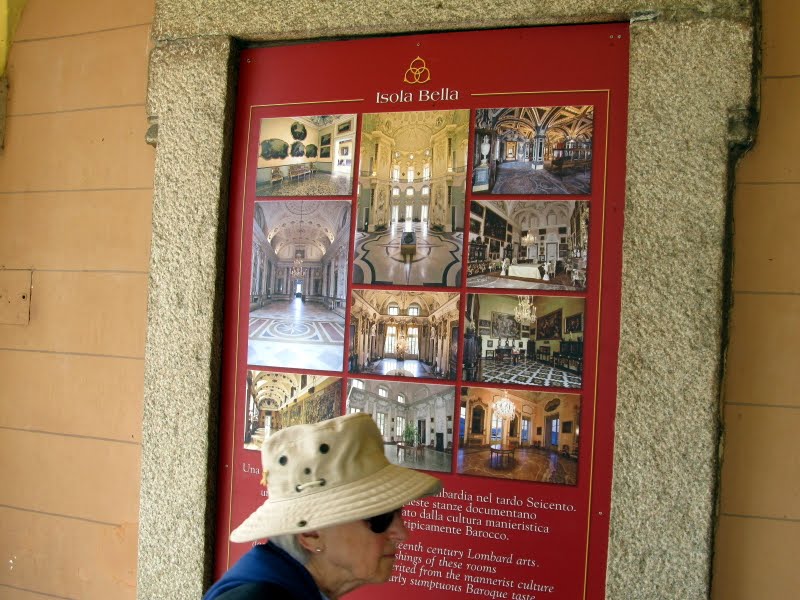
After returning from our morning visit to Monte Mottarone, we first headed back to the Hotel Fiorentino for lunch, which featured a delicious asparagus risotto.
Having fortified ourselves for the afternoon's excursion, we were quite happy to walk along Stresa's lakefront once more
in order to board a small ferryboat to Isola Bella.
Guides K and P discuss the upcoming visit while the rest of us board the ferry.
Isola Bella is one of the Borromean Islands of Lago Maggiore. Until 1632, the island was a rocky crag occupied by a tiny fishing village. In that year the influential Borromeo family began the construction of a palazzo that was dedicated to the wife of Carlo III de Borromeo, Isabella D'Adda, from whom the island takes its name. Construction was interrupted around middle of the century when the Duchy of Milan was struck by a devastating outbreak of the plague. Construction resumed when the island passed to Carlo’s sons, who completed the palazzo and turned it into a place of sumptuous parties and theatrical events for the nobility of Europe. The gardens were completed later and inaugurated in 1671. There have been many famous visitors who stayed at Isola Bella, including Napoleon and his wife Josephine. Here are some views of the palazzo from the exterior.
We were not allowed to take photographs of the interior of the palazzo although we did have a guided tour throughout. This is as good as it got for photos of the interior.
We were able to take some pictures of the garden from inside the palazzo, however.
The Borromeo family motto was "humilitas" (humility) and that motif was worked into decorations throughout the interior of the palazzo and in the garden, as here, even though humility seemed at odds with the opulence and ostentation that were evident throughout.
After our tour of the palazzo, we were able to spend about an hour strolling through the gardens at our leisure. This was the entrance.
From here, we mounted a staircase adorned with floral planters
to arrive at the park before the theater.
The famous white peacocks could be found preening and parading on the grassy areas of the garden
and accepted our adulation as their due.
Sagittarius (22 November - 21 December) is a fire sign ruled by the planet Jupiter and represented by a Centaur wielding a bow and arrow. Sagittarians tend to have dreams that are very dear to their hearts and are the bases for their motivations. Their freedom to dream is essential to their well-being. Among many other things, they love children, animals and travel.
Showing posts with label Wildlife. Show all posts
02 June 2011
17 September 2010
Little Boy in a Big Land
After some of the business aspects of his parents' trip to the West were concluded, Prince Tyger and his family spent some time in Park City, Utah where some of the winter Olympic events for the 2002 Olympics were held. Obviously, their summertime visit found conditions much changed from those of the Olympics.
Big T, who loves to go mountain-biking, left Prince Tyger with Sweet Momma H and spent an afternoon biking around the hilly ascents.
What goes up must come back down, so Big T savored the moment.
Sweet Momma H, in her pre-Tyger days, would normally have accompanied Big T in his adventure. But even she might have balked at such an ascent in such hot weather. So, she and the Tyger relaxed and wandered around the lodge where they were staying. Prince Tyger loved having so much space around him - and so few people.
Finding a sign just his size was also great fun!
But Prince Tyger was happy to see Big T again because he too wanted to scale the mountain, although not by mountain bike. The chair lift suited the Tyger just fine.
Hold on, tight, Papa! That space between the chair seat and the safety bar looks wide enough for little Tygers to slip through!
There they go! Prince Tyger loved it.
And how did they come down this time? Very, very fast!
Still, the experience didn't daunt the Tyger's enthusiasm. He wanted "More!"
Big T, who loves to go mountain-biking, left Prince Tyger with Sweet Momma H and spent an afternoon biking around the hilly ascents.
What goes up must come back down, so Big T savored the moment.
Sweet Momma H, in her pre-Tyger days, would normally have accompanied Big T in his adventure. But even she might have balked at such an ascent in such hot weather. So, she and the Tyger relaxed and wandered around the lodge where they were staying. Prince Tyger loved having so much space around him - and so few people.
Finding a sign just his size was also great fun!
But Prince Tyger was happy to see Big T again because he too wanted to scale the mountain, although not by mountain bike. The chair lift suited the Tyger just fine.
Hold on, tight, Papa! That space between the chair seat and the safety bar looks wide enough for little Tygers to slip through!
There they go! Prince Tyger loved it.
And how did they come down this time? Very, very fast!
Still, the experience didn't daunt the Tyger's enthusiasm. He wanted "More!"
18 May 2010
Here comes the Sun!
I hope that I haven't jinxed everything by using the S-word. But today, I woke up to it. What a strangely wonderful feeling it was after days and days ... and days ... of cloudy skies, wind and rain! According to the paper, we should have more sunny days, at least for the rest of the week. What a lift to the spirits! It's like finally coming out of a dark tunnel.
Temperatures are still cooler than usual for this time of year. Personally, I'm not complaining. Having been raised in a northern climate, I prefer cool to HOT. But it's apparently wreaking small havoc on some of the wildlife, specifically the birds. It's awfully cool for new nestlings. Perhaps even worse, the insects aren't hatching as they should so that the adult birds find foraging for food more difficult.
Of course, I am just as happy not to see lots of insects, even though insects have their place in the grand scheme of things. But how nice it is finally to see the colors of May! Even the trains seem to rush by with panache.
And how I love the romantic wisteria blossoms!
If I wake to sunshine again tomorrow, I will begin to believe!
Temperatures are still cooler than usual for this time of year. Personally, I'm not complaining. Having been raised in a northern climate, I prefer cool to HOT. But it's apparently wreaking small havoc on some of the wildlife, specifically the birds. It's awfully cool for new nestlings. Perhaps even worse, the insects aren't hatching as they should so that the adult birds find foraging for food more difficult.
Of course, I am just as happy not to see lots of insects, even though insects have their place in the grand scheme of things. But how nice it is finally to see the colors of May! Even the trains seem to rush by with panache.
And how I love the romantic wisteria blossoms!
If I wake to sunshine again tomorrow, I will begin to believe!
15 April 2010
More from Morges
As it turned out, it was a good thing that I visited Morges yesterday while we had the sun. We were supposed to have sun today, but didn't. Rain is expected again tonight. So I have memories of yesterday to post today. At least, they help to remind me of how beautiful the weather can be.
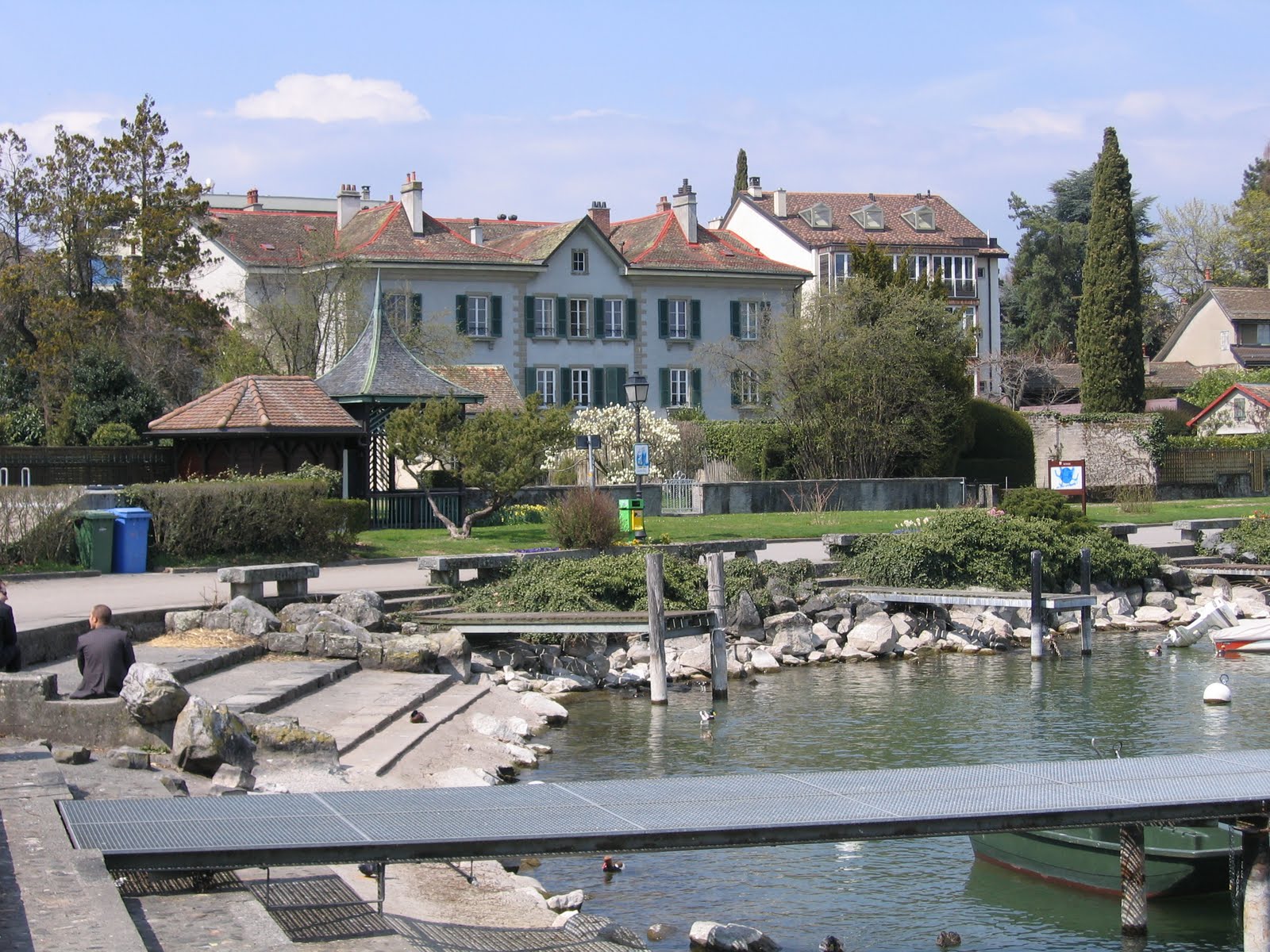
I spent some time yesterday meandering along the lake front while I was visiting the town. There are some nice apartment buildings along the shore.
As might be expected, there were several ducks swimming nearby. But I was quite surprised to see a pair of redheaded ducks among them. So far as I can remember, it's the first time that I've seen them here. I'm not sure whether they are redheads or canvasbacks, or another species entirely. This one seems to have features of both. Redheads and canvasbacks are native to North America and are, at least in the case of redheads, "rare vagrants" to Western Europe. Rare vagrants or not, they are here now. I hope they have residence permits.
I wasn't the only passerby enjoying the view.
There were flowers, including tulips, everywhere, not simply in Independence Park where the major Tulip Festival is held.
The boats at their moorings appear ready to set sail. And the small boats in the distance are part of an afternoon sailing class.
This little sidewalk cafe was well occupied.
I can hardly dare to believe it. But apart from a few stutters and halts, Spring is finally here!
I spent some time yesterday meandering along the lake front while I was visiting the town. There are some nice apartment buildings along the shore.
As might be expected, there were several ducks swimming nearby. But I was quite surprised to see a pair of redheaded ducks among them. So far as I can remember, it's the first time that I've seen them here. I'm not sure whether they are redheads or canvasbacks, or another species entirely. This one seems to have features of both. Redheads and canvasbacks are native to North America and are, at least in the case of redheads, "rare vagrants" to Western Europe. Rare vagrants or not, they are here now. I hope they have residence permits.
I wasn't the only passerby enjoying the view.
There were flowers, including tulips, everywhere, not simply in Independence Park where the major Tulip Festival is held.
The boats at their moorings appear ready to set sail. And the small boats in the distance are part of an afternoon sailing class.
This little sidewalk cafe was well occupied.
I can hardly dare to believe it. But apart from a few stutters and halts, Spring is finally here!
27 February 2010
Bless the beasts
If, in some future incarnation, I ever come back to Earth as an animal, I could do much worse than to end up in Switzerland. In fact, if an initiative currently on the ballot scheduled for voting on 7 March 2010 is passed, I could not do better anywhere else on Earth.
The initiative asks voters to decide whether each of Switzerland's 26 cantons (similar to states in the US) should be required to appoint an animal lawyer to represent the interests of pets and farm animals in court. If passed, this would mean that every canton would in effect have a dedicated public prosecutor for dogs, cats and other vertebrates that have been abused by humans. The initiative was launched after the group, Swiss Animal Protection, successfully gathered some 144,000 signatures to force a nationwide vote. Swiss Animal Protection argues that abuses on pets are often not taken seriously by local authorities and don't make it up to court.
The canton of Zurich has already pioneered animal rights. It has had a part-time post of animal welfare attorney there since 2007. French-Swiss lawyer Antoine F. Goetschel, who holds the post, is Europe's only animal lawyer and the figurehead for a movement that wants to expand Zurich's pioneering legal system across Switzerland. Goetschel is also one of the founders of the Zurich-based Foundation for the Animal in the Law, which has the largest public library of texts on animal welfare law and animal ethics in the German-speaking world.
According to Goetschel, the Swiss constitution now prohibits keeping pigs in single pens and parakeets alone in a cage. Those who own dogs have to take a training course. Beginning in 2013, it will be forbidden to tie horses in their stalls. Goetschel has already acted on behalf of a dead pike, after prosecutors in Zurich accused a fisherman of torture because the battle between man and fish lasted about ten minutes. I can picture the reaction of sports fisherman in Montana to such a "trial" and it would not be pretty. The complaint was not successful, by the way.
The Swiss federal government is not on board with this initiative, saying that animal lawyers are unnecessary and existing laws are sufficient. We'll have to see what the voting outcome will be on 7 March.
In another vein, one perhaps not quite as draconian as appointing a prosecutor to enforce animal rights, there are groups that are raising funds so that frogs, toads, salamanders and similar species can get from one side of the road to the other without becoming vehicle casualties. As the weather grows warmer, these amphibians leave their winter nests to migrate to the ponds and marshes to reproduce, encountering major highways as obstacles. The association Pro Natura Genève, together with other communal and association partners, has mobilized efforts to create seven tunnels, called crapauducs, that will allow these little creatures to pass underneath the most frequented highways in those areas where their best-known routes are affected. Such passages are necessary to maintain genetic diversity in these species.
All things considered, and if I am in a position to have my "druthers," I'd like to come back as a horse and yes, I'd like to live in Switzerland!
The initiative asks voters to decide whether each of Switzerland's 26 cantons (similar to states in the US) should be required to appoint an animal lawyer to represent the interests of pets and farm animals in court. If passed, this would mean that every canton would in effect have a dedicated public prosecutor for dogs, cats and other vertebrates that have been abused by humans. The initiative was launched after the group, Swiss Animal Protection, successfully gathered some 144,000 signatures to force a nationwide vote. Swiss Animal Protection argues that abuses on pets are often not taken seriously by local authorities and don't make it up to court.
The canton of Zurich has already pioneered animal rights. It has had a part-time post of animal welfare attorney there since 2007. French-Swiss lawyer Antoine F. Goetschel, who holds the post, is Europe's only animal lawyer and the figurehead for a movement that wants to expand Zurich's pioneering legal system across Switzerland. Goetschel is also one of the founders of the Zurich-based Foundation for the Animal in the Law, which has the largest public library of texts on animal welfare law and animal ethics in the German-speaking world.
According to Goetschel, the Swiss constitution now prohibits keeping pigs in single pens and parakeets alone in a cage. Those who own dogs have to take a training course. Beginning in 2013, it will be forbidden to tie horses in their stalls. Goetschel has already acted on behalf of a dead pike, after prosecutors in Zurich accused a fisherman of torture because the battle between man and fish lasted about ten minutes. I can picture the reaction of sports fisherman in Montana to such a "trial" and it would not be pretty. The complaint was not successful, by the way.
The Swiss federal government is not on board with this initiative, saying that animal lawyers are unnecessary and existing laws are sufficient. We'll have to see what the voting outcome will be on 7 March.
In another vein, one perhaps not quite as draconian as appointing a prosecutor to enforce animal rights, there are groups that are raising funds so that frogs, toads, salamanders and similar species can get from one side of the road to the other without becoming vehicle casualties. As the weather grows warmer, these amphibians leave their winter nests to migrate to the ponds and marshes to reproduce, encountering major highways as obstacles. The association Pro Natura Genève, together with other communal and association partners, has mobilized efforts to create seven tunnels, called crapauducs, that will allow these little creatures to pass underneath the most frequented highways in those areas where their best-known routes are affected. Such passages are necessary to maintain genetic diversity in these species.
All things considered, and if I am in a position to have my "druthers," I'd like to come back as a horse and yes, I'd like to live in Switzerland!
05 February 2010
Gifts from the sea
The view outside today shows a thoroughly water-logged world. There is snow at higher elevations. It's a wonderful day to "cocoon" and sip hot chocolate or tea while wrapped in a blanket with a good novel to read, or to "surf the Net" to see what else is happening in the world. This assumes, of course, that one is retired, as I am, and has such luxury and leisure. For me, this very interesting video from The Guardian, depicting about four minutes' worth of a day with "The Last Horse Fishermen of Belgium" fits right into the soggy ambiance.
According to Greek mythology, the sea god Poseidon created the horse. His Roman counterpart, Neptune, was also worshipped as a horse god. Under the name "Neptune Equester," he was also the patron of horse-racing. It is fun to think of horses, animals I have always felt passionately about, as gifts from the sea. And what wonderful gifts they are! There are many myths, legends and even true stories about horses and humans and their interactions together throughout history. Where those stories and water mesh, there can be magic. Although the story is more contemporary, a favorite movie of mine is the Albert Lamorisse classic "White Mane" (Crin blanc: le cheval sauvage) about a wild stallion in the Camargue who is tamed by a young boy.
Another favorite is "The Black Stallion," where Alec Ramsey and The Black spend enough time together on an isolated island that their destinies are forever entwined, as is made clearer by the Walter Farley series than by any of the movies, however beautifully filmed.
I recently saw the movie "Nights in Rodanthe" on
cable TV. You may be forgiven if you think, as I at first thought, that "Rodanthe" is somewhere in Greece. The word apparently means "rose blossoms" in Greek. But even if there is such a village somewhere in Greece, it is not the "Rodanthe" of this film. Rodanthe in this context is a small seaside village on Hatteras Island in North Carolina in the US.
I will not discuss the movie, which falls about as far short of "White Mane" or "The Black Stallion" as it possibly can ... and isn't even about horses for the most part. But in the last scene, there is magic. As the female protagonist is taking a solitary stroll along the beach, in mourning for her lost lover, a herd of magnificent wild horses streams by, racing in the surf and sand, manes waving in the wind. While I loved that imagery, I was somewhat startled. Western-born and bred as I am, I had not been aware that there were wild horses on the East Coast of the US other than the Chincoteague ponies of Maryland and Virginia. So, after some time spent in research, I learned that yes, there are other wild horses known as "Bankers." Those shown in "Nights in Rodanthe" are "Bankers," named for the Outer Bank islands where they are found. There are two principal groups, the Corolla Wild Horses and the Shackelford Banks Wild Horses.
It is generally believed that the horses originally arrived on the islands from Spanish vessels as early as 400 years ago. While the early Spanish explorers mapped the eastern coastline of North America, either the vessels were shipwrecked or the horses escaped and were left behind when the explorers left the area. It is generally accepted that most originated from Spanish and Portuguese Barb (after the Barbary Coast of North Africa) stock. They were bred for their stamina, size, temperament, ease of gait, longevity and their ability to survive and work in a sandy, harsh environment. It is also believed that they are related to Arab horses found in the sandy deserts of the Arabian peninsula.
These lovely gifts from the sea, like many of us, wandered far from their origins. These gifts also keep on giving. They are a source of tourism revenue for the areas where they roam free, at one with the wind and the sea from whence they came.
For more information about wild horses of the eastern US, see here, here and here.
According to Greek mythology, the sea god Poseidon created the horse. His Roman counterpart, Neptune, was also worshipped as a horse god. Under the name "Neptune Equester," he was also the patron of horse-racing. It is fun to think of horses, animals I have always felt passionately about, as gifts from the sea. And what wonderful gifts they are! There are many myths, legends and even true stories about horses and humans and their interactions together throughout history. Where those stories and water mesh, there can be magic. Although the story is more contemporary, a favorite movie of mine is the Albert Lamorisse classic "White Mane" (Crin blanc: le cheval sauvage) about a wild stallion in the Camargue who is tamed by a young boy.
Another favorite is "The Black Stallion," where Alec Ramsey and The Black spend enough time together on an isolated island that their destinies are forever entwined, as is made clearer by the Walter Farley series than by any of the movies, however beautifully filmed.
I recently saw the movie "Nights in Rodanthe" on
cable TV. You may be forgiven if you think, as I at first thought, that "Rodanthe" is somewhere in Greece. The word apparently means "rose blossoms" in Greek. But even if there is such a village somewhere in Greece, it is not the "Rodanthe" of this film. Rodanthe in this context is a small seaside village on Hatteras Island in North Carolina in the US.
I will not discuss the movie, which falls about as far short of "White Mane" or "The Black Stallion" as it possibly can ... and isn't even about horses for the most part. But in the last scene, there is magic. As the female protagonist is taking a solitary stroll along the beach, in mourning for her lost lover, a herd of magnificent wild horses streams by, racing in the surf and sand, manes waving in the wind. While I loved that imagery, I was somewhat startled. Western-born and bred as I am, I had not been aware that there were wild horses on the East Coast of the US other than the Chincoteague ponies of Maryland and Virginia. So, after some time spent in research, I learned that yes, there are other wild horses known as "Bankers." Those shown in "Nights in Rodanthe" are "Bankers," named for the Outer Bank islands where they are found. There are two principal groups, the Corolla Wild Horses and the Shackelford Banks Wild Horses.
It is generally believed that the horses originally arrived on the islands from Spanish vessels as early as 400 years ago. While the early Spanish explorers mapped the eastern coastline of North America, either the vessels were shipwrecked or the horses escaped and were left behind when the explorers left the area. It is generally accepted that most originated from Spanish and Portuguese Barb (after the Barbary Coast of North Africa) stock. They were bred for their stamina, size, temperament, ease of gait, longevity and their ability to survive and work in a sandy, harsh environment. It is also believed that they are related to Arab horses found in the sandy deserts of the Arabian peninsula.
These lovely gifts from the sea, like many of us, wandered far from their origins. These gifts also keep on giving. They are a source of tourism revenue for the areas where they roam free, at one with the wind and the sea from whence they came.
For more information about wild horses of the eastern US, see here, here and here.
02 February 2010
Groundhog Day ... the "holiday," not the film
Today is 2 February. In the US and Canada, a furry little mammal called a groundhog emerges from its underground burrow on this day and so it is known as "Groundhog Day." According to Groundhog Day tradition, if the groundhog sees its shadow, then we are "doomed" to six more weeks of winter. According to Wikipedia, the tradition began as a Pennsylvania German custom in southeastern and central Pennsylvania in the 18th and 19h centuries. It supposedly has its origins in ancient European weather lore. But in the ancient tradition, the prognosticating animals are either a hedgehog, a badger or a sacred bear. The groundhog is a North American variation. The style of dress and the ritual around the events of the day, especially in Pennsylvania, are uniquely North American variations. Guess which one is the groundhog in the photo below.
The largest Groundhog Day celebration is held in Punxsutawney, Pennsylvania where large crowds have gathered for the holiday since 1886. The most famous resident of Punxsutawney (from the Delaware Indian term translated as "town of the sandflies") is "Punxsutawney Phil," a groundhog who obligingly goes through his paces on schedule every year. YouTube shows this year's event where Phil duly made his prediction of "six more weeks of winter" with help from his human handlers and to accolades from the crowd.
While Punxsutawney Phil's big moment and close interaction with human crowds generally takes place with grand fanfare on Groundhog Day, this particular groundhog doesn't even live underground as one might reasonably believe. No, he lives in an enclosure next to the children's section of the Punxsutawney Memorial Library with his "wife" Phyllis (of course!) and a couple of other groundhogs. After his prognosticating is finished, he generally spends the rest of the year eating, sleeping and whatever else groundhogs do when they are not in the wild. It's not bad work if you can get it. "Phil" also either has incredible "longevity" genes or is more likely a succession of groundhogs. His handlers claim that he is 124 years old. Contrast this with the normal life span of six years in the wild and ten years in captivity.
According to a recent article (and I can't believe that I am actually quoting Fox News here), "[t]he legend of the groundhog's forecasting powers arguably dates back to the early days of Christianity in Europe when clear skies on the holiday Candlemas Day, celebrated on Feb. 2, meant an extended winter. The tradition was then brought to Germany, with the German twist being that if the sun made an appearance on Candlemas, a hedgehog would cast its shadow, thus predicting six more weeks of bad weather. More specifically, the legend states: 'For as the sun shines on Candlemas Day, so far will the snow swirl in May....' "
This explanation has cleared up something that has always bothered my linear-type logic. It always seemed to me that the groundhog could only see its shadow if the sun was shining.
Wouldn't sunshine generally indicate warmth and the imminent advent of spring? The legend "explains" the fallacy in that logic. The prediction has nothing to do with the shadow, but everything to do with the legend ... and with the fact that winter often continues after the so-called spring solstice.
The largest Groundhog Day celebration is held in Punxsutawney, Pennsylvania where large crowds have gathered for the holiday since 1886. The most famous resident of Punxsutawney (from the Delaware Indian term translated as "town of the sandflies") is "Punxsutawney Phil," a groundhog who obligingly goes through his paces on schedule every year. YouTube shows this year's event where Phil duly made his prediction of "six more weeks of winter" with help from his human handlers and to accolades from the crowd.
While Punxsutawney Phil's big moment and close interaction with human crowds generally takes place with grand fanfare on Groundhog Day, this particular groundhog doesn't even live underground as one might reasonably believe. No, he lives in an enclosure next to the children's section of the Punxsutawney Memorial Library with his "wife" Phyllis (of course!) and a couple of other groundhogs. After his prognosticating is finished, he generally spends the rest of the year eating, sleeping and whatever else groundhogs do when they are not in the wild. It's not bad work if you can get it. "Phil" also either has incredible "longevity" genes or is more likely a succession of groundhogs. His handlers claim that he is 124 years old. Contrast this with the normal life span of six years in the wild and ten years in captivity.
According to a recent article (and I can't believe that I am actually quoting Fox News here), "[t]he legend of the groundhog's forecasting powers arguably dates back to the early days of Christianity in Europe when clear skies on the holiday Candlemas Day, celebrated on Feb. 2, meant an extended winter. The tradition was then brought to Germany, with the German twist being that if the sun made an appearance on Candlemas, a hedgehog would cast its shadow, thus predicting six more weeks of bad weather. More specifically, the legend states: 'For as the sun shines on Candlemas Day, so far will the snow swirl in May....' "
This explanation has cleared up something that has always bothered my linear-type logic. It always seemed to me that the groundhog could only see its shadow if the sun was shining.
Wouldn't sunshine generally indicate warmth and the imminent advent of spring? The legend "explains" the fallacy in that logic. The prediction has nothing to do with the shadow, but everything to do with the legend ... and with the fact that winter often continues after the so-called spring solstice.
28 January 2010
The Furry Invaders
This morning, as I walked into town along the path past the school at the rear of the château, I was literally enchanted to see, suddenly and all too briefly, a red squirrel right in front of me. This is the first time in my life that I have ever seen one in the wild. I am not sure whether I have ever seen one anywhere in the flesh. He (or she) looked exactly like this.
When we first arrived in Switzerland more than 15 years ago, HWMBO told me that he had read that there were no squirrels here at all. In fact, I don't remember seeing any around in those years but I have not been able to find a source for his statement. We have many squirrels around the house in Maryland, given our proximity to a protected habitat -- too many for some, in fact. But those are all gray [grey] and they look like this.
The Eastern Gray squirrel, the species native to Maryland and the Eastern United States, is remarkably adaptable and is the most common squirrel found in most North American habitats, including some in Canada. It was introduced from North America into other areas of the world, namely Ireland, Great Britain and Italy during the Victorian era. There it has proven to be too adaptable for its own good. It has largely driven the red squirrel native to Europe to endangered species status. Many countries in the European Union are concerned with its spread, classify the Eastern gray as an invasive species, and believe that it poses a threat to European biodiversity. Eastern grays were also introduced into South Africa and Australia. They were extirpated altogether in Australia by 1973.
Given these concerns, the European Squirrel Initiative was founded in June 2002. Its goal is "to create, develop and maintain a campaign to win the support and commitment of governments throughout Europe in securing the future of the red squirrel through the effective control of the grey squirrel." The indictment of charges drawn up against the furry little creatures is impressive.
"The grey squirrel (Sciurus carolinensis) is the principal threat to the survival of the red squirrel in Britain. The grey squirrel has already:
Having checked through various sources on the internet (what did we ever do without the internet?), I found studies that predict that the Eastern gray [grey] squirrel will appear in Switzerland from 2031-2041, with significant populations here in 2056-66. The "worst case scenario" predictions are for them to appear significantly sooner.
If that is the case, the studies are already out of date and we are already in the worst case scenario. I have seen gray squirrels in this area of Switzerland since I moved here in 2007.
But today is the first time that I have ever seen a red squirrel. It was a privilege and a joy and I hope that I will see it or another like it again. I hope that others will too.
Could it possibly be that the squirrels have found a way to co-exist with each other ... that the problem is not with the squirrels, but with us?
When we first arrived in Switzerland more than 15 years ago, HWMBO told me that he had read that there were no squirrels here at all. In fact, I don't remember seeing any around in those years but I have not been able to find a source for his statement. We have many squirrels around the house in Maryland, given our proximity to a protected habitat -- too many for some, in fact. But those are all gray [grey] and they look like this.
The Eastern Gray squirrel, the species native to Maryland and the Eastern United States, is remarkably adaptable and is the most common squirrel found in most North American habitats, including some in Canada. It was introduced from North America into other areas of the world, namely Ireland, Great Britain and Italy during the Victorian era. There it has proven to be too adaptable for its own good. It has largely driven the red squirrel native to Europe to endangered species status. Many countries in the European Union are concerned with its spread, classify the Eastern gray as an invasive species, and believe that it poses a threat to European biodiversity. Eastern grays were also introduced into South Africa and Australia. They were extirpated altogether in Australia by 1973.
Given these concerns, the European Squirrel Initiative was founded in June 2002. Its goal is "to create, develop and maintain a campaign to win the support and commitment of governments throughout Europe in securing the future of the red squirrel through the effective control of the grey squirrel." The indictment of charges drawn up against the furry little creatures is impressive.
"The grey squirrel (Sciurus carolinensis) is the principal threat to the survival of the red squirrel in Britain. The grey squirrel has already:
- Driven out the British red squirrel (Sciurus vulgaris L) from all but a few "last outposts" on the mainland
- Caused irreparable damage to coniferous and broadleaved trees such as beech, oak, sycamore and Norway spruce.
- Degraded timber quality;
- Raided birds’ nests to prey on eggs and fledglings;
- Deprived native British wildlife of food both in the wild and in gardens;
- Damaged orchards and gardens;
- Damaged historic and ancient woodlands and forests;
- Invaded and caused damage to domestic and commercial premises;
- Gnawed through electrical cables; and
- Is now posing a serious threat to the great forests of northern Italy, France, Switzerland and Germany."
Having checked through various sources on the internet (what did we ever do without the internet?), I found studies that predict that the Eastern gray [grey] squirrel will appear in Switzerland from 2031-2041, with significant populations here in 2056-66. The "worst case scenario" predictions are for them to appear significantly sooner.
If that is the case, the studies are already out of date and we are already in the worst case scenario. I have seen gray squirrels in this area of Switzerland since I moved here in 2007.
But today is the first time that I have ever seen a red squirrel. It was a privilege and a joy and I hope that I will see it or another like it again. I hope that others will too.
Could it possibly be that the squirrels have found a way to co-exist with each other ... that the problem is not with the squirrels, but with us?
Subscribe to:
Posts (Atom)